 Add to Chrome
 Add to Firefox
 Add to Edge
Gated Graph Attention Networks for Predicting Duration of Large Scale Power Outages Induced by Natural Disasters
Mar 14, 2026
The occurrence of large-scale power outages induced by natural disasters has been on the rise in a changing climate. Such power outages often last extended durations, causing substantial financial losses and socioeconomic impacts to customers. Accurate estimation of outage duration is thus critical for enhancing the resilience of energy infrastructure under severe weather. We formulate such a task as a machine learning (ML) problem with focus on unique real-world challenges: high-order spatial dependency in the data, a moderate number of large-scale outage events, heterogeneous types of such events, and different impacts in a region within each event. To address these challenges, we develop a Bimodal Gated Graph Attention Network (BiGGAT), a graph-based neural network model, that integrates a Graph Attention Network (GAT) with a Gated Recurrent Unit (GRU) to capture the complex spatial characteristics. We evaluate the approach in a setting of inductive learning, using large-scale power outage data from six major hurricanes in the Southeastern United States. Experimental results demonstrate that BiGGAT achieves a superior performance compared to benchmark models.

Graph Attention Network for Predicting Duration of Large-Scale Power Outages Induced by Natural Disasters
Nov 14, 2025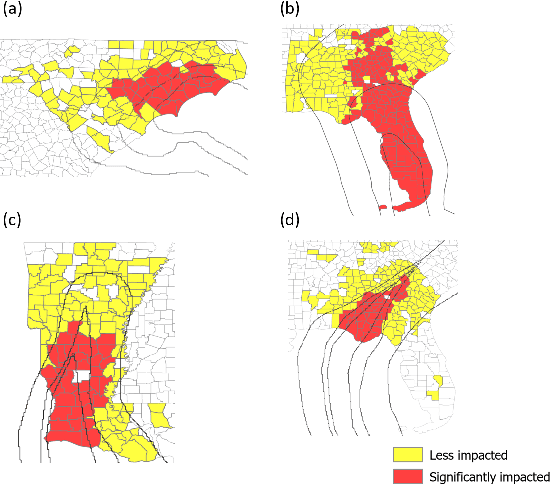
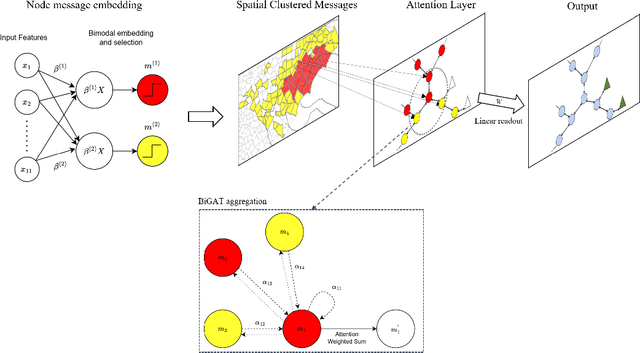
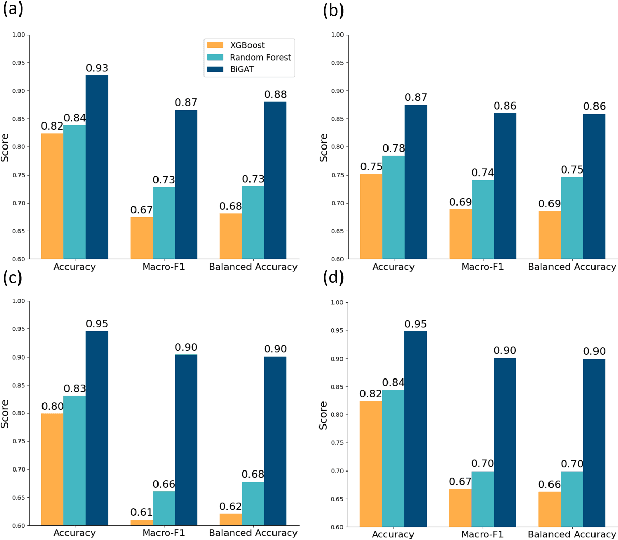
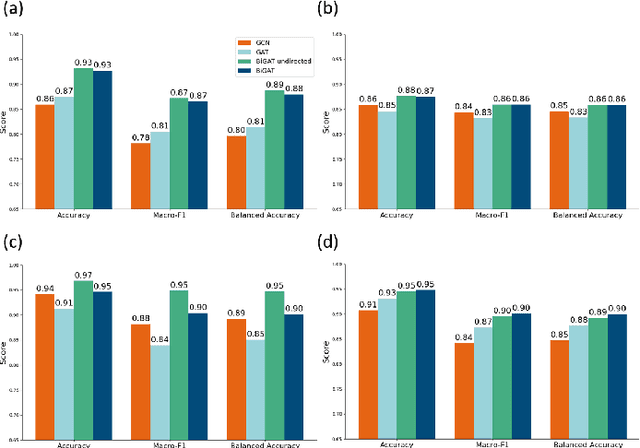
Natural disasters such as hurricanes, wildfires, and winter storms have induced large-scale power outages in the U.S., resulting in tremendous economic and societal impacts. Accurately predicting power outage recovery and impact is key to resilience of power grid. Recent advances in machine learning offer viable frameworks for estimating power outage duration from geospatial and weather data. However, three major challenges are inherent to the task in a real world setting: spatial dependency of the data, spatial heterogeneity of the impact, and moderate event data. We propose a novel approach to estimate the duration of severe weather-induced power outages through Graph Attention Networks (GAT). Our network uses a simple structure from unsupervised pre-training, followed by semi-supervised learning. We use field data from four major hurricanes affecting $501$ counties in eight Southeastern U.S. states. The model exhibits an excellent performance ($>93\%$ accuracy) and outperforms the existing methods XGBoost, Random Forest, GCN and simple GAT by $2\% - 15\%$ in both the overall performance and class-wise accuracy.