 Add to Chrome
 Add to Firefox
 Add to Edge
Setoka: A Benchmark for Hierarchical User Understanding in Personalized Agents over Heterogeneous Data
Jul 29, 2026
Personalized agents are increasingly applied to assist users across a wide range of tasks. Effective personalized assistance requires not only retrieving explicit facts from past interactions stored in agent memory, but also inferring abstract personal characteristics. However, existing memory benchmarks primarily evaluate whether an agent can retrieve information explicitly stated in conversational histories, failing to provide an effective assessment of deeper user understanding. In this work, we propose Setoka, a benchmark for evaluating memory-augmented personalized agents with hierarchical user understanding from heterogeneous data. Grounded in theories from cognitive and personality psychology, Setoka defines four levels of user understanding, i.e., semantic memory, episodic memory, behavior pattern, and personality trait. Moreover, to enable realistic yet privacy-preserving evaluation, we design a psychometrics-based pipeline that synthesizes diverse, coherent heterogeneous user data and queries at scale. Finally, we leverage Setoka to evaluate 3 language models combined with 5 memory systems for 10 synthetic users. Our comprehensive evaluation reveals that while existing systems perform well on semantic memory retrieval, their performance declines on episodic memory. Moreover, when dealing with behavior pattern and personality trait understanding tasks that require integrating heterogeneous and fragmented information dispersed over time, performance declines even further. These findings demonstrate that user understanding cannot be handled by simple fact retrieval, motivating the design of memory mechanisms for cross-source integration and abstraction over long-term user behavior.

EasyTime: Time Series Forecasting Made Easy
Dec 23, 2024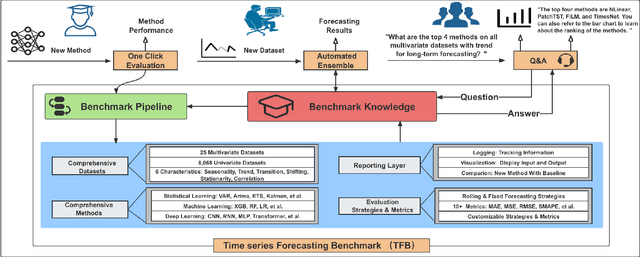


Time series forecasting has important applications across diverse domains. EasyTime, the system we demonstrate, facilitates easy use of time-series forecasting methods by researchers and practitioners alike. First, EasyTime enables one-click evaluation, enabling researchers to evaluate new forecasting methods using the suite of diverse time series datasets collected in the preexisting time series forecasting benchmark (TFB). This is achieved by leveraging TFB's flexible and consistent evaluation pipeline. Second, when practitioners must perform forecasting on a new dataset, a nontrivial first step is often to find an appropriate forecasting method. EasyTime provides an Automated Ensemble module that combines the promising forecasting methods to yield superior forecasting accuracy compared to individual methods. Third, EasyTime offers a natural language Q&A module leveraging large language models. Given a question like "Which method is best for long term forecasting on time series with strong seasonality?", EasyTime converts the question into SQL queries on the database of results obtained by TFB and then returns an answer in natural language and charts. By demonstrating EasyTime, we intend to show how it is possible to simplify the use of time series forecasting and to offer better support for the development of new generations of time series forecasting methods.