 Add to Chrome
 Add to Firefox
 Add to Edge
Quantization-Aware Distillation for NVFP4 Inference Accuracy Recovery
Jan 27, 2026
This technical report presents quantization-aware distillation (QAD) and our best practices for recovering accuracy of NVFP4-quantized large language models (LLMs) and vision-language models (VLMs). QAD distills a full-precision teacher model into a quantized student model using a KL divergence loss. While applying distillation to quantized models is not a new idea, we observe key advantages of QAD for today's LLMs: 1. It shows remarkable effectiveness and stability for models trained through multi-stage post-training pipelines, including supervised fine-tuning (SFT), reinforcement learning (RL), and model merging, where traditional quantization-aware training (QAT) suffers from engineering complexity and training instability; 2. It is robust to data quality and coverage, enabling accuracy recovery without full training data. We evaluate QAD across multiple post-trained models including AceReason Nemotron, Nemotron 3 Nano, Nemotron Nano V2, Nemotron Nano V2 VL (VLM), and Llama Nemotron Super v1, showing consistent recovery to near-BF16 accuracy.

Tiered Pruning for Efficient Differentialble Inference-Aware Neural Architecture Search
Oct 03, 2022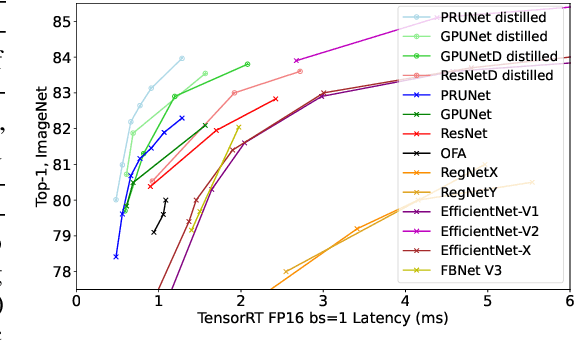
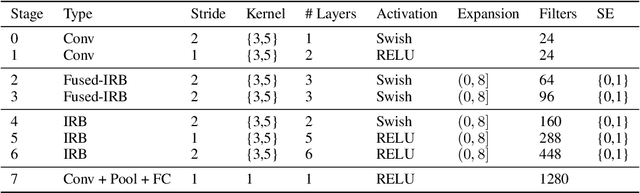
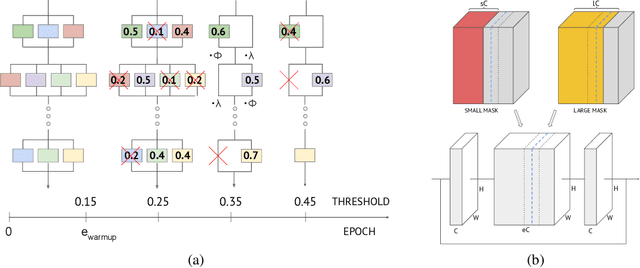
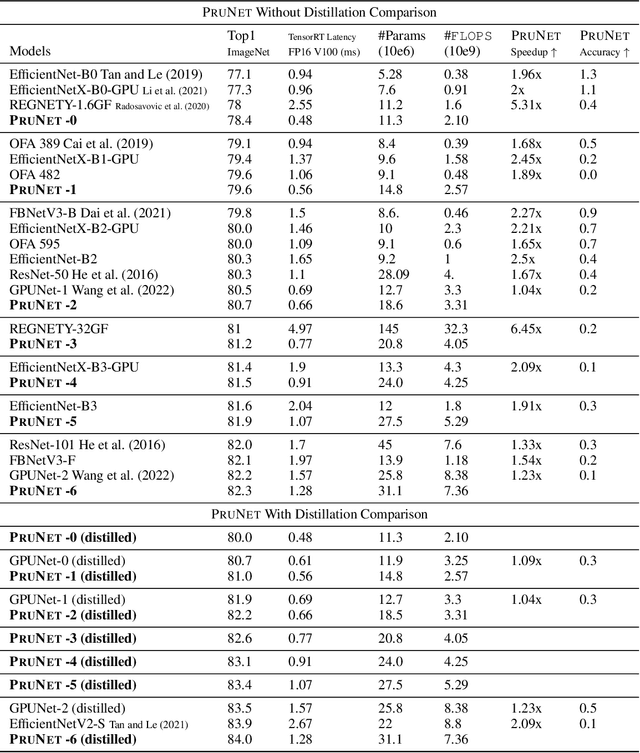
We propose three novel pruning techniques to improve the cost and results of inference-aware Differentiable Neural Architecture Search (DNAS). First, we introduce , a stochastic bi-path building block for DNAS, which can search over inner hidden dimensions with memory and compute complexity. Second, we present an algorithm for pruning blocks within a stochastic layer of the SuperNet during the search. Third, we describe a novel technique for pruning unnecessary stochastic layers during the search. The optimized models resulting from the search are called PruNet and establishes a new state-of-the-art Pareto frontier for NVIDIA V100 in terms of inference latency for ImageNet Top-1 image classification accuracy. PruNet as a backbone also outperforms GPUNet and EfficientNet on the COCO object detection task on inference latency relative to mean Average Precision (mAP).