 Add to Chrome
 Add to Firefox
 Add to Edge
Expressivity of Programmable-Metasurface-Based Physical Neural Networks: Encoding Non-Linearity, Structural Non-Linearity, and Depth
Mar 13, 2026
Wave-based signal processing conventionally encodes input data into the input wavefront, making it challenging to implement non-linear operations. Programmable wave systems enable an alternative approach: encoding the input data into the scattering properties of tunable components. With such structural input encoding, two potentially non-linear mappings are involved: first, from the input data to the tunable components' scattering characteristics, and, second, from these scattering characteristics to the output wavefront. In this paper, we systematically examine the expressivity of a wave-based physical neural network (WPNN) with structural input encoding. Our analysis is based on a physics-consistent multiport-network model of a compact D-band rich-scattering cavity parametrized by a 100-element programmable metasurface. We separately control encoding non-linearity, structural non-linearity, and network depth in order to examine their interplay, considering a controlled scalar regression task. With phase encoding and strong inter-element mutual coupling (MC), both aforementioned mappings are strongly non-linear and the WPNN performs very well even with a single layer. We further observe that additional layers can partially compensate for weak inter-element MC. In addition, we demonstrate that WPNN depth can improve expressivity even when it is not associated with an increase in trainable weights. Altogether, our results provide a physics-consistent picture of how encoding choice, MC strength, and depth jointly govern the expressive power of PM-based WPNNs, informing design choices for future experimental implementations of WPNNs.

Efficient Frequency Selective Surface Analysis via End-to-End Model-Based Learning
Oct 22, 2024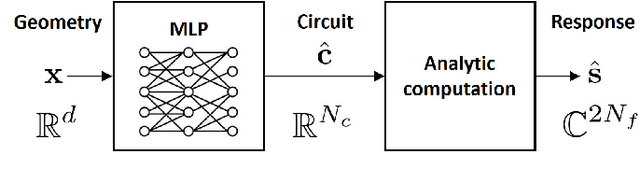
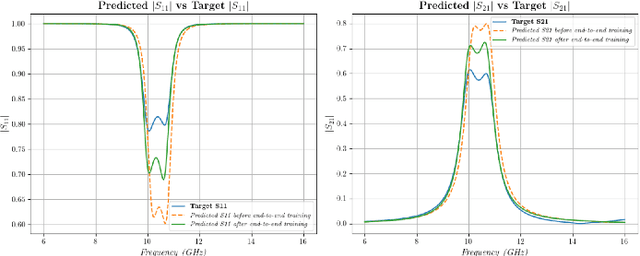
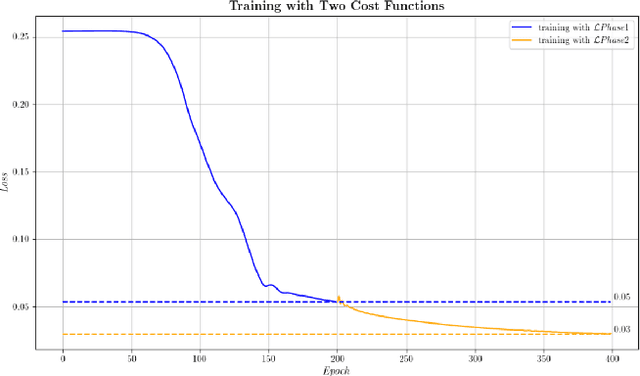
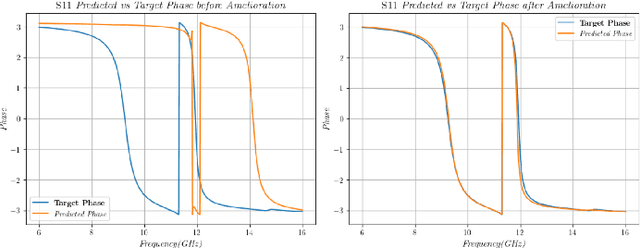
This paper introduces an innovative end-to-end model-based deep learning approach for efficient electromagnetic analysis of high-dimensional frequency selective surfaces (FSS). Unlike traditional data-driven methods that require large datasets, this approach combines physical insights from equivalent circuit models with deep learning techniques to significantly reduce model complexity and enhance prediction accuracy. Compared to previously introduced model-based learning approaches, the proposed method is trained end-to-end from the physical structure of the FSS (geometric parameters) to its electromagnetic response (S-parameters). Additionally, an improvement in phase prediction accuracy through a modified loss function is presented. Comparisons with direct models, including deep neural networks (DNN) and radial basis function networks (RBFN), demonstrate the superiority of the model-based approach in terms of computational efficiency, model size, and generalization capability.