 Add to Chrome
 Add to Firefox
 Add to Edge
Score $\times$ Decoder: A Unified View of Unsupervised Inference-Time Scaling for Hallucination Mitigation
May 30, 2026
Large language models hallucinate even when the answer lies within their parameters. While inference-time scaling can surface this latent knowledge, the most effective methods require supervision: a trained verifier or reward model. We ask what can be done with only a base language model: which intrinsic signal best identifies correct outputs, and how should it be decoded? We cast this as a score~$\times$~decoder grid pairing four scores (perplexity, contrastive, power-distribution likelihood, and self-verification) with three decoding families (optimization, sampling, consensus), and evaluate every cell on MATH500 with the base and instruction-tuned Qwen3-1.7B. While self-verification, which prompts the model to judge its own answer and is sharpened by a training-free virtual-thinking prefix, works well in most settings, no score has a fixed quality: its value depends on the decoder that consumes it and on model capability. When no supervision is available, the score and the decoding family must be chosen together.

Mitigating Distribution Sharpening in Math RLVR via Distribution-Aligned Hint Synthesis and Backward Hint Annealing
Apr 09, 2026Reinforcement learning with verifiable rewards (RLVR) can improve low-$k$ reasoning accuracy while narrowing solution coverage on challenging math questions, and pass@1 gains do not necessarily translate into better large-$k$ performance. Existing hint-based approaches can make challenging questions trainable, but they leave two issues underexplored: teacher-student distribution mismatch and the need to reduce hint exposure to match no-hint evaluation. We address these issues through two components. Distribution-Aligned Hint Synthesis (DAHS) constructs verified teacher hints conditioned on student-style responses. Backward Hint Annealing (BHA) anneals hint exposure across difficulty buckets and uses per-question hint dropout to preserve no-hint updates throughout RL training. We evaluate the method in math RLVR under the DAPO training framework across AIME24, AIME25, and AIME26 using $\texttt{Qwen3-1.7B-Base}$ and $\texttt{Llama-3.2-1B-Instruct}$. On $\texttt{Qwen3-1.7B-Base}$, our method improves both pass@1 and pass@2048 relative to DAPO across the three AIME benchmarks. On $\texttt{Llama-3.2-1B-Instruct}$, the gains are concentrated in the large-$k$ regime. These results suggest that, in math RLVR, hint scaffolding is effective when it restores learnable updates on challenging questions early in training and is then gradually removed before no-hint evaluation.
CmdCaliper: A Semantic-Aware Command-Line Embedding Model and Dataset for Security Research
Nov 02, 2024
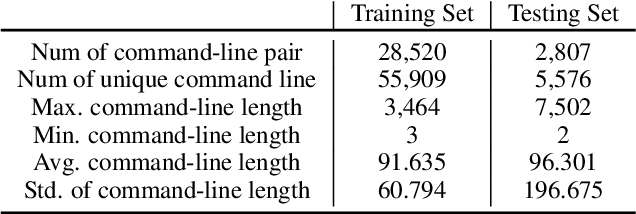
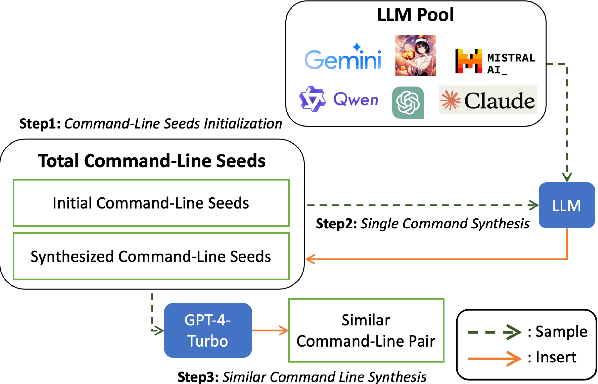

This research addresses command-line embedding in cybersecurity, a field obstructed by the lack of comprehensive datasets due to privacy and regulation concerns. We propose the first dataset of similar command lines, named CyPHER, for training and unbiased evaluation. The training set is generated using a set of large language models (LLMs) comprising 28,520 similar command-line pairs. Our testing dataset consists of 2,807 similar command-line pairs sourced from authentic command-line data. In addition, we propose a command-line embedding model named CmdCaliper, enabling the computation of semantic similarity with command lines. Performance evaluations demonstrate that the smallest version of CmdCaliper (30 million parameters) suppresses state-of-the-art (SOTA) sentence embedding models with ten times more parameters across various tasks (e.g., malicious command-line detection and similar command-line retrieval). Our study explores the feasibility of data generation using LLMs in the cybersecurity domain. Furthermore, we release our proposed command-line dataset, embedding models' weights and all program codes to the public. This advancement paves the way for more effective command-line embedding for future researchers.