 Add to Chrome
 Add to Firefox
 Add to Edge
Stabilizing Physics-Informed Consistency Models via Structure-Preserving Training
Feb 10, 2026
We propose a physics-informed consistency modeling framework for solving partial differential equations (PDEs) via fast, few-step generative inference. We identify a key stability challenge in physics-constrained consistency training, where PDE residuals can drive the model toward trivial or degenerate solutions, degrading the learned data distribution. To address this, we introduce a structure-preserving two-stage training strategy that decouples distribution learning from physics enforcement by freezing the coefficient decoder during physics-informed fine-tuning. We further propose a two-step residual objective that enforces physical consistency on refined, structurally valid generative trajectories rather than noisy single-step predictions. The resulting framework enables stable, high-fidelity inference for both unconditional generation and forward problems. We demonstrate that forward solutions can be obtained via a projection-based zero-shot inpainting procedure, achieving consistent accuracy of diffusion baselines with orders of magnitude reduction in computational cost.

TINNs: Time-Induced Neural Networks for Solving Time-Dependent PDEs
Jan 28, 2026Physics-informed neural networks (PINNs) solve time-dependent partial differential equations (PDEs) by learning a mesh-free, differentiable solution that can be evaluated anywhere in space and time. However, standard space--time PINNs take time as an input but reuse a single network with shared weights across all times, forcing the same features to represent markedly different dynamics. This coupling degrades accuracy and can destabilize training when enforcing PDE, boundary, and initial constraints jointly. We propose Time-Induced Neural Networks (TINNs), a novel architecture that parameterizes the network weights as a learned function of time, allowing the effective spatial representation to evolve over time while maintaining shared structure. The resulting formulation naturally yields a nonlinear least-squares problem, which we optimize efficiently using a Levenberg--Marquardt method. Experiments on various time-dependent PDEs show up to $4\times$ improved accuracy and $10\times$ faster convergence compared to PINNs and strong baselines.
Physics-Informed Machine Learning for Two-Phase Moving-Interface and Stefan Problems
Dec 16, 2025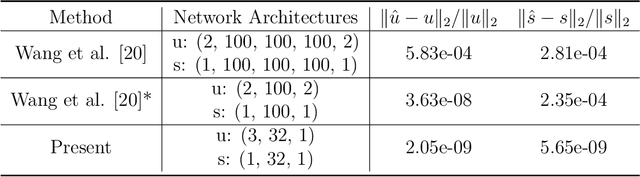
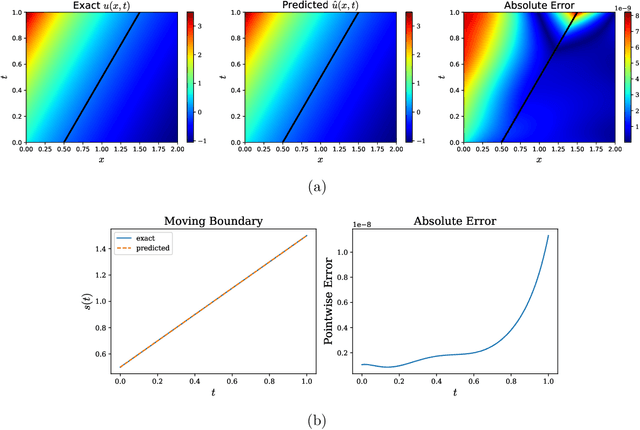
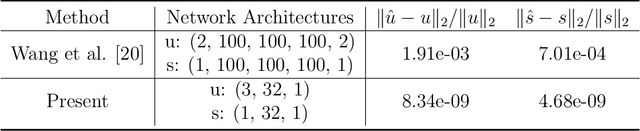
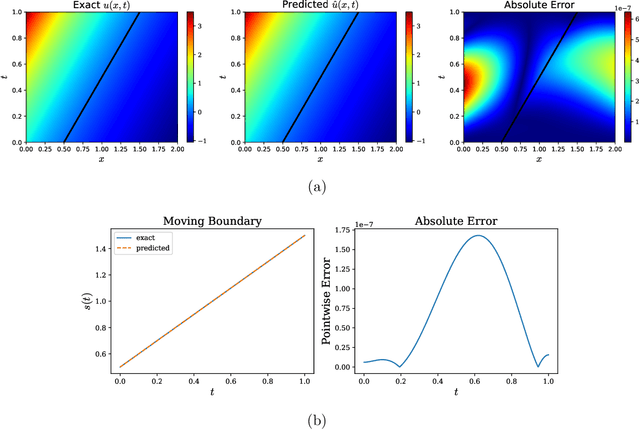
The Stefan problem is a classical free-boundary problem that models phase-change processes and poses computational challenges due to its moving interface and nonlinear temperature-phase coupling. In this work, we develop a physics-informed neural network framework for solving two-phase Stefan problems. The proposed method explicitly tracks the interface motion and enforces the discontinuity in the temperature gradient across the interface while maintaining global consistency of the temperature field. Our approach employs two neural networks: one representing the moving interface and the other for the temperature field. The interface network allows rapid categorization of thermal diffusivity in the spatial domain, which is a crucial step for selecting training points for the temperature network. The temperature network's input is augmented with a modified zero-level set function to accurately capture the jump in its normal derivative across the interface. Numerical experiments on two-phase dynamical Stefan problems demonstrate the superior accuracy and effectiveness of our proposed method compared with the ones obtained by other neural network methodology in literature. The results indicate that the proposed framework offers a robust and flexible alternative to traditional numerical methods for solving phase-change problems governed by moving boundaries. In addition, the proposed method can capture an unstable interface evolution associated with the Mullins-Sekerka instability.
Consistency Training with Physical Constraints
Feb 11, 2025We propose a physics-aware Consistency Training (CT) method that accelerates sampling in Diffusion Models with physical constraints. Our approach leverages a two-stage strategy: (1) learning the noise-to-data mapping via CT, and (2) incorporating physics constraints as a regularizer. Experiments on toy examples show that our method generates samples in a single step while adhering to the imposed constraints. This approach has the potential to efficiently solve partial differential equations (PDEs) using deep generative modeling.
A Shallow Ritz Method for elliptic problems with Singular Sources
Jul 26, 2021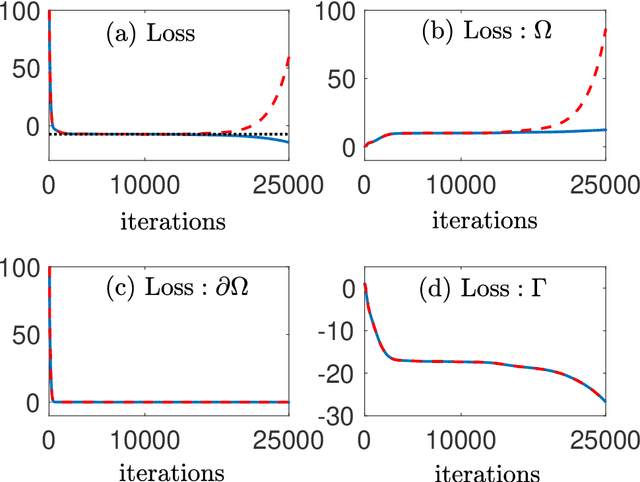

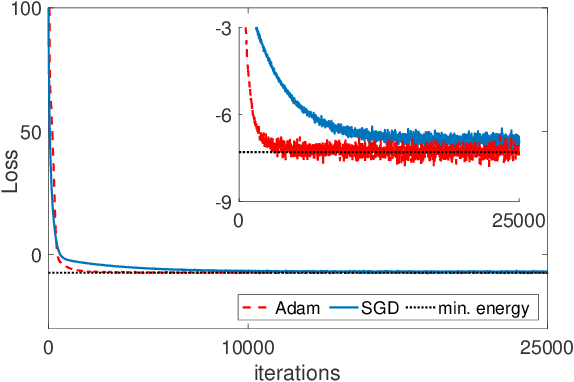

In this paper, a shallow Ritz-type neural network for solving elliptic problems with delta function singular sources on an interface is developed. There are three novel features in the present work; namely, (i) the delta function singularity is naturally removed, (ii) level set function is introduced as a feather input, (iii) it is completely shallow consisting of only one hidden layer. We first introduce the energy functional of the problem and then transform the contribution of singular sources to a regular surface integral along the interface. In such a way the delta function singularity can be naturally removed without the introduction of discrete delta function that is commonly used in traditional regularization methods such as the well-known immersed boundary method. The original problem is then reformulated as a minimization problem. We propose a shallow Ritz-type neural network with one hidden layer to approximate the global minimizer of the energy functional. As a result, the network is trained by minimizing the loss function that is a discrete version of the energy. In addition, we include the level set function of the interface as a feature input and find that it significantly improves the training efficiency and accuracy. We perform a series of numerical tests to demonstrate the accuracy of the present network as well as its capability for problems in irregular domains and in higher dimensions.
Mitigating Asymmetric Nonlinear Weight Update Effects in Hardware Neural Network based on Analog Resistive Synapse
Dec 16, 2017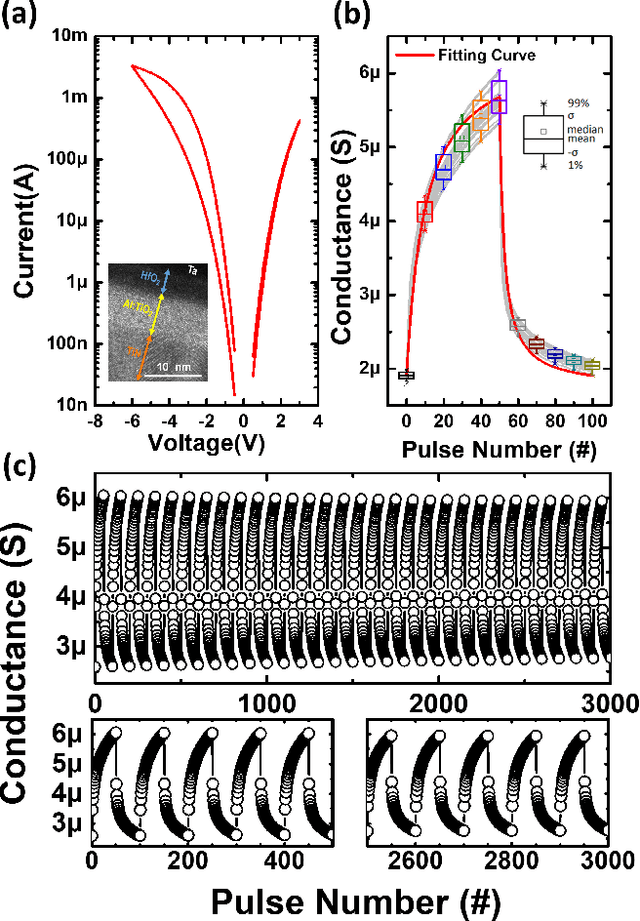
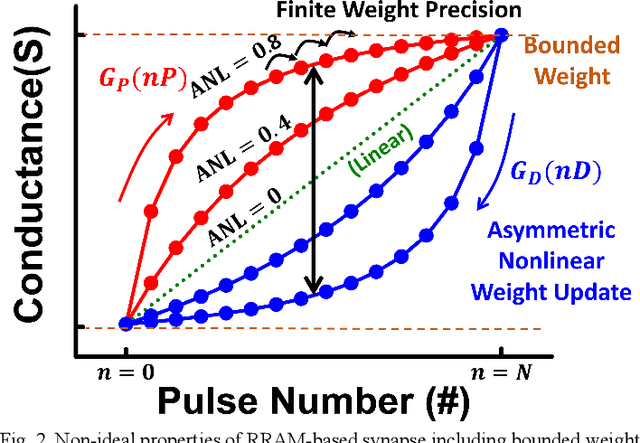
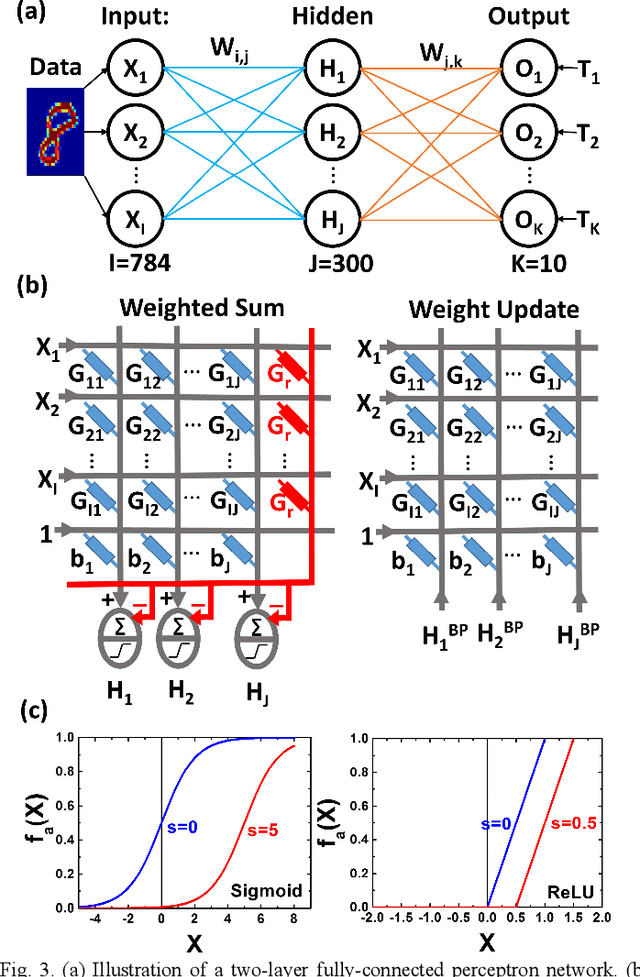
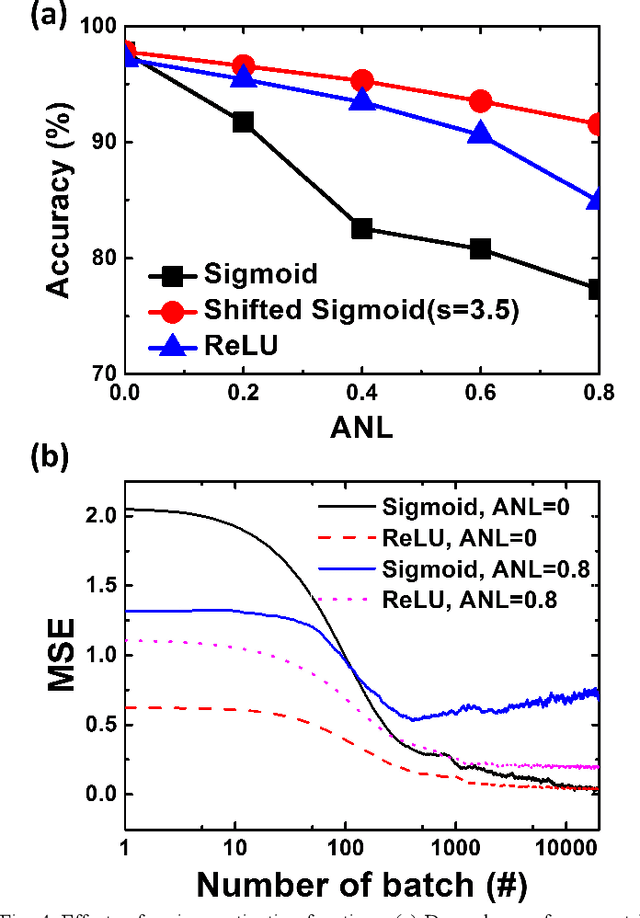
Asymmetric nonlinear weight update is considered as one of the major obstacles for realizing hardware neural networks based on analog resistive synapses because it significantly compromises the online training capability. This paper provides new solutions to this critical issue through co-optimization with the hardware-applicable deep-learning algorithms. New insights on engineering activation functions and a threshold weight update scheme effectively suppress the undesirable training noise induced by inaccurate weight update. We successfully trained a two-layer perceptron network online and improved the classification accuracy of MNIST handwritten digit dataset to 87.8/94.8% by using 6-bit/8-bit analog synapses, respectively, with extremely high asymmetric nonlinearity.