 Add to Chrome
 Add to Firefox
 Add to Edge
U-FedTomAtt: Ultra-lightweight Federated Learning with Attention for Tomato Disease Recognition
Feb 18, 2026
Federated learning has emerged as a privacy-preserving and efficient approach for deploying intelligent agricultural solutions. Accurate edge-based diagnosis across geographically dispersed farms is crucial for recognising tomato diseases in sustainable farming. Traditional centralised training aggregates raw data on a central server, leading to communication overhead, privacy risks and latency. Meanwhile, edge devices require lightweight networks to operate effectively within limited resources. In this paper, we propose U-FedTomAtt, an ultra-lightweight federated learning framework with attention for tomato disease recognition in resource-constrained and distributed environments. The model comprises only 245.34K parameters and 71.41 MFLOPS. First, we propose an ultra-lightweight neural network with dilated bottleneck (DBNeck) modules and a linear transformer to minimise computational and memory overhead. To mitigate potential accuracy loss, a novel local-global residual attention (LoGRA) module is incorporated. Second, we propose the federated dual adaptive weight aggregation (FedDAWA) algorithm that enhances global model accuracy. Third, our framework is validated using three benchmark datasets for tomato diseases under simulated federated settings. Experimental results show that the proposed method achieves 0.9910% and 0.9915% Top-1 accuracy and 0.9923% and 0.9897% F1-scores on SLIF-Tomato and PlantVillage tomato datasets, respectively.

Siamese Network-based Lightweight Framework for Tomato Leaf Disease Recognition
Sep 18, 2022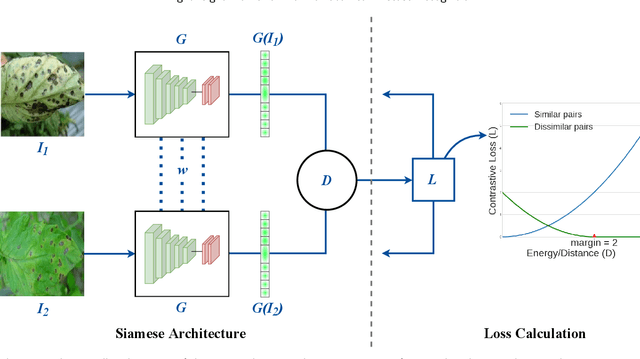
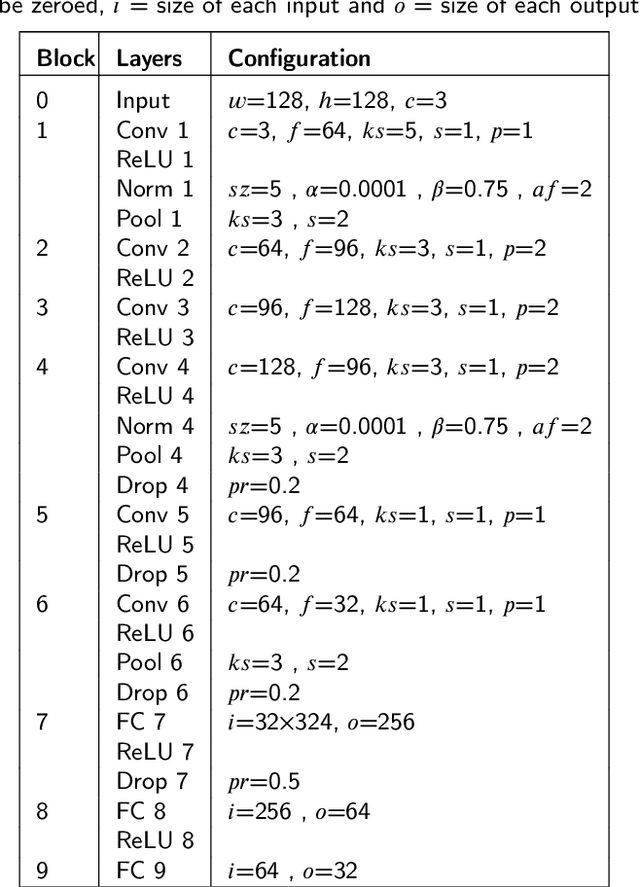
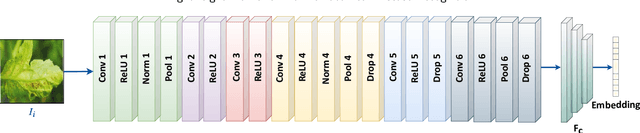
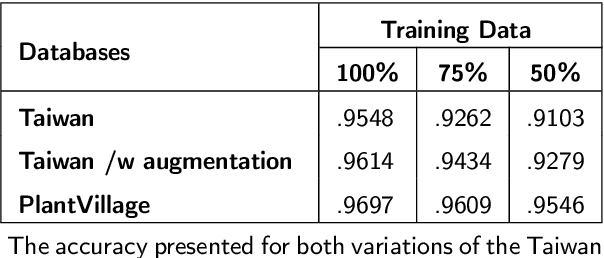
Automatic tomato disease recognition from leaf images is vital to avoid crop losses by applying control measures on time. Even though recent deep learning-based tomato disease recognition methods with classical training procedures showed promising recognition results, they demand large labelled data and involve expensive training. The traditional deep learning models proposed for tomato disease recognition also consume high memory and storage because of a high number of parameters. While lightweight networks overcome some of these issues to a certain extent, they continue to show low performance and struggle to handle imbalanced data. In this paper, a novel Siamese network-based lightweight framework is proposed for automatic tomato leaf disease recognition. This framework achieves the highest accuracy of 96.97% on the tomato subset obtained from the PlantVillage dataset and 95.48% on the Taiwan tomato leaf disease dataset. Experimental results further confirm that the proposed framework is effective with imbalanced and small data. The backbone deep network integrated with this framework is lightweight with approximately 2.9629 million trainable parameters, which is way lower than existing lightweight deep networks.
Deep COVID-19 Recognition using Chest X-ray Images: A Comparative Analysis
Jul 26, 2022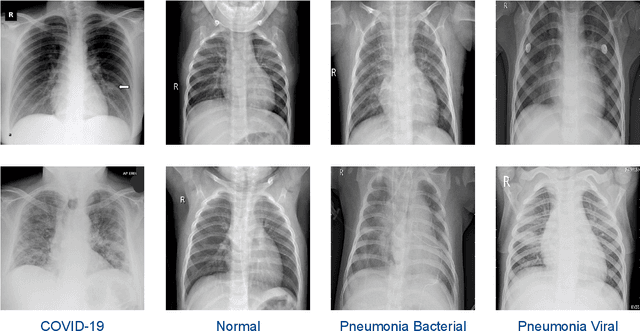
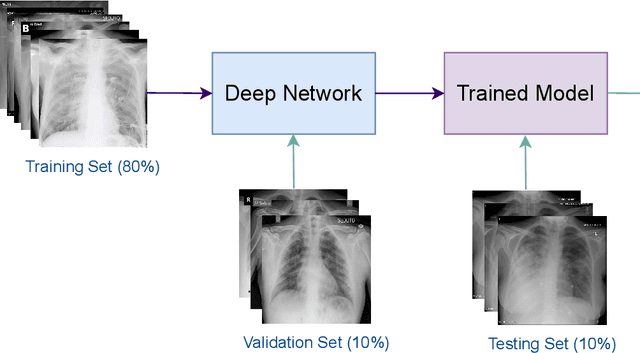
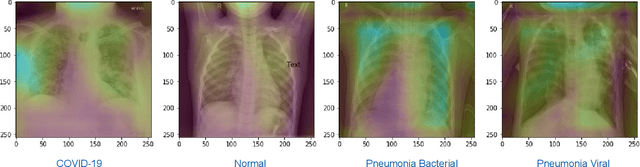
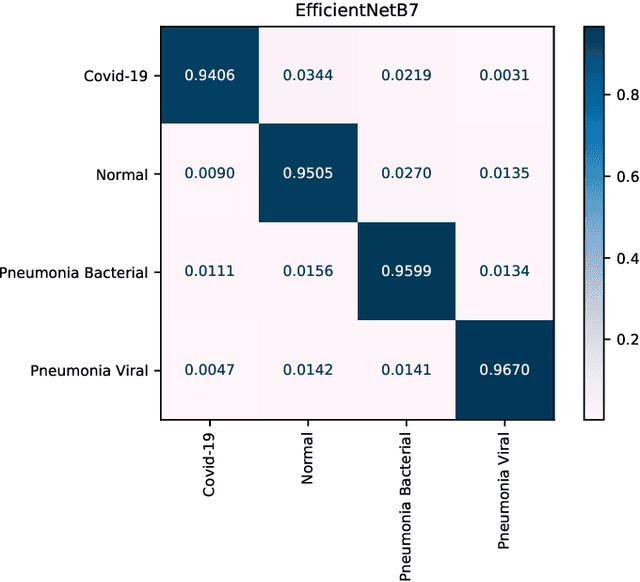
The novel coronavirus variant, which is also widely known as COVID-19, is currently a common threat to all humans across the world. Effective recognition of COVID-19 using advanced machine learning methods is a timely need. Although many sophisticated approaches have been proposed in the recent past, they still struggle to achieve expected performances in recognizing COVID-19 using chest X-ray images. In addition, the majority of them are involved with the complex pre-processing task, which is often challenging and time-consuming. Meanwhile, deep networks are end-to-end and have shown promising results in image-based recognition tasks during the last decade. Hence, in this work, some widely used state-of-the-art deep networks are evaluated for COVID-19 recognition with chest X-ray images. All the deep networks are evaluated on a publicly available chest X-ray image dataset. The evaluation results show that the deep networks can effectively recognize COVID-19 from chest X-ray images. Further, the comparison results reveal that the EfficientNetB7 network outperformed other existing state-of-the-art techniques.
* 5 pages