 Add to Chrome
 Add to Firefox
 Add to Edge
PlumeQuant: Uncertainty-aware consistency assessment of methane plume masks and emission-rate estimates
Jul 15, 2026
Imaging spectrometers increasingly distribute source-resolved methane plume products in which the plume mask, integrated mass enhancement (IME), plume length, emission rate, and uncertainty are physically and algorithmically linked. Using 63 EMIT-derived Carbon Mapper plume records from 27 scenes, we show that these published scalar quantities do not uniquely constrain the plume boundary: substantially different yet plausible masks reproduce the same IME, plume length, and emission rate. Genetic-algorithm (GA) ensembles conditioned on the published IME and plume length make this equifinality explicit: the high-confidence core selected by nearly all target-consistent masks covers a median of 13% of the plausible footprint envelope, and ambiguity is largest for weak, low-overlap plumes. The diagnostics come from PlumeQuant, which recomputes IME, plume length, emission rate, and five-term uncertainty from distributed product components under stated conventions and evaluates four mask representations: the distributed reference mask, a transparent Carbon Mapper-informed analogue (CM-like), the GA ensemble, and optional expert edits. The CM-like mask is generated per plume without access to the reference mask or published quantities, with settings fixed once on a scene-disjoint 44-plume development split. It reproduced published IME with +0.72% median difference and emission rate with +0.16% (6.98% mean absolute), reached 0.843 median intersection-over-union against the reference masks, and matched the published uncertainty scale (median ratio 1.01). Holdout mean absolute errors were 7.6% (IME), 9.5% (length), and 6.1% (rate). These are product-level consistency diagnostics, not independent validation. They flag weak, offset, or ambiguous plumes for expert review.

Discovery of Nonlinear Dynamics with Automated Basis Function Generation
May 10, 2026Discovering governing equations from observational data remains a fundamental challenge in scientific modeling, particularly when the underlying mathematical structure is unknown. Traditional sparse identification methods like SINDy excel at discovering parsimonious models but require researchers to specify candidate basis functions a priori, a limitation that often leads to model failure when critical terms are omitted or when systems exhibit unconventional dynamics. Purely symbolic regression approaches offer unlimited flexibility but struggle with noise sensitivity and frequently produce overly complex, unstable equations. We present AutoSINDy, a hybrid Discovery-then-Solve framework that combines the exploratory power of symbolic regression with the robust sparsity-promoting capabilities of SINDy. Our method operates in three stages: (1) PySR-based symbolic regression discovers candidate functional forms from bootstrapped data chunks; (2) a curation pipeline decomposes, expands, and filters these expressions using collinearity analysis to construct a minimal yet comprehensive library; and (3) SINDy identifies sparse governing equations from this custom-tailored library. Extensive experiments across canonical nonlinear systems demonstrate that AutoSINDy consistently recovers ground-truth equations even under high observational noise, achieving a ground-truth recovery rate of 92.8% across all trials. Compared with standard SINDy using enriched libraries and standalone symbolic regression, AutoSINDy achieves higher predictive accuracy, superior generalization to unseen trajectories, and substantially lower symbolic complexity.
Mapping Network States Using Connectivity Queries
Dec 24, 2020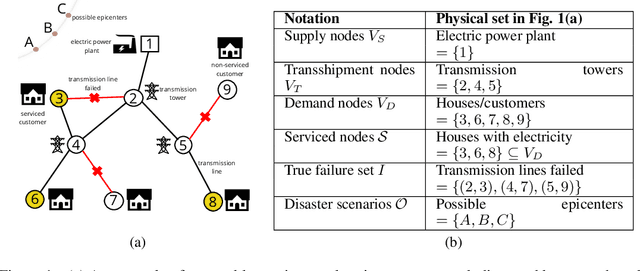
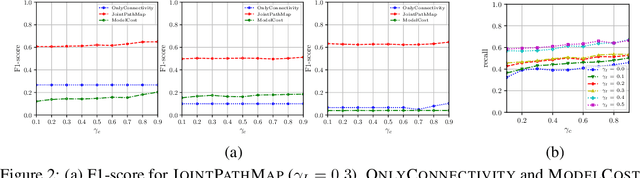
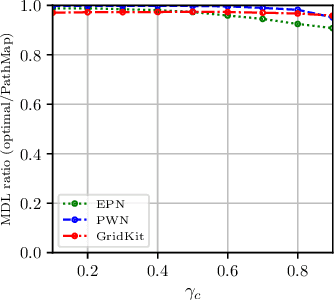
Can we infer all the failed components of an infrastructure network, given a sample of reachable nodes from supply nodes? One of the most critical post-disruption processes after a natural disaster is to quickly determine the damage or failure states of critical infrastructure components. However, this is non-trivial, considering that often only a fraction of components may be accessible or observable after a disruptive event. Past work has looked into inferring failed components given point probes, i.e. with a direct sample of failed components. In contrast, we study the harder problem of inferring failed components given partial information of some `serviceable' reachable nodes and a small sample of point probes, being the first often more practical to obtain. We formulate this novel problem using the Minimum Description Length (MDL) principle, and then present a greedy algorithm that minimizes MDL cost effectively. We evaluate our algorithm on domain-expert simulations of real networks in the aftermath of an earthquake. Our algorithm successfully identify failed components, especially the critical ones affecting the overall system performance.
TensorFlow.js: Machine Learning for the Web and Beyond
Jan 16, 2019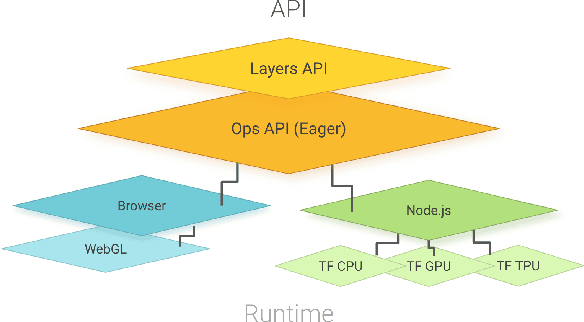
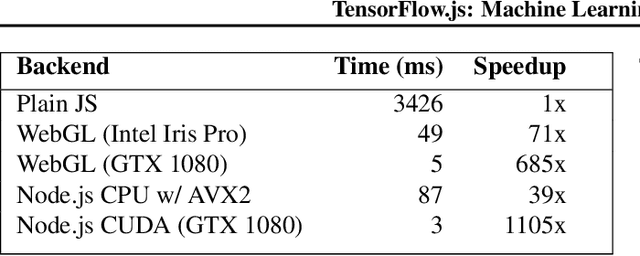
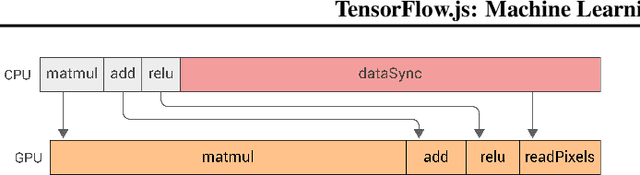

TensorFlow.js is a library for building and executing machine learning algorithms in JavaScript. TensorFlow.js models run in a web browser and in the Node.js environment. The library is part of the TensorFlow ecosystem, providing a set of APIs that are compatible with those in Python, allowing models to be ported between the Python and JavaScript ecosystems. TensorFlow.js has empowered a new set of developers from the extensive JavaScript community to build and deploy machine learning models and enabled new classes of on-device computation. This paper describes the design, API, and implementation of TensorFlow.js, and highlights some of the impactful use cases.
Embedding Projector: Interactive Visualization and Interpretation of Embeddings
Nov 16, 2016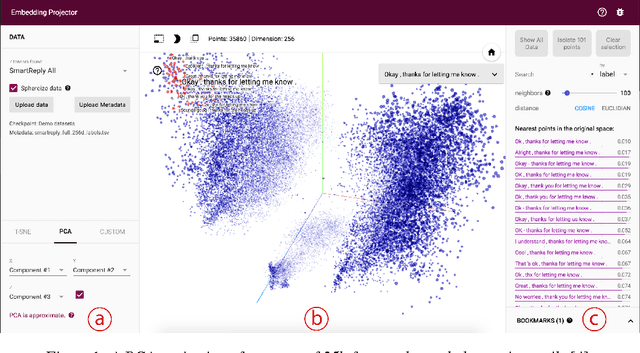
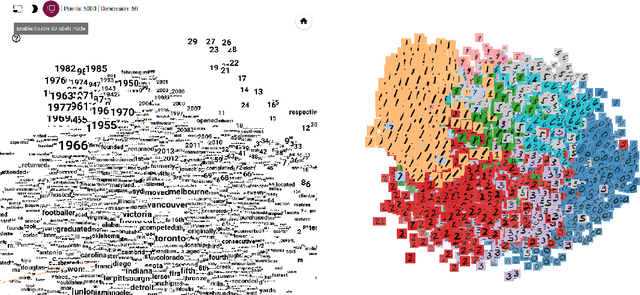
Embeddings are ubiquitous in machine learning, appearing in recommender systems, NLP, and many other applications. Researchers and developers often need to explore the properties of a specific embedding, and one way to analyze embeddings is to visualize them. We present the Embedding Projector, a tool for interactive visualization and interpretation of embeddings.