 Add to Chrome
 Add to Firefox
 Add to Edge
Assessing the Added Value of Onboard Earth Observation Processing with the IRIDE HEO Service Segment
Apr 08, 2026
Current operational Earth Observation (EO) services, including the Copernicus Emergency Management Service (CEMS), the European Forest Fire Information System (EFFIS), and the Copernicus Land Monitoring Service (CLMS), rely primarily on ground-based processing pipelines. While these systems provide mature large-scale information products, they remain constrained by downlink latency, bandwidth limitations, and limited capability for autonomous observation prioritisation. The International Report for an Innovative Defence of Earth (IRIDE) programme is a national Earth observation initiative led by the Italian government to support public authorities through timely, objective information derived from spaceborne data. Rather than a single constellation, IRIDE is designed as a constellation of constellations, integrating heterogeneous sensing technologies within a unified service-oriented architecture. Within this framework, Hawk for Earth Observation (HEO) enables onboard generation of data products, allowing information extraction earlier in the processing chain. This paper examines the limitations of ground-only architectures and evaluates the added value of onboard processing at the operational service level. The IRIDE burnt-area mapping service is used as a representative case study to demonstrate how onboard intelligence can support higher spatial detail (sub-three-metre ground sampling distance), smaller detectable events (minimum mapping unit of three hectares), and improved system responsiveness. Rather than replacing existing Copernicus services, the IRIDE HEO capability is positioned as a complementary layer providing image-driven pre-classification to support downstream emergency and land-management workflows. This work highlights the operational value of onboard intelligence for emerging low-latency EO service architectures.

Local vs. Global: Local Land-Use and Land-Cover Models Deliver Higher Quality Maps
Dec 01, 2024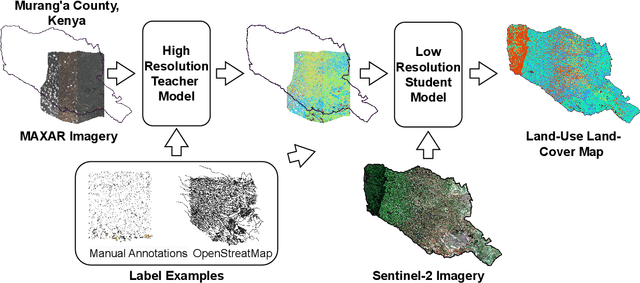
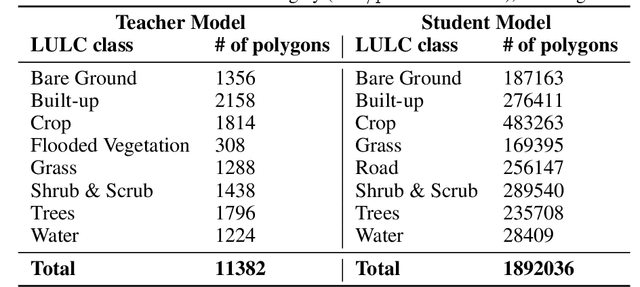


Approximately 20% of Africa's population suffered from undernourishment, and 868 million people experienced moderate to severe food insecurity in 2022. Land-use and land-cover maps provide crucial insights for addressing food insecurity, e.g., by mapping croplands. The development of global land-cover maps has been facilitated by the increasing availability of earth observation data and advancements in geospatial machine learning. However, these global maps exhibit lower accuracy and inconsistencies in Africa, partly due to the lack of representative training data. To address this issue, we propose a data-centric framework with a teacher-student model setup, which uses diverse data sources of satellite images and label examples to produce local land-cover maps. Our method trains a high-resolution teacher model on images with a resolution of 0.331 m/pixel and a low-resolution student model on publicly available images with a resolution of 10 m/pixel. The student model also utilizes the teacher model's output as its weak label examples through knowledge distillation. We evaluated our framework using Murang'a County, Kenya, as a use case and achieved significant improvements, i.e., 0.14 in the F1 score and 0.21 in Intersection-over-Union, compared to the best global map. Our evaluation also revealed inconsistencies in existing global maps, with a maximum agreement rate of 0.30 among themselves. Insights obtained from our cross-collaborative work can provide valuable guidance to local and national policymakers in making informed decisions to improve resource utilization and food security.