 Add to Chrome
 Add to Firefox
 Add to Edge
Quantifying the Impact of Lossy Compression on Neural Generative Surrogate Modeling
Jun 14, 2026
Neural networks are used as generative surrogate models for scientific discovery, which are trainable approximations of scientific simulations. These models enable users to replace time-consuming numerical simulations with learned alternatives, providing quick solutions. However, high-fidelity generative surrogate models require massive training datasets, which can create storage and I/O challenges. Lossy compression is a promising way to reduce this burden, but compression errors may affect the model quality in subtle ways, making it challenging to quantify their impact. In this work, we examine how lossy compression of training data impacts the quality of generative surrogate models. We begin by characterizing the uncertainty inherent in training neural networks, showing that identical training configurations can produce different models. By exploiting this variability, we propose a method to estimate how much compression-induced error a surrogate model can tolerate without affecting its accuracy. Evaluation of two application simulations demonstrates that our approach significantly reduces memory/storage requirements and speeds up training while producing high-quality surrogate models. These results show that lossy compression saves data storage up to 23.7x and 39x with negligible impact on the quality of the surrogate model. Meanwhile, reducing the size of the training data set also enhances the data loading speed and reduces the training time by up to 3x.

Optimizing Agentic Language Model Inference via Speculative Tool Calls
Dec 17, 2025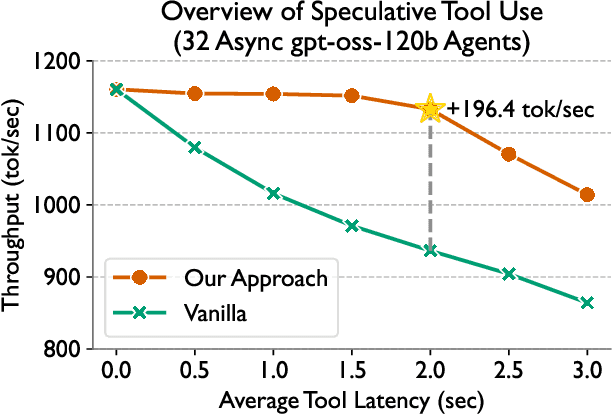
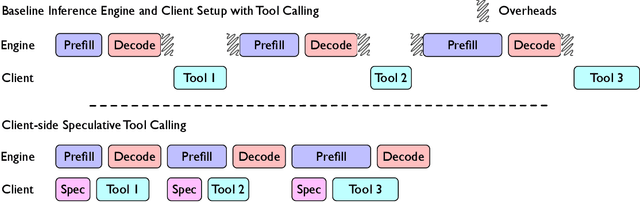
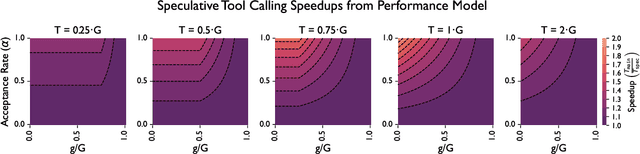
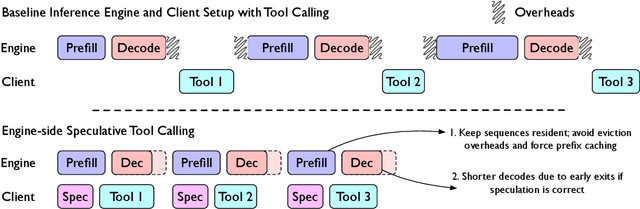
Language models (LMs) are becoming increasingly dependent on external tools. LM-based agentic frameworks frequently interact with their environment via such tools to search files, run code, call APIs, etc. Further, modern reasoning-based LMs use tools such as web search and Python code execution to enhance their reasoning capabilities. While tools greatly improve the capabilities of LMs, they also introduce performance bottlenecks during the inference process. In this paper, we introduce novel systems optimizations to address such performance bottlenecks by speculating tool calls and forcing sequences to remain resident in the inference engine to minimize overheads. Our optimizations lead to throughput improvements of several hundred tokens per second when hosting inference for LM agents. We provide a theoretical analysis of our algorithms to provide insights into speculation configurations that will yield the best performance. Further, we recommend a new "tool cache" API endpoint to enable LM providers to easily adopt these optimizations.