 Add to Chrome
 Add to Firefox
 Add to Edge
LEAF-SQL: Level-wise Exploration with Adaptive Fine-graining for Text-to-SQL Skeleton Prediction
May 10, 2026
Text-to-SQL translates natural language questions into executable SQL queries, enabling intuitive database access for non-experts. While large language models achieve strong performance on Text-to-SQL with prompting, they still struggle with complex queries that involve deeply nested logic or multiple clauses. A widely used approach employs SQL skeletons--intermediate representations of query logic--to streamline generation, but existing methods are limited by their reliance on a single structural hypothesis and lack of progressive reasoning. To overcome these limitations, we propose LEAF-SQL, a novel framework that reframes skeleton prediction as a coarse-to-fine tree search process. LEAF-SQL enables systematic exploration of diverse structural hypotheses with adaptive refinement. Several key techniques are employed in LEAF-SQL: (1) a three-level skeleton hierarchy to guide the search, (2) a Skeleton Formulation Agent to generate diverse candidates, and (3) a Skeleton Evaluation Agent to efficiently prune the search space. This integrated design yields skeleton candidates that are both structurally diverse and granularity-adaptive, providing a stronger foundation for the SQL generation. Extensive experiments show that LEAF-SQL consistently improves the performance of various LLM backbones. On the official hidden test set of the challenging BIRD benchmark, our method achieves 71.6 execution accuracy, which outperforms leading search-based and skeleton-based methods, affirming its effectiveness for complex queries.

Token-Event-Role Structure-based Multi-Channel Document-Level Event Extraction
Jun 30, 2023
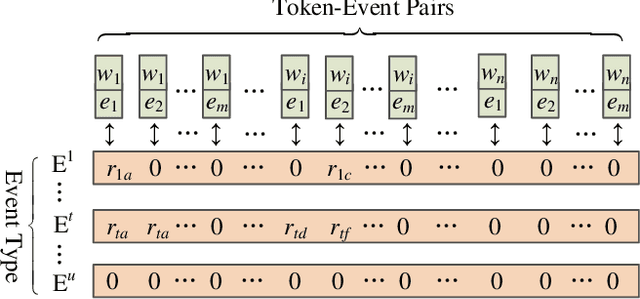
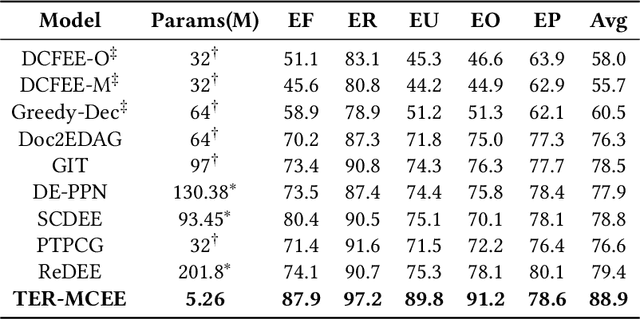
Document-level event extraction is a long-standing challenging information retrieval problem involving a sequence of sub-tasks: entity extraction, event type judgment, and event type-specific multi-event extraction. However, addressing the problem as multiple learning tasks leads to increased model complexity. Also, existing methods insufficiently utilize the correlation of entities crossing different events, resulting in limited event extraction performance. This paper introduces a novel framework for document-level event extraction, incorporating a new data structure called token-event-role and a multi-channel argument role prediction module. The proposed data structure enables our model to uncover the primary role of tokens in multiple events, facilitating a more comprehensive understanding of event relationships. By leveraging the multi-channel prediction module, we transform entity and multi-event extraction into a single task of predicting token-event pairs, thereby reducing the overall parameter size and enhancing model efficiency. The results demonstrate that our approach outperforms the state-of-the-art method by 9.5 percentage points in terms of the F1 score, highlighting its superior performance in event extraction. Furthermore, an ablation study confirms the significant value of the proposed data structure in improving event extraction tasks, further validating its importance in enhancing the overall performance of the framework.