 Add to Chrome
 Add to Firefox
 Add to Edge
Hypothesis-Conditioned Query Rewriting for Decision-Useful Retrieval
Mar 19, 2026
Retrieval-Augmented Generation (RAG) improves Large Language Models (LLMs) by grounding generation in external, non-parametric knowledge. However, when a task requires choosing among competing options, simply grounding generation in broadly relevant context is often insufficient to drive the final decision. Existing RAG methods typically rely on a single initial query, which often favors topical relevance over decision-relevant evidence, and therefore retrieves background information that can fail to discriminate among answer options. To address this issue, here we propose Hypothesis-Conditioned Query Rewriting (HCQR), a training-free pre-retrieval framework that reorients RAG from topic-oriented retrieval to evidence-oriented retrieval. HCQR first derives a lightweight working hypothesis from the input question and candidate options, and then rewrites retrieval into three targeted queries that seek evidence to: (1) support the hypothesis, (2) distinguish it from competing alternatives, and (3) verify salient clues in the question. This approach enables context retrieval that is more directly aligned with answer selection, allowing the generator to confirm or overturn the initial hypothesis based on the retrieved evidence. Experiments on MedQA and MMLU-Med show that HCQR consistently outperforms single-query RAG and re-rank/filter baselines, improving average accuracy over Simple RAG by 5.9 and 3.6 points, respectively. Code is available at https://anonymous.4open.science/r/HCQR-1C2E.

Read Like a Radiologist: Efficient Vision-Language Model for 3D Medical Imaging Interpretation
Dec 18, 2024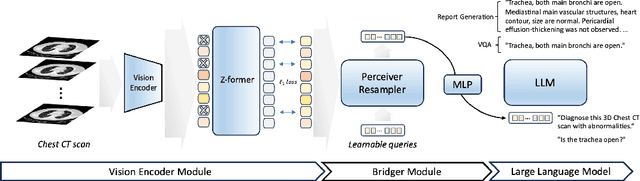
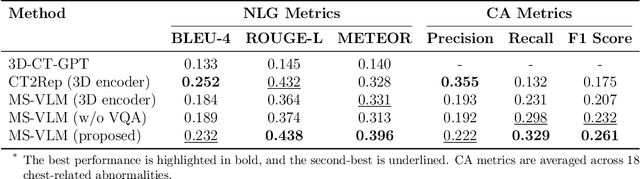
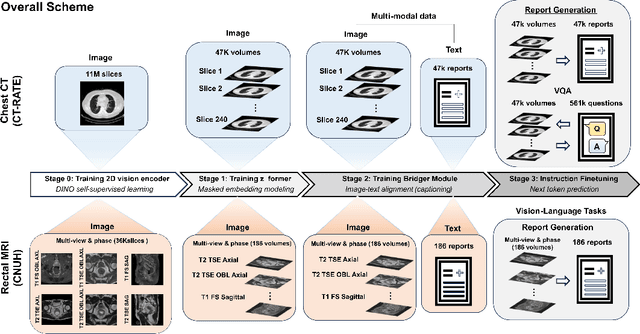
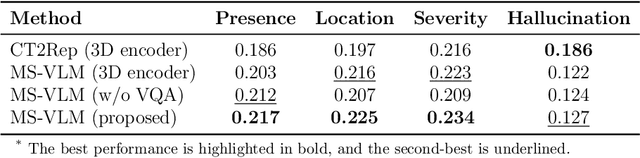
Recent medical vision-language models (VLMs) have shown promise in 2D medical image interpretation. However extending them to 3D medical imaging has been challenging due to computational complexities and data scarcity. Although a few recent VLMs specified for 3D medical imaging have emerged, all are limited to learning volumetric representation of a 3D medical image as a set of sub-volumetric features. Such process introduces overly correlated representations along the z-axis that neglect slice-specific clinical details, particularly for 3D medical images where adjacent slices have low redundancy. To address this limitation, we introduce MS-VLM that mimic radiologists' workflow in 3D medical image interpretation. Specifically, radiologists analyze 3D medical images by examining individual slices sequentially and synthesizing information across slices and views. Likewise, MS-VLM leverages self-supervised 2D transformer encoders to learn a volumetric representation that capture inter-slice dependencies from a sequence of slice-specific features. Unbound by sub-volumetric patchification, MS-VLM is capable of obtaining useful volumetric representations from 3D medical images with any slice length and from multiple images acquired from different planes and phases. We evaluate MS-VLM on publicly available chest CT dataset CT-RATE and in-house rectal MRI dataset. In both scenarios, MS-VLM surpasses existing methods in radiology report generation, producing more coherent and clinically relevant reports. These findings highlight the potential of MS-VLM to advance 3D medical image interpretation and improve the robustness of medical VLMs.