 Add to Chrome
 Add to Firefox
 Add to Edge
Multi-User ISAC with Heterogeneous Unknown Parameters: Optimal Beamforming based on Distribution Information
Apr 24, 2026
This paper studies an integrated sensing and communication (ISAC) system where a multi-antenna base station (BS) communicates with multiple single-antenna users in the downlink and senses the unknown and random angle information of a target based on its prior distribution information and the received echo signals. We focus on a challenging scenario with heterogeneous unknown parameters where the target's reflection coefficient is also unknown with no prior information. We consider a general transmit beamforming structure with both communication beams and dedicated sensing beams, where the communication users can cancel the interference caused by the pre-determined sensing signals. By adopting the periodic posterior Cramer-Rao bound (PCRB) to quantify a lower bound of the mean-cyclic error (MCE) for sensing the periodic angle parameter, we optimize the transmit beamforming to minimize the periodic PCRB, subject to individual communication user rate constraints, which is a non-convex problem. By leveraging the semi-definite relaxation (SDR) technique and Lagrange duality theory, we derive the optimal solution and prove that at most one dedicated sensing beam is needed. Numerical results validate our analysis and effectiveness of the proposed beamforming design.

MIMO Integrated Sensing and Communication Exploiting Prior Information
Dec 20, 2023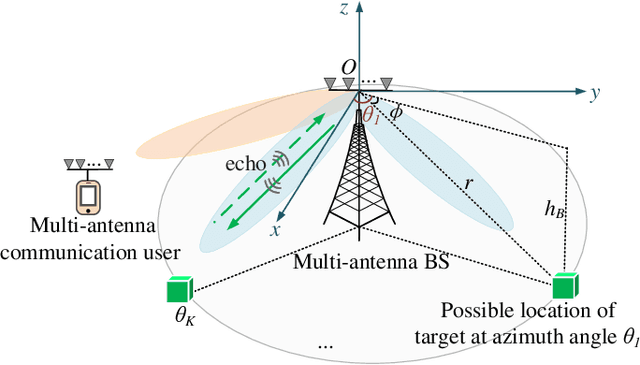
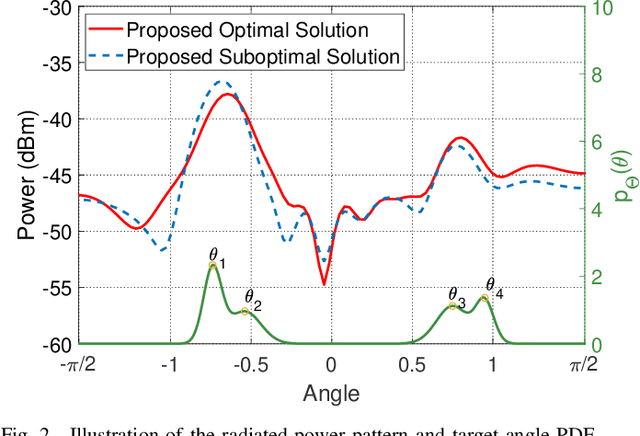
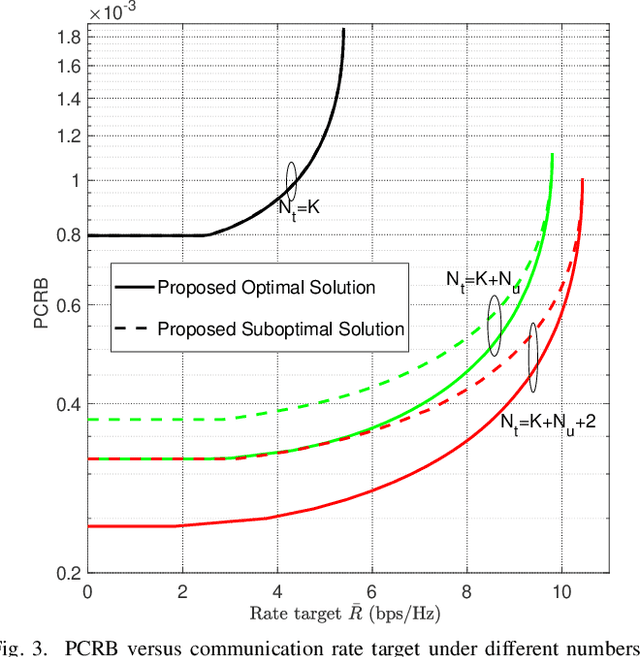
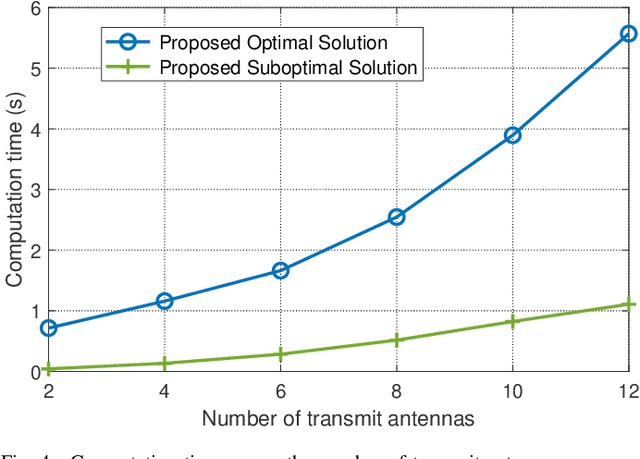
In this paper, we study a multiple-input multiple-output (MIMO) integrated sensing and communication (ISAC) system where one multi-antenna base station (BS) sends information to a user with multiple antennas in the downlink and simultaneously senses the location parameter of a target based on its reflected echo signals received back at the BS receive antennas. We focus on the case where the location parameter to be sensed is unknown and random, for which the prior distribution information is available for exploitation. First, we propose to adopt the posterior Cram\'er-Rao bound (PCRB) as the sensing performance metric with prior information, which quantifies a lower bound of the mean-squared error (MSE). Since the PCRB is in a complicated form, we derive a tight upper bound of it to draw more insights. Based on this, we analytically show that by exploiting the prior distribution information, the PCRB is always no larger than the CRB averaged over random location realizations without prior information exploitation. Next, we formulate the transmit covariance matrix optimization problem to minimize the sensing PCRB under a communication rate constraint. We obtain the optimal solution and derive useful properties on its rank. Then, by considering the derived PCRB upper bound as the objective function, we propose a low-complexity suboptimal solution in semi-closed form. Numerical results demonstrate the effectiveness of our proposed designs in MIMO ISAC exploiting prior information.
MIMO Radar Transmit Signal Optimization for Target Localization Exploiting Prior Information
May 15, 2023In this paper, we consider a multiple-input multiple-output (MIMO) radar system for localizing a target based on its reflected echo signals. Specifically, we aim to estimate the random and unknown angle information of the target, by exploiting its prior distribution information. First, we characterize the estimation performance by deriving the posterior Cram\'er-Rao bound (PCRB), which quantifies a lower bound of the estimation mean-squared error (MSE). Since the PCRB is in a complicated form, we derive a tight upper bound of it to approximate the estimation performance. Based on this, we analytically show that by exploiting the prior distribution information, the PCRB is always no larger than the Cram\'er-Rao bound (CRB) averaged over random angle realizations without prior information exploitation. Next, we formulate the transmit signal optimization problem to minimize the PCRB upper bound. We show that the optimal sample covariance matrix has a rank-one structure, and derive the optimal signal solution in closed form. Numerical results show that our proposed design achieves significantly improved PCRB performance compared to various benchmark schemes.