 Add to Chrome
 Add to Firefox
 Add to Edge
SpaR3D-MoE: Adaptive 3D Spatial Reasoning from Sparse Views Meets Geometry-Inductive Mixture-of-Experts
Jul 07, 2026
Recent Multimodal Large Language Models (MLLMs) struggle to bridge the representational gap between 2D semantic understanding and 3D spatial geometry. Existing 3D-aware models either rely on costly 3D-specific data or utilize RGB-only inputs with heuristic sampling and monolithic, shallow fusion, which respectively disrupt essential spatiotemporal connectivity and induce modality contention across diverse spatial tasks. To overcome these bottlenecks, we introduce SpaR3D-MoE, an end-to-end framework that enables adaptive spatial reasoning by equipping MLLMs with geometry-aware capabilities from only sparse RGB inputs. First, we propose an adaptive spatiotemporal manifold sampling mechanism that constructs a geometry-aware spatiotemporal graph to extract informative keyframes, effectively mitigating sequence redundancy while preserving the scene's topological connectivity. Second, we introduce the heterogeneous geometry-inductive Mixture-of-Experts driven by an instruction-pose aware router, which adaptively routes multimodal tokens to specialized experts, resolving the cross-modal contention inherent in monolithic fusion. Extensive experiments on VSI-Bench, ScanQA, and SQA3D demonstrate that our method achieves state-of-the-art performance. Notably, SpaR3D-MoE achieves the highest average score of 63.5 on VSI-Bench, outperforming the strongest baseline by 7.8 absolute points, alongside relative improvements of 35.4% and 51.4% in Route Plan and Relative Direction tasks, respectively.

Sparse3DPR: Training-Free 3D Hierarchical Scene Parsing and Task-Adaptive Subgraph Reasoning from Sparse RGB Views
Nov 11, 2025Recently, large language models (LLMs) have been explored widely for 3D scene understanding. Among them, training-free approaches are gaining attention for their flexibility and generalization over training-based methods. However, they typically struggle with accuracy and efficiency in practical deployment. To address the problems, we propose Sparse3DPR, a novel training-free framework for open-ended scene understanding, which leverages the reasoning capabilities of pre-trained LLMs and requires only sparse-view RGB inputs. Specifically, we introduce a hierarchical plane-enhanced scene graph that supports open vocabulary and adopts dominant planar structures as spatial anchors, which enables clearer reasoning chains and more reliable high-level inferences. Furthermore, we design a task-adaptive subgraph extraction method to filter query-irrelevant information dynamically, reducing contextual noise and improving 3D scene reasoning efficiency and accuracy. Experimental results demonstrate the superiority of Sparse3DPR, which achieves a 28.7% EM@1 improvement and a 78.2% speedup compared with ConceptGraphs on the Space3D-Bench. Moreover, Sparse3DPR obtains comparable performance to training-based methods on ScanQA, with additional real-world experiments confirming its robustness and generalization capability.
TSDASeg: A Two-Stage Model with Direct Alignment for Interactive Point Cloud Segmentation
Jun 26, 2025The rapid advancement of 3D vision-language models (VLMs) has spurred significant interest in interactive point cloud processing tasks, particularly for real-world applications. However, existing methods often underperform in point-level tasks, such as segmentation, due to missing direct 3D-text alignment, limiting their ability to link local 3D features with textual context. To solve this problem, we propose TSDASeg, a Two-Stage model coupled with a Direct cross-modal Alignment module and memory module for interactive point cloud Segmentation. We introduce the direct cross-modal alignment module to establish explicit alignment between 3D point clouds and textual/2D image data. Within the memory module, we employ multiple dedicated memory banks to separately store text features, visual features, and their cross-modal correspondence mappings. These memory banks are dynamically leveraged through self-attention and cross-attention mechanisms to update scene-specific features based on prior stored data, effectively addressing inconsistencies in interactive segmentation results across diverse scenarios. Experiments conducted on multiple 3D instruction, reference, and semantic segmentation datasets demonstrate that the proposed method achieves state-of-the-art performance.
Density-aware Global-Local Attention Network for Point Cloud Segmentation
Nov 30, 2024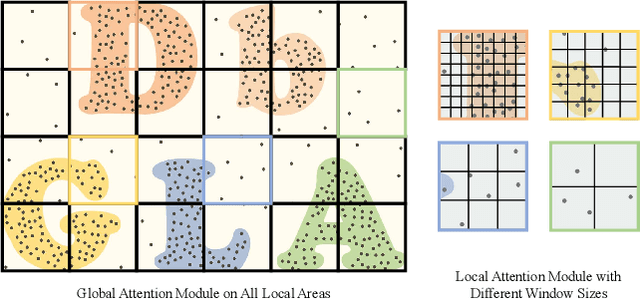
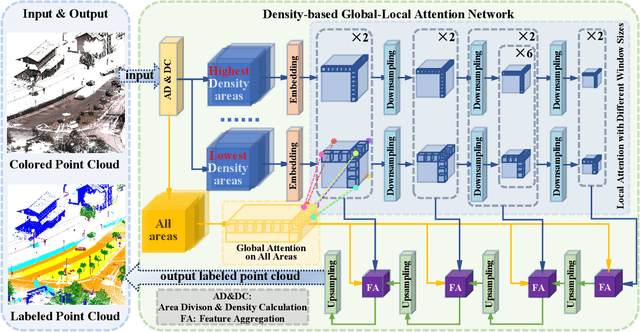
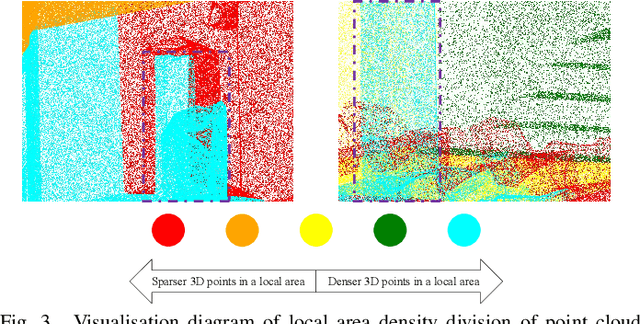
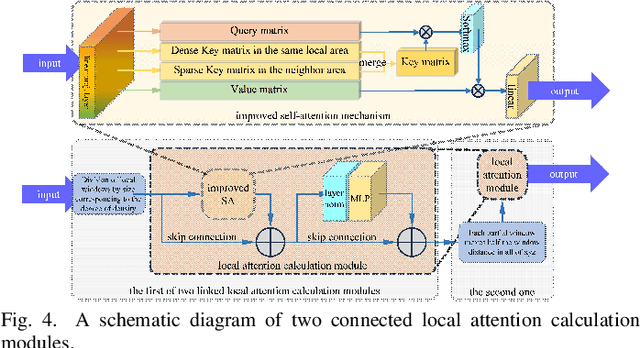
3D point cloud segmentation has a wide range of applications in areas such as autonomous driving, augmented reality, virtual reality and digital twins. The point cloud data collected in real scenes often contain small objects and categories with small sample sizes, which are difficult to handle by existing networks. In this regard, we propose a point cloud segmentation network that fuses local attention based on density perception with global attention. The core idea is to increase the effective receptive field of each point while reducing the loss of information about small objects in dense areas. Specifically, we divide different sized windows for local areas with different densities to compute attention within the window. Furthermore, we consider each local area as an independent token for the global attention of the entire input. A category-response loss is also proposed to balance the processing of different categories and sizes of objects. In particular, we set up an additional fully connected layer in the middle of the network for prediction of the presence of object categories, and construct a binary cross-entropy loss to respond to the presence of categories in the scene. In experiments, our method achieves competitive results in semantic segmentation and part segmentation tasks on several publicly available datasets. Experiments on point cloud data obtained from complex real-world scenes filled with tiny objects also validate the strong segmentation capability of our method for small objects as well as small sample categories.