 Add to Chrome
 Add to Firefox
 Add to Edge
Business World Model
Jun 08, 2026
Businesses are increasingly adopting AI-enabled tools to improve productivity, reduce costs, and enhance products and services. However, the transformative potential of AI extends beyond automating predefined tasks: it lies in enabling intelligent systems to plan, optimize, and execute business initiatives from high-level strategic objectives. This paper introduces the concept and architecture of a business world model (BWM), a world model specialized for business and organizational environments. Inspired by world models in artificial intelligence, cognitive science, and control theory, a BWM encodes business states, dynamics, constraints, objectives, and feasible action space to support autonomous decision-making. We propose a business-semantics-centric formulation in which business states, dynamics and actions are linked to key business entities. Within this framework, agents can simulate alternative action sequences, estimate their effects on future business outcomes, and evaluate trade-offs under uncertainty. The proposed architecture integrates semantic data representations, probabilistic machine learning models, deterministic business rules, and explicit action space into a coherent structure for planning and counterfactual reasoning. Although its individual components are not new, the contribution of BWM lies in organizing them as an executable internal simulator for business initiatives. This work establishes a conceptual foundation for autonomous business systems capable of moving from instruction-based execution toward goal-driven planning and execution.

Autonomous Business System via Neuro-symbolic AI
Jan 22, 2026Current business environments require organizations to continuously reconfigure cross-functional processes, yet enterprise systems are still organized around siloed departments, rigid workflows, and hard-coded automation. Meanwhile large language models (LLMs) excel at interpreting natural language and unstructured data but lack deterministic, verifiable execution of complex business logic. To address this gap, here we introduce AUTOBUS, an Autonomous Business System that integrates LLM-based AI agents, predicate-logic programming, and business-semantics-centric enterprise data into a coherent neuro-symbolic AI architecture for orchestrating end-to-end business initiatives. AUTOBUS models an initiative as a network of tasks with explicit pre/post conditions, required data, evaluation rules, and API-level actions. Enterprise data is organized as a knowledge graph whose entities, relationships, and constraints are translated into logic facts and foundational rules, providing the semantic grounding for task reasoning. Core AI agents synthesize task instructions, enterprise semantics, and available tools into task-specific logic programs, which are executed by a logic engine that enforces constraints, coordinates auxiliary tools, and orchestrate execution of actions and outcomes. Humans define and maintain the semantics, policies and task instructions, curate tools, and supervise high-impact or ambiguous decisions, ensuring accountability and adaptability. We detail the AUTOBUS architecture, the anatomy of the AI agent generated logic programs, and the role of humans and auxiliary tools in the lifecycle of a business initiative.
Towards Data Systems That Are Business Semantic-Centric and AI Agents-Assisted
Jun 05, 2025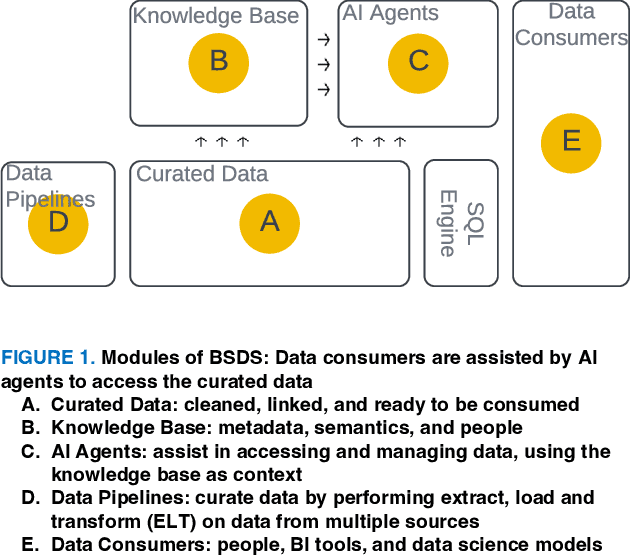
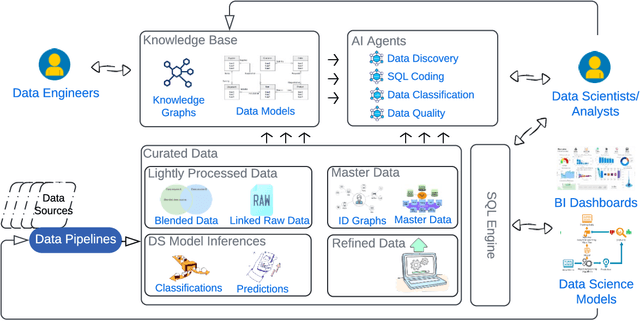
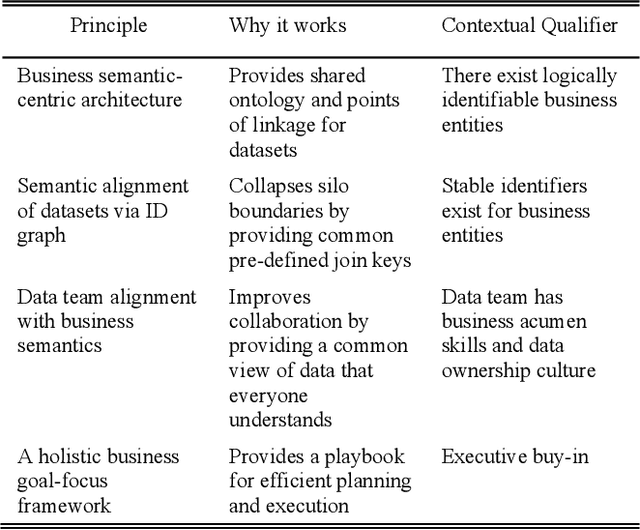
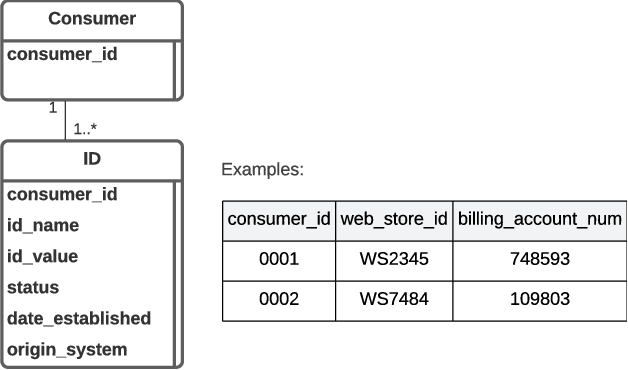
Contemporary businesses operate in dynamic environments requiring rapid adaptation to achieve goals and maintain competitiveness. Existing data platforms often fall short by emphasizing tools over alignment with business needs, resulting in inefficiencies and delays. To address this gap, I propose the Business Semantics Centric, AI Agents Assisted Data System (BSDS), a holistic system that integrates architecture, workflows, and team organization to ensure data systems are tailored to business priorities rather than dictated by technical constraints. BSDS redefines data systems as dynamic enablers of business success, transforming them from passive tools into active drivers of organizational growth. BSDS has a modular architecture that comprises curated data linked to business entities, a knowledge base for context-aware AI agents, and efficient data pipelines. AI agents play a pivotal role in assisting with data access and system management, reducing human effort, and improving scalability. Complementing this architecture, BSDS incorporates workflows optimized for both exploratory data analysis and production requirements, balancing speed of delivery with quality assurance. A key innovation of BSDS is its incorporation of the human factor. By aligning data team expertise with business semantics, BSDS bridges the gap between technical capabilities and business needs. Validated through real-world implementation, BSDS accelerates time-to-market for data-driven initiatives, enhances cross-functional collaboration, and provides a scalable blueprint for businesses of all sizes. Future research can build on BSDS to explore optimization strategies using complex systems and adaptive network theories, as well as developing autonomous data systems leveraging AI agents.