 Add to Chrome
 Add to Firefox
 Add to Edge
LakeFM: Toward a Foundation Model for Aquatic Ecosystems Using Irregular Multivariate Multi-depth Time Series Data
Jun 09, 2026
Understanding and forecasting lake dynamics is critical for monitoring water quality and ecosystem health across lakes and reservoirs. While machine learning methods have been recently applied to ecological time-series data, existing works assume regular sampling in time and depth, and struggle to generalize across lakes with heterogeneous variables, depths, and observation patterns. To address these limitations, we introduce \textsc{LakeFM}, a foundation model for aquatic systems, pre-trained on large-scale ecological datasets comprising both simulated and observed lakes. Through extensive empirical evaluation, we show that \textsc{LakeFM} learns meaningful representations spanning broader lake-level characteristics, and achieves competitive or often superior-forecasting performance compared to existing time-series foundation and non-foundation models, while producing physically plausible predictions consistent with real-world lake dynamics.

Physics-Guided Architecture (PGA) of Neural Networks for Quantifying Uncertainty in Lake Temperature Modeling
Nov 06, 2019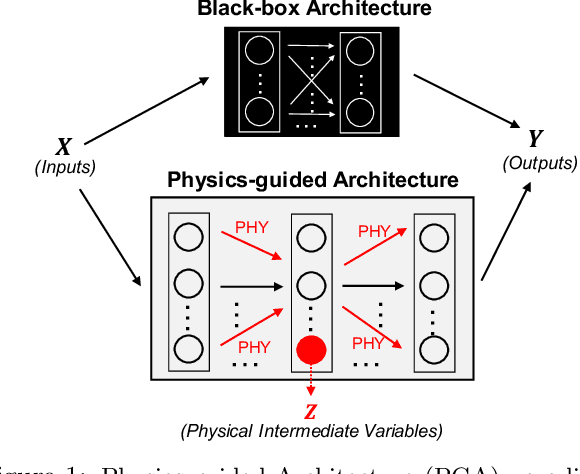
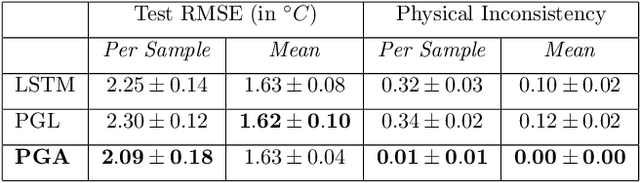
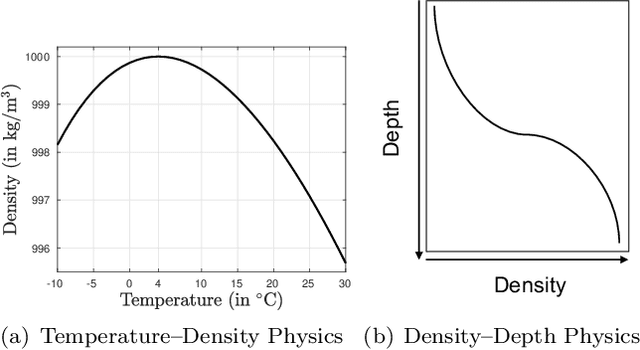
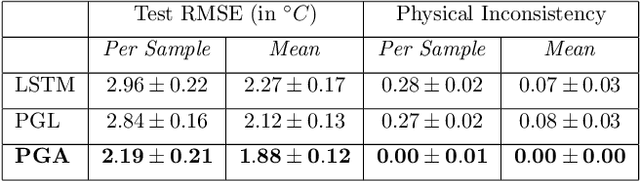
To simultaneously address the rising need of expressing uncertainties in deep learning models along with producing model outputs which are consistent with the known scientific knowledge, we propose a novel physics-guided architecture (PGA) of neural networks in the context of lake temperature modeling where the physical constraints are hard coded in the neural network architecture. This allows us to integrate such models with state of the art uncertainty estimation approaches such as Monte Carlo (MC) Dropout without sacrificing the physical consistency of our results. We demonstrate the effectiveness of our approach in ensuring better generalizability as well as physical consistency in MC estimates over data collected from Lake Mendota in Wisconsin and Falling Creek Reservoir in Virginia, even with limited training data. We further show that our MC estimates correctly match the distribution of ground-truth observations, thus making the PGA paradigm amenable to physically grounded uncertainty quantification.