 Add to Chrome
 Add to Firefox
 Add to Edge
HiFi-RAG: Hierarchical Content Filtering and Two-Pass Generation for Open-Domain RAG
Dec 27, 2025
Retrieval-Augmented Generation (RAG) in open-domain settings faces significant challenges regarding irrelevant information in retrieved documents and the alignment of generated answers with user intent. We present HiFi-RAG (Hierarchical Filtering RAG), the winning closed-source system in the Text-to-Text static evaluation of the MMU-RAGent NeurIPS 2025 Competition. Our approach moves beyond standard embedding-based retrieval via a multi-stage pipeline. We leverage the speed and cost-efficiency of Gemini 2.5 Flash (4-6x cheaper than Pro) for query formulation, hierarchical content filtering, and citation attribution, while reserving the reasoning capabilities of Gemini 2.5 Pro for final answer generation. On the MMU-RAGent validation set, our system outperformed the baseline, improving ROUGE-L to 0.274 (+19.6%) and DeBERTaScore to 0.677 (+6.2%). On Test2025, our custom dataset evaluating questions that require post-cutoff knowledge (post January 2025), HiFi-RAG outperforms the parametric baseline by 57.4% in ROUGE-L and 14.9% in DeBERTaScore.

SANPO: A Scene Understanding, Accessibility, Navigation, Pathfinding, Obstacle Avoidance Dataset
Sep 21, 2023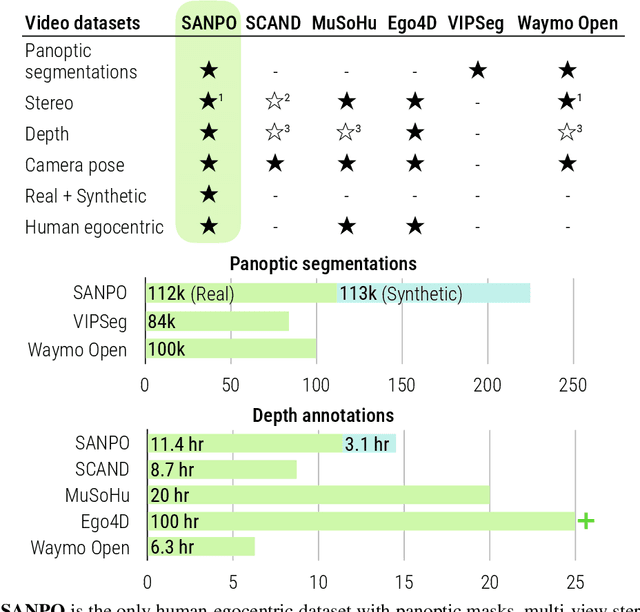
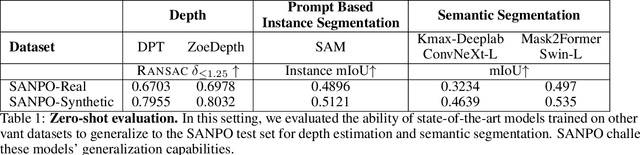
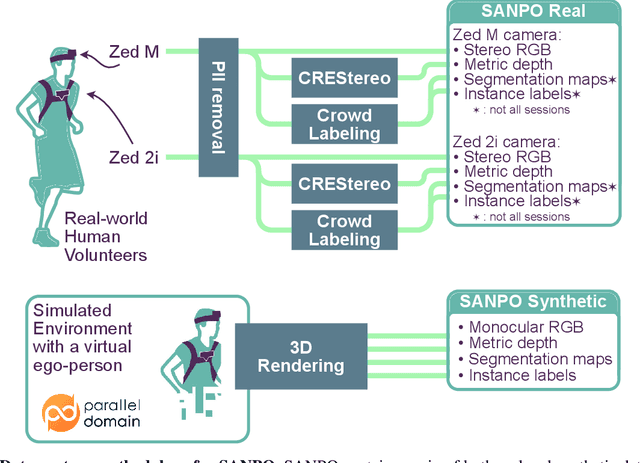
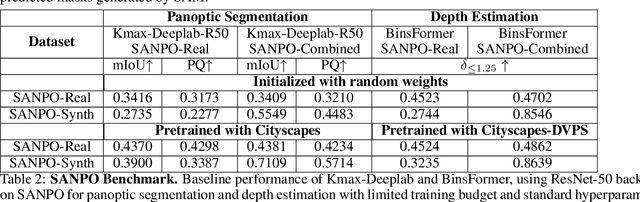
We introduce SANPO, a large-scale egocentric video dataset focused on dense prediction in outdoor environments. It contains stereo video sessions collected across diverse outdoor environments, as well as rendered synthetic video sessions. (Synthetic data was provided by Parallel Domain.) All sessions have (dense) depth and odometry labels. All synthetic sessions and a subset of real sessions have temporally consistent dense panoptic segmentation labels. To our knowledge, this is the first human egocentric video dataset with both large scale dense panoptic segmentation and depth annotations. In addition to the dataset we also provide zero-shot baselines and SANPO benchmarks for future research. We hope that the challenging nature of SANPO will help advance the state-of-the-art in video segmentation, depth estimation, multi-task visual modeling, and synthetic-to-real domain adaptation, while enabling human navigation systems. SANPO is available here: https://google-research-datasets.github.io/sanpo_dataset/