 Add to Chrome
 Add to Firefox
 Add to Edge
Learning Pore-scale Multiphase Flow from 4D Velocimetry
Mar 12, 2026
Multiphase flow in porous media underpins subsurface energy and environmental technologies, including geological CO$_2$ storage and underground hydrogen storage, yet pore-scale dynamics in realistic three-dimensional materials remain difficult to characterize and predict. Here we introduce a multimodal learning framework that infers multiphase pore-scale flow directly from time-resolved four-dimensional (4D) micro-velocimetry measurements. The model couples a graph network simulator for Lagrangian tracer-particle motion with a 3D U-Net for voxelized interface evolution. The imaged pore geometry serves as a boundary constraint to the flow velocity and the multiphase interface predictions, which are coupled and updated iteratively at each time step. Trained autoregressively on experimental sequences in capillary-dominated conditions ($Ca\approx10^{-6}$), the learned surrogate captures transient, nonlocal flow perturbations and abrupt interface rearrangements (Haines jumps) over rollouts spanning seconds of physical time, while reducing hour-to-day--scale direct numerical simulations to seconds of inference. By providing rapid, experimentally informed predictions, the framework opens a route to ''digital experiments'' to replicate pore-scale physics observed in multiphase flow experiments, offering an efficient tool for exploring injection conditions and pore-geometry effects relevant to subsurface carbon and hydrogen storage.

Learning Pore-scale Multi-phase Flow from Experimental Data with Graph Neural Network
Nov 21, 2024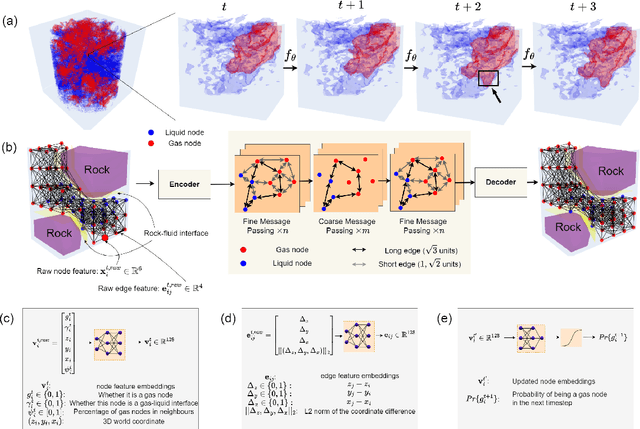

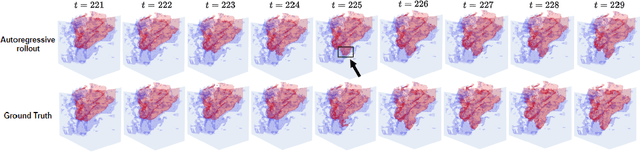
Understanding the process of multiphase fluid flow through porous media is crucial for many climate change mitigation technologies, including CO$_2$ geological storage, hydrogen storage, and fuel cells. However, current numerical models are often incapable of accurately capturing the complex pore-scale physics observed in experiments. In this study, we address this challenge using a graph neural network-based approach and directly learn pore-scale fluid flow using micro-CT experimental data. We propose a Long-Short-Edge MeshGraphNet (LSE-MGN) that predicts the state of each node in the pore space at each time step. During inference, given an initial state, the model can autoregressively predict the evolution of the multiphase flow process over time. This approach successfully captures the physics from the high-resolution experimental data while maintaining computational efficiency, providing a promising direction for accurate and efficient pore-scale modeling of complex multiphase fluid flow dynamics.