 Add to Chrome
 Add to Firefox
 Add to Edge
From STLS to Projection-based Dictionary Selection in Sparse Regression for System Identification
Dec 16, 2025
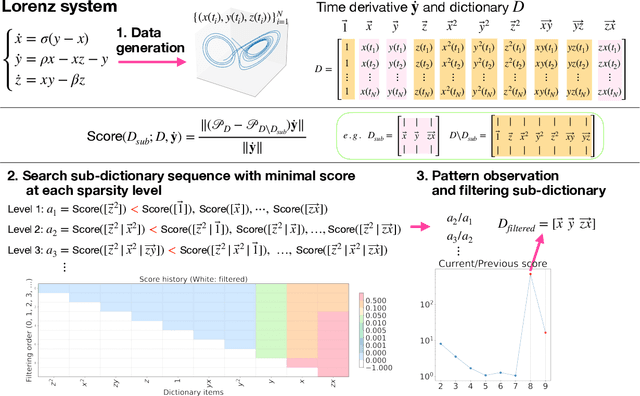
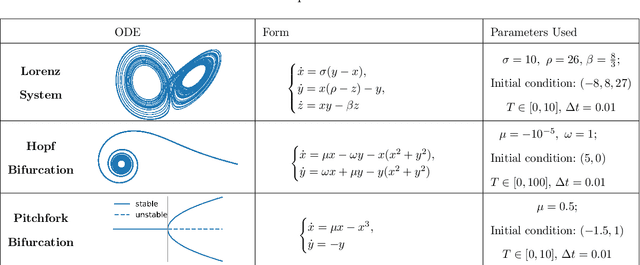
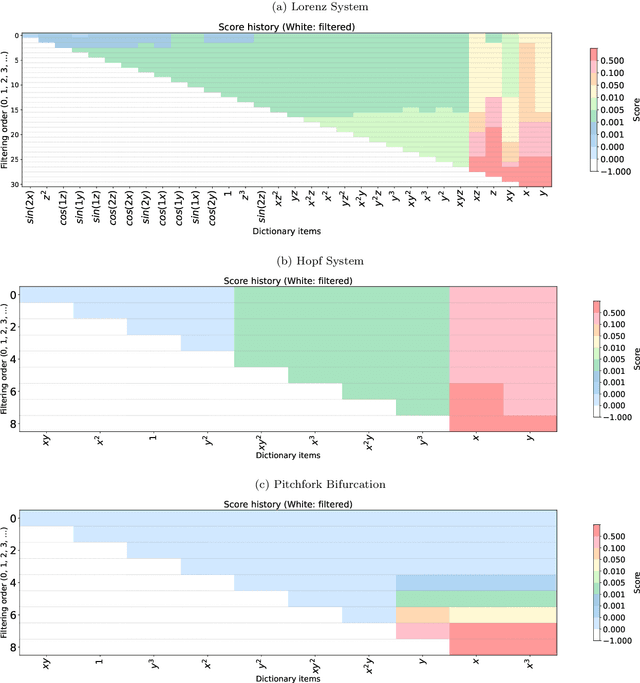
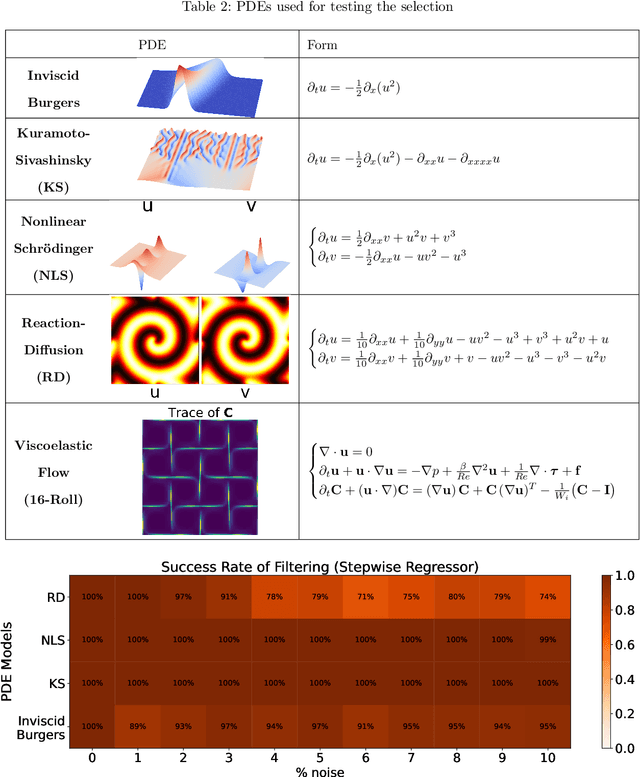
In this work, we revisit dictionary-based sparse regression, in particular, Sequential Threshold Least Squares (STLS), and propose a score-guided library selection to provide practical guidance for data-driven modeling, with emphasis on SINDy-type algorithms. STLS is an algorithm to solve the $\ell_0$ sparse least-squares problem, which relies on splitting to efficiently solve the least-squares portion while handling the sparse term via proximal methods. It produces coefficient vectors whose components depend on both the projected reconstruction errors, here referred to as the scores, and the mutual coherence of dictionary terms. The first contribution of this work is a theoretical analysis of the score and dictionary-selection strategy. This could be understood in both the original and weak SINDy regime. Second, numerical experiments on ordinary and partial differential equations highlight the effectiveness of score-based screening, improving both accuracy and interpretability in dynamical system identification. These results suggest that integrating score-guided methods to refine the dictionary more accurately may help SINDy users in some cases to enhance their robustness for data-driven discovery of governing equations.

Predicting Energy Budgets in Droplet Dynamics: A Recurrent Neural Network Approach
Mar 24, 2024Neural networks in fluid mechanics offer an efficient approach for exploring complex flows, including multiphase and free surface flows. The recurrent neural network, particularly the Long Short-Term Memory (LSTM) model, proves attractive for learning mappings from transient inputs to dynamic outputs. This study applies LSTM to predict transient and static outputs for fluid flows under surface tension effects. Specifically, we explore two distinct droplet dynamic scenarios: droplets with diverse initial shapes impacting with solid surfaces, as well as the coalescence of two droplets following collision. Using only dimensionless numbers and geometric time series data from numerical simulations, LSTM predicts the energy budget. The marker-and-cell front-tracking methodology combined with a marker-and-cell finite-difference strategy is adopted for simulating the droplet dynamics. Using a recurrent neural network (RNN) architecture fed with time series data derived from geometrical parameters, as for example droplet diameter variation, our study shows the accuracy of our approach in predicting energy budgets, as for instance the kinetic, dissipation, and surface energy trends, across a range of Reynolds and Weber numbers in droplet dynamic problems. Finally, a two-phase sequential neural network using only geometric data, which is readily available in experimental settings, is employed to predict the energies and then use them to estimate static parameters, such as the Reynolds and Weber numbers. While our methodology has been primarily validated with simulation data, its adaptability to experimental datasets is a promising avenue for future exploration. We hope that our strategy can be useful for diverse applications, spanning from inkjet printing to combustion engines, where the prediction of energy budgets or dissipation energies is crucial.