 Add to Chrome
 Add to Firefox
 Add to Edge
MerLin: A Discovery Engine for Photonic and Hybrid Quantum Machine Learning
Feb 11, 2026
Identifying where quantum models may offer practical benefits in near term quantum machine learning (QML) requires moving beyond isolated algorithmic proposals toward systematic and empirical exploration across models, datasets, and hardware constraints. We introduce MerLin, an open source framework designed as a discovery engine for photonic and hybrid quantum machine learning. MerLin integrates optimized strong simulation of linear optical circuits into standard PyTorch and scikit learn workflows, enabling end to end differentiable training of quantum layers. MerLin is designed around systematic benchmarking and reproducibility. As an initial contribution, we reproduce eighteen state of the art photonic and hybrid QML works spanning kernel methods, reservoir computing, convolutional and recurrent architectures, generative models, and modern training paradigms. These reproductions are released as reusable, modular experiments that can be directly extended and adapted, establishing a shared experimental baseline consistent with empirical benchmarking methodologies widely adopted in modern artificial intelligence. By embedding photonic quantum models within established machine learning ecosystems, MerLin allows practitioners to leverage existing tooling for ablation studies, cross modality comparisons, and hybrid classical quantum workflows. The framework already implements hardware aware features, allowing tests on available quantum hardware while enabling exploration beyond its current capabilities, positioning MerLin as a future proof co design tool linking algorithms, benchmarks, and hardware.

Efficient Self-Supervised Barlow Twins from Limited Tissue Slide Cohorts for Colonic Pathology Diagnostics
Nov 08, 2024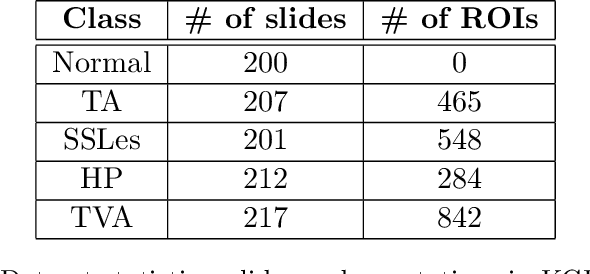
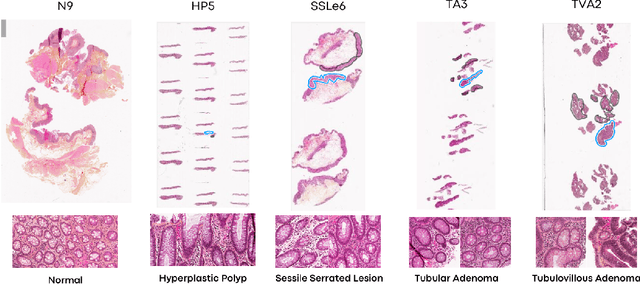
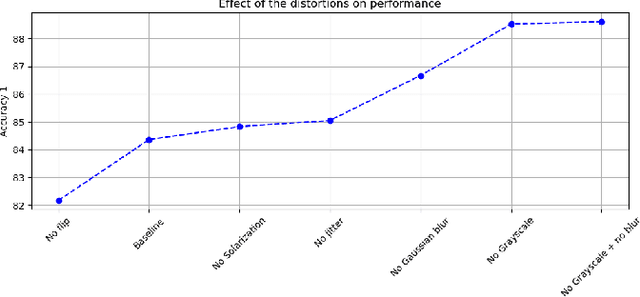

Colorectal cancer (CRC) is one of the few cancers that have an established dysplasia-carcinoma sequence that benefits from screening. Everyone over 50 years of age in Canada is eligible for CRC screening. About 20\% of those people will undergo a biopsy for a pre-neoplastic polyp and, in many cases, multiple polyps. As such, these polyp biopsies make up the bulk of a pathologist's workload. Developing an efficient computational model to help screen these polyp biopsies can improve the pathologist's workflow and help guide their attention to critical areas on the slide. DL models face significant challenges in computational pathology (CPath) because of the gigapixel image size of whole-slide images and the scarcity of detailed annotated datasets. It is, therefore, crucial to leverage self-supervised learning (SSL) methods to alleviate the burden and cost of data annotation. However, current research lacks methods to apply SSL frameworks to analyze pathology data effectively. This paper aims to propose an optimized Barlow Twins framework for colorectal polyps screening. We adapt its hyperparameters, augmentation strategy and encoder to the specificity of the pathology data to enhance performance. Additionally, we investigate the best Field of View (FoV) for colorectal polyps screening and propose a new benchmark dataset for CRC screening, made of four types of colorectal polyps and normal tissue, by performing downstream tasking on MHIST and NCT-CRC-7K datasets. Furthermore, we show that the SSL representations are more meaningful and qualitative than the supervised ones and that Barlow Twins benefits from the Swin Transformer when applied to pathology data. Codes are avaialble from https://github.com/AtlasAnalyticsLab/PathBT.