 Add to Chrome
 Add to Firefox
 Add to Edge
Torus Graphs for Large Scale Neural Phase Analysis
May 30, 2026
Oscillatory neural signals such as electroencephalography (EEG) and local field potentials (LFPs) show phase relationships that coordinate communication across brain regions. Modern recordings capture hundreds of channels across many frequency bins, yet standard phase analyses are restricted to only a few variables. The Torus Graph (TG) model, an exponential-family distribution over phases whose univariate and pairwise potentials generalize von Mises distributions, infers principled structure among oscillations but models only static, undirected dependencies and is limited to $\sim \! 100$ variables because its score matching inference scales as $\mathcal{O}(d^{6})$. We introduce a stochastic score matching procedure that reduces the per-iteration cost to $\mathcal{O}(d^{2})$, enabling inference on datasets with thousands of variables. This scalable foundation supports analyses of 1,860 frequency-phase features from multi-electrode LFPs and enables two extensions previously inaccessible to TGs or classical circular statistics: (i) a TG Hidden Markov Model capturing state-dependent phase-coupling changes (e.g., spindle-related states during sleep) and (ii) an autoregressive TG inferring directional interactions via transfer-entropy estimation. Applied to LFP recordings, these models reveal state-dependent phase-interaction patterns between wakefulness and NREM sleep. Together, they enable systematic, large-scale mapping of dynamic and directional phase relationships across brain and cognitive states.

HiPPO Zoo: Explicit Memory Mechanisms for Interpretable State Space Models
Feb 24, 2026Representing the past in a compressed, efficient, and informative manner is a central problem for systems trained on sequential data. The HiPPO framework, originally proposed by Gu & Dao et al., provides a principled approach to sequential compression by projecting signals onto orthogonal polynomial (OP) bases via structured linear ordinary differential equations. Subsequent works have embedded these dynamics in state space models (SSMs), where HiPPO structure serves as an initialization. Nonlinear successors of these SSM methods such as Mamba are state-of-the-art for many tasks with long-range dependencies, but the mechanisms by which they represent and prioritize history remain largely implicit. In this work, we revisit the HiPPO framework with the goal of making these mechanisms explicit. We show how polynomial representations of history can be extended to support capabilities of modern SSMs such as adaptive allocation of memory and associative memory while retaining direct interpretability in the OP basis. We introduce a unified framework comprising five such extensions, which we collectively refer to as a "HiPPO zoo." Each extension exposes a specific modeling capability through an explicit, interpretable modification of the HiPPO framework. The resulting models adapt their memory online and train in streaming settings with efficient updates. We illustrate the behaviors and modeling advantages of these extensions through a range of synthetic sequence modeling tasks, demonstrating that capabilities typically associated with modern SSMs can be realized through explicit, interpretable polynomial memory structures.
Recognizing and Extracting Cybersecurtity-relevant Entities from Text
Aug 02, 2022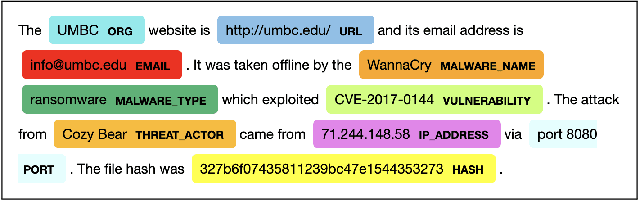
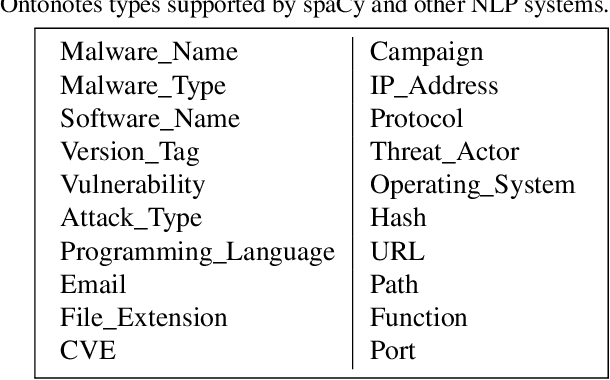
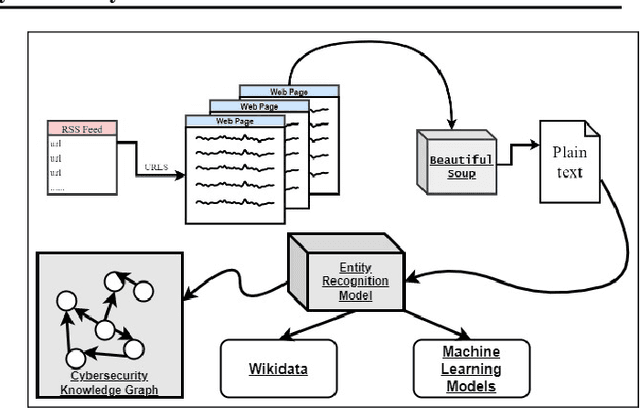
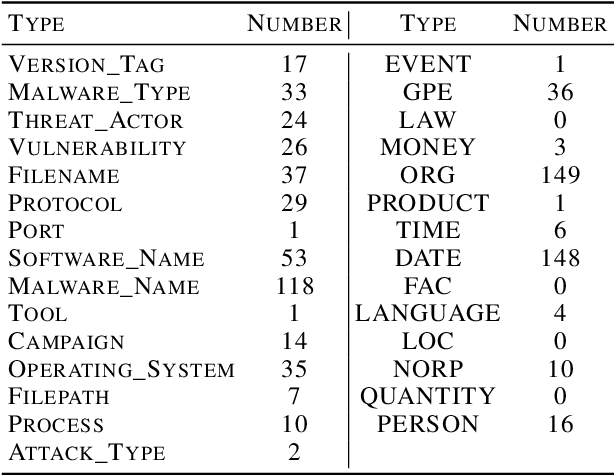
Cyber Threat Intelligence (CTI) is information describing threat vectors, vulnerabilities, and attacks and is often used as training data for AI-based cyber defense systems such as Cybersecurity Knowledge Graphs (CKG). There is a strong need to develop community-accessible datasets to train existing AI-based cybersecurity pipelines to efficiently and accurately extract meaningful insights from CTI. We have created an initial unstructured CTI corpus from a variety of open sources that we are using to train and test cybersecurity entity models using the spaCy framework and exploring self-learning methods to automatically recognize cybersecurity entities. We also describe methods to apply cybersecurity domain entity linking with existing world knowledge from Wikidata. Our future work will survey and test spaCy NLP tools and create methods for continuous integration of new information extracted from text.