 Add to Chrome
 Add to Firefox
 Add to Edge
Rethinking Ground Truth: A Case Study on Human Label Variation in MLLM Benchmarking
Mar 20, 2026
Human Label Variation (HLV), i.e. systematic differences among annotators' judgments, remains underexplored in benchmarks despite rapid progress in large language model (LLM) development. We address this gap by introducing an evaluation protocol for multimodal large language model (MLLM) benchmarking that explicitly accounts for two conditions: (1) human label agreement and (2) disagreement. We apply this protocol to two state-of-the-art MLLM families (Gemma 3, Qwen 2.5 VL) using non-aggregated human annotations from a social media content classification dataset. Across tasks, we find that larger models tend to perform best on high-agreement subsets, yet often underperform medium-sized models when human disagreement is high, indicating that parameter count alone does not determine sensitivity to ambiguity and subjectivity. These results show that benchmarks based solely on consensus labels can overstate model capabilities in such domains and that incorporating human label variation yields more realistic and robust assessments of MLLMs in content moderation pipelines.
* 6 pages, 3 tables, 1 figure

BoN Appetit Team at LeWiDi-2025: Best-of-N Test-time Scaling Can Not Stomach Annotation Disagreements (Yet)
Oct 14, 2025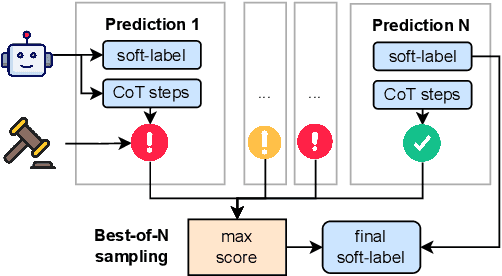
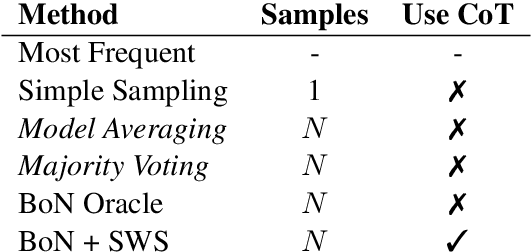
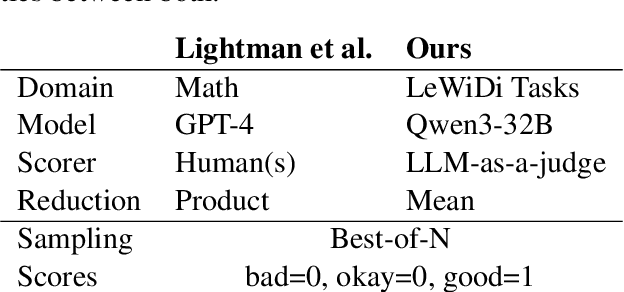
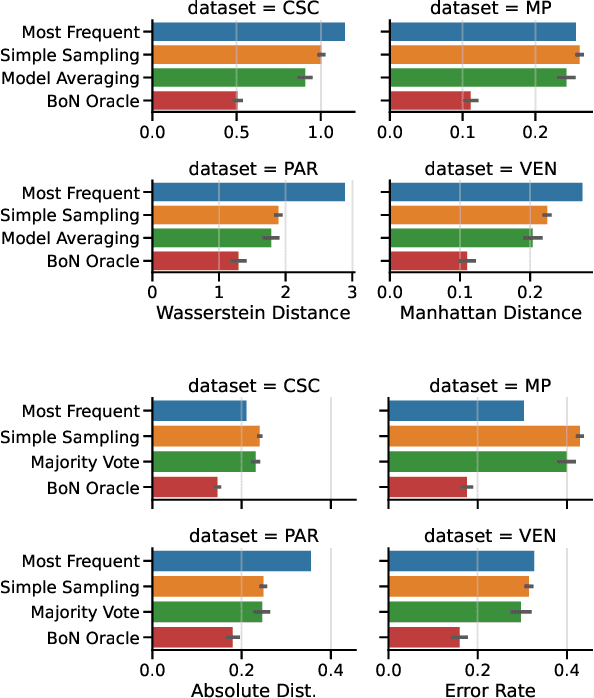
Test-time scaling is a family of techniques to improve LLM outputs at inference time by performing extra computation. To the best of our knowledge, test-time scaling has been limited to domains with verifiably correct answers, like mathematics and coding. We transfer test-time scaling to the LeWiDi-2025 tasks to evaluate annotation disagreements. We experiment with three test-time scaling methods: two benchmark algorithms (Model Averaging and Majority Voting), and a Best-of-N sampling method. The two benchmark methods improve LLM performance consistently on the LeWiDi tasks, but the Best-of-N method does not. Our experiments suggest that the Best-of-N method does not currently transfer from mathematics to LeWiDi tasks, and we analyze potential reasons for this gap.