 Add to Chrome
 Add to Firefox
 Add to Edge
Prompting with the human-touch: evaluating model-sensitivity of foundation models for musculoskeletal CT segmentation
Mar 11, 2026
Promptable Foundation Models (FMs), initially introduced for natural image segmentation, have also revolutionized medical image segmentation. The increasing number of models, along with evaluations varying in datasets, metrics, and compared models, makes direct performance comparison between models difficult and complicates the selection of the most suitable model for specific clinical tasks. In our study, 11 promptable FMs are tested using non-iterative 2D and 3D prompting strategies on a private and public dataset focusing on bone and implant segmentation in four anatomical regions (wrist, shoulder, hip and lower leg). The Pareto-optimal models are identified and further analyzed using human prompts collected through a dedicated observer study. Our findings are: 1) The segmentation performance varies a lot between FMs and prompting strategies; 2) The Pareto-optimal models in 2D are SAM and SAM2.1, in 3D nnInteractive and Med-SAM2; 3) Localization accuracy and rater consistency vary with anatomical structures, with higher consistency for simple structures (wrist bones) and lower consistency for complex structures (pelvis, tibia, implants); 4) The segmentation performance drops using human prompts, suggesting that performance reported on "ideal" prompts extracted from reference labels might overestimate the performance in a human-driven setting; 5) All models were sensitive to prompt variations. While two models demonstrated intra-rater robustness, it did not scale to inter-rater settings. We conclude that the selection of the most optimal FM for a human-driven setting remains challenging, with even high-performing FMs being sensitive to variations in human input prompts. Our code base for prompt extraction and model inference is available: https://github.com/CarolineMagg/segmentation-FM-benchmark/

Zero-shot capability of SAM-family models for bone segmentation in CT scans
Nov 13, 2024


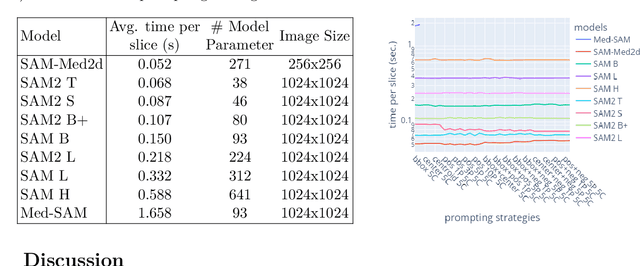
The Segment Anything Model (SAM) and similar models build a family of promptable foundation models (FMs) for image and video segmentation. The object of interest is identified using prompts, such as bounding boxes or points. With these FMs becoming part of medical image segmentation, extensive evaluation studies are required to assess their strengths and weaknesses in clinical setting. Since the performance is highly dependent on the chosen prompting strategy, it is important to investigate different prompting techniques to define optimal guidelines that ensure effective use in medical image segmentation. Currently, no dedicated evaluation studies exist specifically for bone segmentation in CT scans, leaving a gap in understanding the performance for this task. Thus, we use non-iterative, ``optimal'' prompting strategies composed of bounding box, points and combinations to test the zero-shot capability of SAM-family models for bone CT segmentation on three different skeletal regions. Our results show that the best settings depend on the model type and size, dataset characteristics and objective to optimize. Overall, SAM and SAM2 prompted with a bounding box in combination with the center point for all the components of an object yield the best results across all tested settings. As the results depend on multiple factors, we provide a guideline for informed decision-making in 2D prompting with non-interactive, ''optimal'' prompts.