 Add to Chrome
 Add to Firefox
 Add to Edge
Spectral Subsurface Scattering from RGB via Biophysical Skin Inversion
Jun 25, 2026
In this paper we present a spectral optical inversion for skin for path tracing-based rendering of subsurface scattering. Skin is a complex multilayered medium, with appearance determined by the mixture of biophysical chromophores. However, current methods rely on medium homogeneization, with optical parameters obtained via albedo inversion from a reflectance texture and hand-tuned scattering distance and anisotropy. This results into significant art-skilled manual labor for authoring, and an inaccurate scattering profile for skin. To solve these problems, we generalize existing albedo inversion techniques, and propose a framework that predicts full-spectral skin scattering parameters from a single RGB diffuse albedo. Our method builds upon a new mixture-of-media representation, that approximates the aggregated multilayered appearance of skin by mixing the aggregated scattering of three uncorrelated media. We train a chained neural decoder that maps RGB diffuse albedo to the optical properties of the mixture of media, including anisotropy, scattering radius and scattering albedo. Then, we show this mixture can be used in a random-walk-based path tracer with minimal modifications, by simply randomly selecting the medium to traverse.

Wispy to Voluminous: Prior-free Multi-view Capture of Strand-level Facial Hair
Jun 06, 2026Facial hair is a defining trait of personal identity, yet remains a critical bottleneck for digital avatars. Recent volumetric methods achieve photorealism but bake hair into the underlying face geometry, preventing editability and failing to resolve sparse, strand-like structures. Meanwhile, scalp-hair reconstruction methods target dense hair volumes and do not transfer to the sparse, spatially-varying nature of facial hair. We present a pipeline that automatically reconstructs facial hair -- beard, mustache, lashes, and brows -- from multi-view images, converting an unstructured 3D Gaussian representation into an explicit curve-based strand representation. We resolve geometric ambiguities in four stages: (i) optimizing 3D Gaussians constrained by tracked head geometry to enforce early ray termination and suppress sub-surface noise; (ii) tracing continuous strands robust to frequent crossings and extreme curvature; (iii) grounding strands to the surface and resolving root-tip ambiguity via a physically-motivated prior; and (iv) refining the reconstruction through opacity-driven density control under photometric optimization. To our knowledge, this is the first method to reconstruct high-fidelity facial hair strands from a 3D Gaussian representation. The recovered strands faithfully preserve the orientation and sparsity patterns characteristic of facial hair, and yield assets immediately suitable for downstream production tasks, including facial animation and physical simulation, geometric grooming and transfer, appearance editing, and physics-based rendering.
Neural Relighting with Subsurface Scattering by Learning the Radiance Transfer Gradient
Jun 15, 2023Reconstructing and relighting objects and scenes under varying lighting conditions is challenging: existing neural rendering methods often cannot handle the complex interactions between materials and light. Incorporating pre-computed radiance transfer techniques enables global illumination, but still struggles with materials with subsurface scattering effects. We propose a novel framework for learning the radiance transfer field via volume rendering and utilizing various appearance cues to refine geometry end-to-end. This framework extends relighting and reconstruction capabilities to handle a wider range of materials in a data-driven fashion. The resulting models produce plausible rendering results in existing and novel conditions. We will release our code and a novel light stage dataset of objects with subsurface scattering effects publicly available.
Estimation of Spectral Biophysical Skin Properties from Captured RGB Albedo
Jan 26, 2022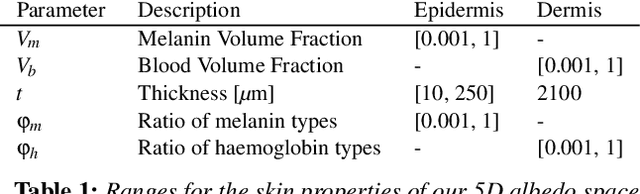
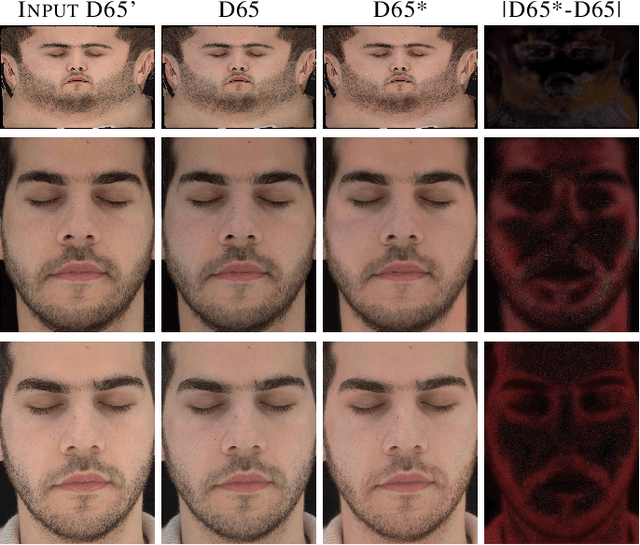
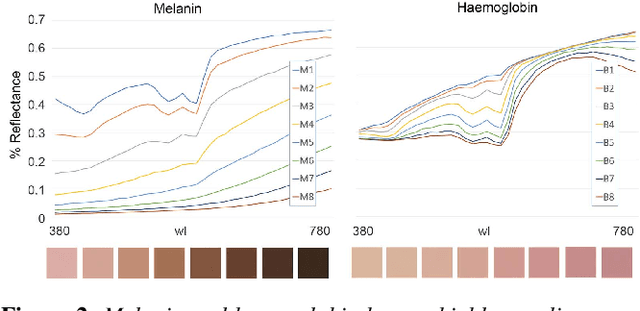
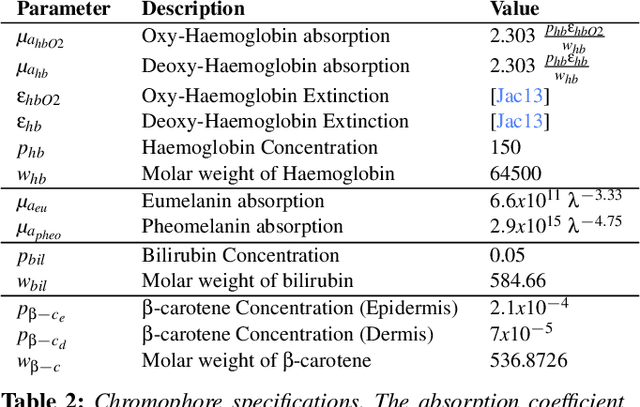
We present a new method to reconstruct and manipulate the spectral properties of human skin from simple RGB albedo captures. To this end, we leverage Monte Carlo light simulation over an accurate biophysical human skin layering model parameterized by its most important components, thereby covering a plausible range of colors. The practical complexity of the model allows us to learn the inverse mapping from any albedo to its most probable associated skin properties. Our technique can faithfully reproduce any skin type, being expressive enough to automatically handle more challenging areas like the lips or imperfections in the face. Thanks to the smoothness of the skin parameters maps recovered, the albedo can be robustly edited through meaningful biophysical properties.