 Add to Chrome
 Add to Firefox
 Add to Edge
GeMM-GAN: A Multimodal Generative Model Conditioned on Histopathology Images and Clinical Descriptions for Gene Expression Profile Generation
Jan 21, 2026
Biomedical research increasingly relies on integrating diverse data modalities, including gene expression profiles, medical images, and clinical metadata. While medical images and clinical metadata are routinely collected in clinical practice, gene expression data presents unique challenges for widespread research use, mainly due to stringent privacy regulations and costly laboratory experiments. To address these limitations, we present GeMM-GAN, a novel Generative Adversarial Network conditioned on histopathology tissue slides and clinical metadata, designed to synthesize realistic gene expression profiles. GeMM-GAN combines a Transformer Encoder for image patches with a final Cross Attention mechanism between patches and text tokens, producing a conditioning vector to guide a generative model in generating biologically coherent gene expression profiles. We evaluate our approach on the TCGA dataset and demonstrate that our framework outperforms standard generative models and generates more realistic and functionally meaningful gene expression profiles, improving by more than 11\% the accuracy on downstream disease type prediction compared to current state-of-the-art generative models. Code will be available at: https://github.com/francescapia/GeMM-GAN

LCF3D: A Robust and Real-Time Late-Cascade Fusion Framework for 3D Object Detection in Autonomous Driving
Jan 14, 2026Accurately localizing 3D objects like pedestrians, cyclists, and other vehicles is essential in Autonomous Driving. To ensure high detection performance, Autonomous Vehicles complement RGB cameras with LiDAR sensors, but effectively combining these data sources for 3D object detection remains challenging. We propose LCF3D, a novel sensor fusion framework that combines a 2D object detector on RGB images with a 3D object detector on LiDAR point clouds. By leveraging multimodal fusion principles, we compensate for inaccuracies in the LiDAR object detection network. Our solution combines two key principles: (i) late fusion, to reduce LiDAR False Positives by matching LiDAR 3D detections with RGB 2D detections and filtering out unmatched LiDAR detections; and (ii) cascade fusion, to recover missed objects from LiDAR by generating new 3D frustum proposals corresponding to unmatched RGB detections. Experiments show that LCF3D is beneficial for domain generalization, as it turns out to be successful in handling different sensor configurations between training and testing domains. LCF3D achieves significant improvements over LiDAR-based methods, particularly for challenging categories like pedestrians and cyclists in the KITTI dataset, as well as motorcycles and bicycles in nuScenes. Code can be downloaded from: https://github.com/CarloSgaravatti/LCF3D.
Promptable Foundation Models for SAR Remote Sensing: Adapting the Segment Anything Model for Snow Avalanche Segmentation
Jan 03, 2026Remote sensing solutions for avalanche segmentation and mapping are key to supporting risk forecasting and mitigation in mountain regions. Synthetic Aperture Radar (SAR) imagery from Sentinel-1 can be effectively used for this task, but training an effective detection model requires gathering a large dataset with high-quality annotations from domain experts, which is prohibitively time-consuming. In this work, we aim to facilitate and accelerate the annotation of SAR images for avalanche mapping. We build on the Segment Anything Model (SAM), a segmentation foundation model trained on natural images, and tailor it to Sentinel-1 SAR data. Adapting SAM to our use-case requires addressing several domain-specific challenges: (i) domain mismatch, since SAM was not trained on satellite/SAR imagery; (ii) input adaptation, because SAR products typically provide more than three channels, while SAM is constrained to RGB images; (iii) robustness to imprecise prompts that can affect target identification and degrade the segmentation quality, an issue exacerbated in small, low-contrast avalanches; and (iv) training efficiency, since standard fine-tuning is computationally demanding for SAM. We tackle these challenges through a combination of adapters to mitigate the domain gap, multiple encoders to handle multi-channel SAR inputs, prompt-engineering strategies to improve avalanche localization accuracy, and a training algorithm that limits the training time of the encoder, which is recognized as the major bottleneck. We integrate the resulting model into an annotation tool and show experimentally that it speeds up the annotation of SAR images.
A Multimodal Hybrid Late-Cascade Fusion Network for Enhanced 3D Object Detection
Apr 25, 2025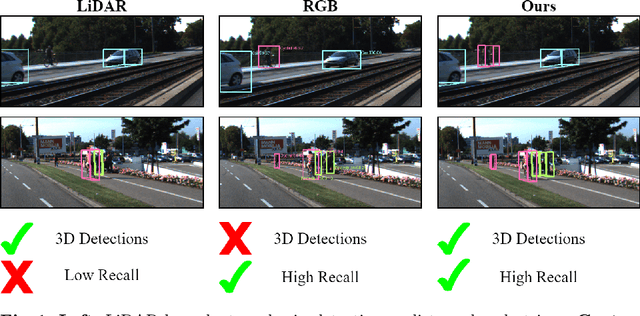
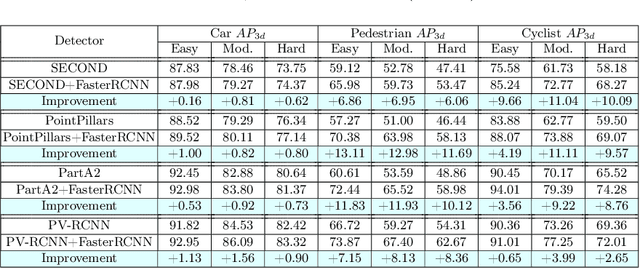
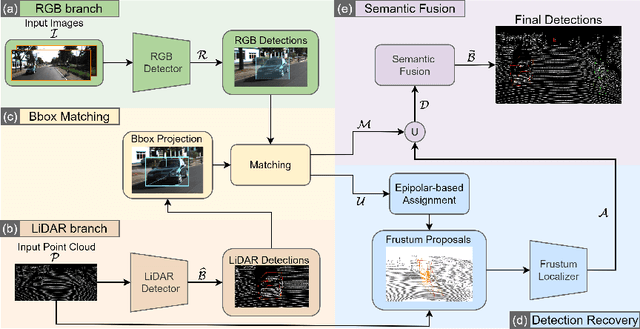
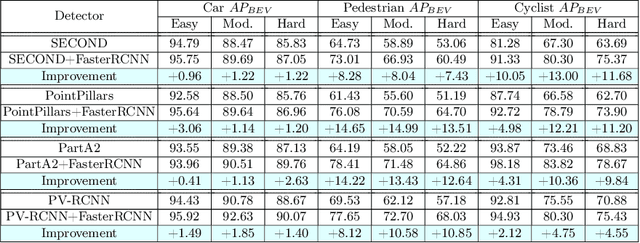
We present a new way to detect 3D objects from multimodal inputs, leveraging both LiDAR and RGB cameras in a hybrid late-cascade scheme, that combines an RGB detection network and a 3D LiDAR detector. We exploit late fusion principles to reduce LiDAR False Positives, matching LiDAR detections with RGB ones by projecting the LiDAR bounding boxes on the image. We rely on cascade fusion principles to recover LiDAR False Negatives leveraging epipolar constraints and frustums generated by RGB detections of separate views. Our solution can be plugged on top of any underlying single-modal detectors, enabling a flexible training process that can take advantage of pre-trained LiDAR and RGB detectors, or train the two branches separately. We evaluate our results on the KITTI object detection benchmark, showing significant performance improvements, especially for the detection of Pedestrians and Cyclists.