 Add to Chrome
 Add to Firefox
 Add to Edge
Learning Fault-Tolerant Locomotion with Adaptive Gait Timing
Aug 07, 2026
Hardware failures require legged robots to rapidly reorganize coordination and gait timing to maintain stability and mobility. This is particularly challenging for larger quadrupeds, where increased mass and tighter actuation limits reduce the feasibility of aggressive, high-frequency compensation strategies often observed on smaller platforms. In this work, we propose a deep reinforcement learning approach for fault-tolerant locomotion under actuator power loss. The method employs an asymmetric actor-critic architecture in which the critic has access to privileged information during training, while the actor learns to reconstruct a corresponding latent representation from proprioceptive observations. We introduce a latent-alignment loss that encourages consistency between actor and critic representations. Additionally, we augment the action space with a learnable gait frequency parameter, enabling adaptive gait timing in response to terrain variations and actuator degradation without predefined faulty-leg strategies. The approach is validated in high-fidelity simulation on uneven terrain and real-world experiments on flat ground using a 68 kg quadruped robot.

RL-Augmented MPC for Non-Gaited Legged and Hybrid Locomotion
Mar 11, 2026We propose a contact-explicit hierarchical architecture coupling Reinforcement Learning (RL) and Model Predictive Control (MPC), where a high-level RL agent provides gait and navigation commands to a low-level locomotion MPC. This offloads the combinatorial burden of contact timing from the MPC by learning acyclic gaits through trial and error in simulation. We show that only a minimal set of rewards and limited tuning are required to obtain effective policies. We validate the architecture in simulation across robotic platforms spanning 50 kg to 120 kg and different MPC implementations, observing the emergence of acyclic gaits and timing adaptations in flat-terrain legged and hybrid locomotion, and further demonstrating extensibility to non-flat terrains. Across all platforms, we achieve zero-shot sim-to-sim transfer without domain randomization, and we further demonstrate zero-shot sim-to-real transfer without domain randomization on Centauro, our 120 kg wheeled-legged humanoid robot. We make our software framework and evaluation results publicly available at https://github.com/AndrePatri/AugMPC.
The Importance and the Limitations of Sim2Real for Robotic Manipulation in Precision Agriculture
Aug 10, 2020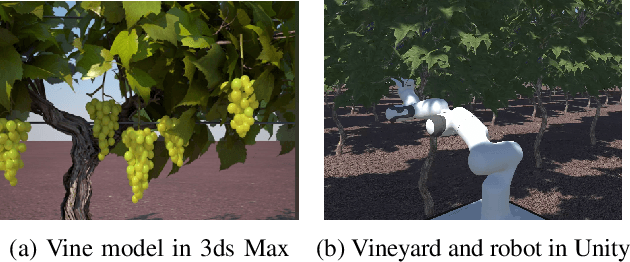
In recent years Sim2Real approaches have brought great results to robotics. Techniques such as model-based learning or domain randomization can help overcome the gap between simulation and reality, but in some situations simulation accuracy is still needed. An example is agricultural robotics, which needs detailed simulations, both in terms of dynamics and visuals. However, simulation software is still not capable of such quality and accuracy. Current Sim2Real techniques are helpful in mitigating the problem, but for these specific tasks they are not enough.