 Add to Chrome
 Add to Firefox
 Add to Edge
AlphaCNOT: Learning CNOT Minimization with Model-Based Planning
Apr 15, 2026
Quantum circuit optimization is a central task in Quantum Computing, as current Noisy Intermediate Scale Quantum devices suffer from error propagation that often scales with the number of operations. Among quantum operations, the CNOT gate is of fundamental importance, being the only 2-qubit gate in the universal Clifford+T set. The problem of CNOT gates minimization has been addressed by heuristic algorithms such as the well-known Patel-Markov-Hayes (PMH) for linear reversible synthesis (i.e., CNOT minimization with no topological constraints), and more recently by Reinforcement Learning (RL) based strategies in the more complex case of topology-aware synthesis, where each CNOT can act on a subset of all qubits pairs. In this work we introduce AlphaCNOT, a RL framework based on Monte Carlo Tree Search (MCTS) that address effectively the CNOT minimization problem by modeling it as a planning problem. In contrast to other RL- based solution, our method is model-based, i.e. it can leverage lookahead search to evaluate future trajectories, thus finding more efficient sequences of CNOTs. Our method achieves a reduction of up to 32% in CNOT gate count compared to PMH baseline on linear reversible synthesis, while in the constraint version we report a consistent gate count reduction on a variety of topologies with up to 8 qubits, with respect to state-of-the-art RL-based solutions. Our results suggest the combination of RL with search-based strategies can be applied to different circuit optimization tasks, such as Clifford minimization, thus fostering the transition toward the "quantum utility" era.

Vulnerability Detection in Ethereum Smart Contracts via Machine Learning: A Qualitative Analysis
Jul 26, 2024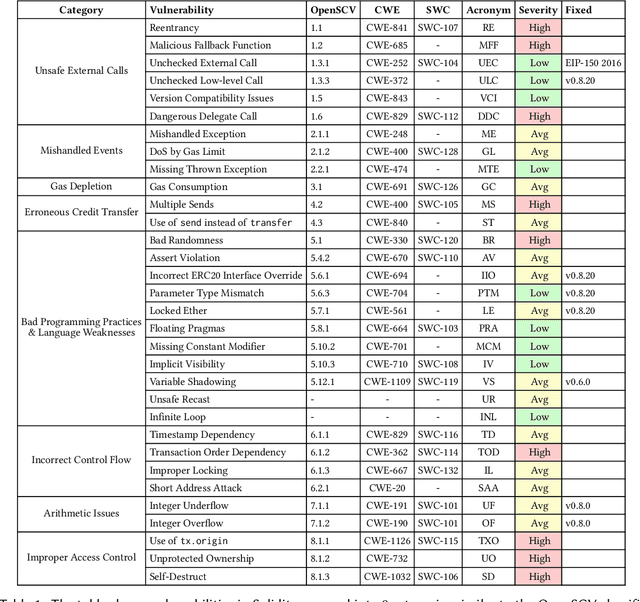
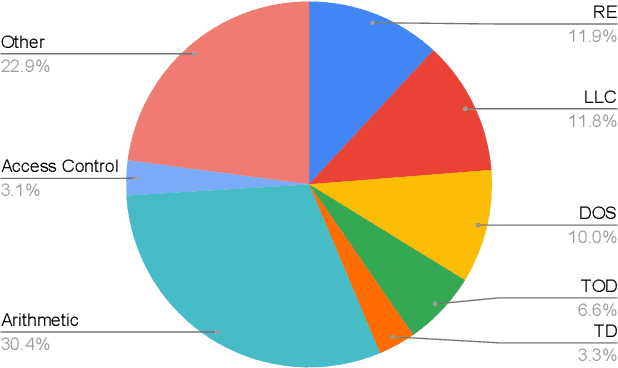
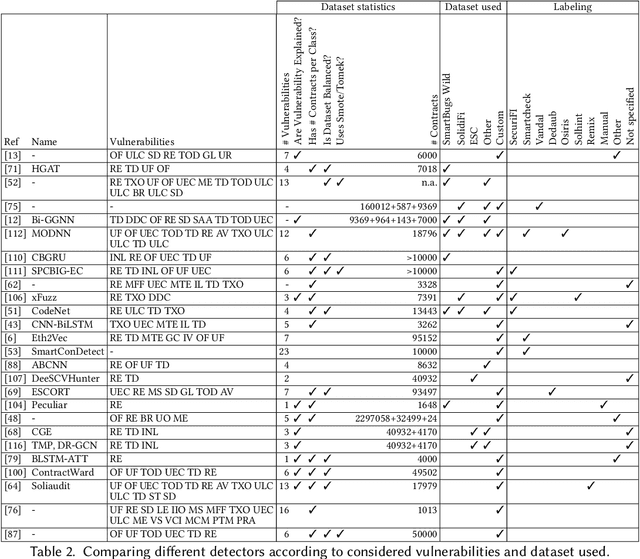
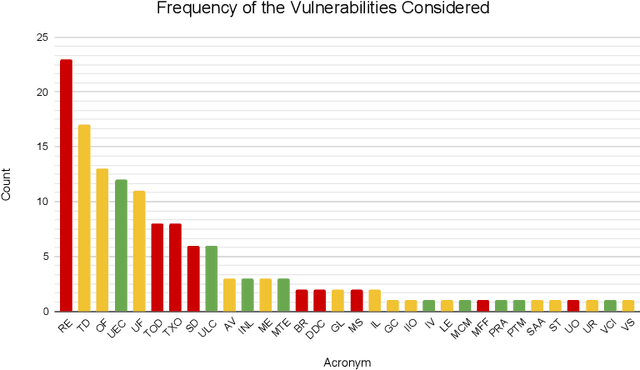
Smart contracts are central to a myriad of critical blockchain applications, from financial transactions to supply chain management. However, their adoption is hindered by security vulnerabilities that can result in significant financial losses. Most vulnerability detection tools and methods available nowadays leverage either static analysis methods or machine learning. Unfortunately, as valuable as they are, both approaches suffer from limitations that make them only partially effective. In this survey, we analyze the state of the art in machine-learning vulnerability detection for Ethereum smart contracts, by categorizing existing tools and methodologies, evaluating them, and highlighting their limitations. Our critical assessment unveils issues such as restricted vulnerability coverage and dataset construction flaws, providing us with new metrics to overcome the difficulties that restrain a sound comparison of existing solutions. Driven by our findings, we discuss best practices to enhance the accuracy, scope, and efficiency of vulnerability detection in smart contracts. Our guidelines address the known flaws while at the same time opening new avenues for research and development. By shedding light on current challenges and offering novel directions for improvement, we contribute to the advancement of secure smart contract development and blockchain technology as a whole.
Neural Networks Reduction via Lumping
Sep 15, 2022


The increasing size of recently proposed Neural Networks makes it hard to implement them on embedded devices, where memory, battery and computational power are a non-trivial bottleneck. For this reason during the last years network compression literature has been thriving and a large number of solutions has been been published to reduce both the number of operations and the parameters involved with the models. Unfortunately, most of these reducing techniques are actually heuristic methods and usually require at least one re-training step to recover the accuracy. The need of procedures for model reduction is well-known also in the fields of Verification and Performances Evaluation, where large efforts have been devoted to the definition of quotients that preserve the observable underlying behaviour. In this paper we try to bridge the gap between the most popular and very effective network reduction strategies and formal notions, such as lumpability, introduced for verification and evaluation of Markov Chains. Elaborating on lumpability we propose a pruning approach that reduces the number of neurons in a network without using any data or fine-tuning, while completely preserving the exact behaviour. Relaxing the constraints on the exact definition of the quotienting method we can give a formal explanation of some of the most common reduction techniques.