 Add to Chrome
 Add to Firefox
 Add to Edge
Assessing Code Understanding in LLMs
Mar 31, 2025
We present an empirical evaluation of Large Language Models in code understanding associated with non-trivial, semantic-preserving program transformations such as copy propagation or constant folding. Our findings show that LLMs fail to judge semantic equivalence in approximately 41\% of cases when no context is provided and in 29\% when given a simple generic context. To improve accuracy, we advocate integrating LLMs with code-optimization tools to enhance training and facilitate more robust program understanding.

Vulnerability Detection in Ethereum Smart Contracts via Machine Learning: A Qualitative Analysis
Jul 26, 2024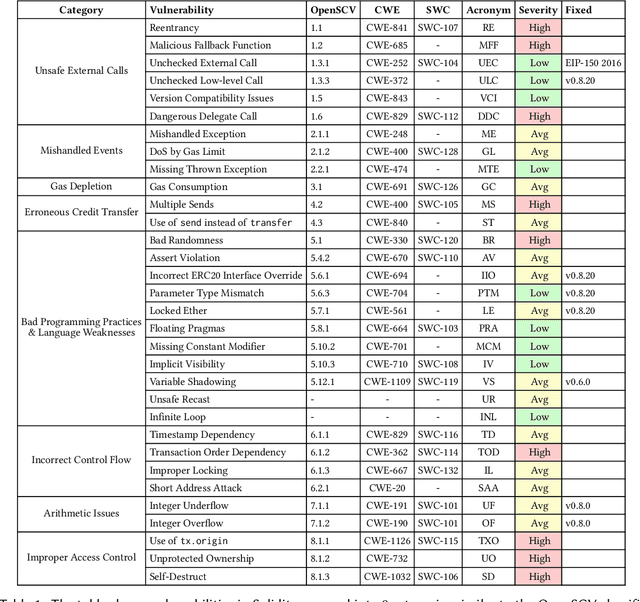
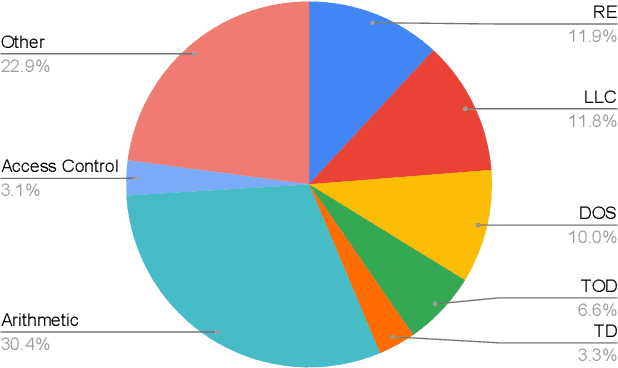
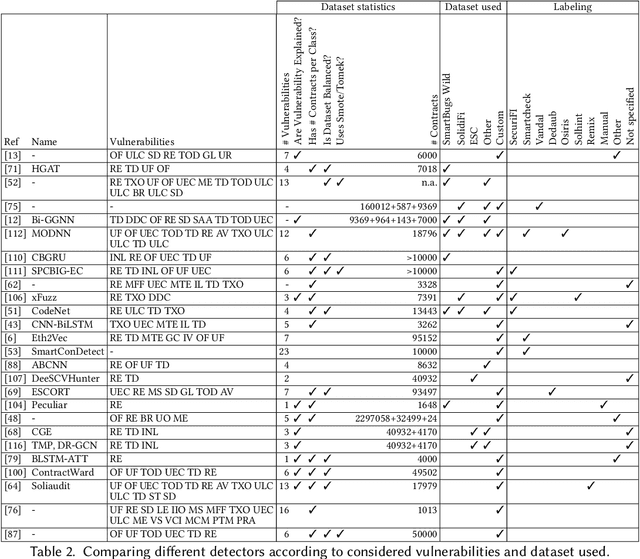
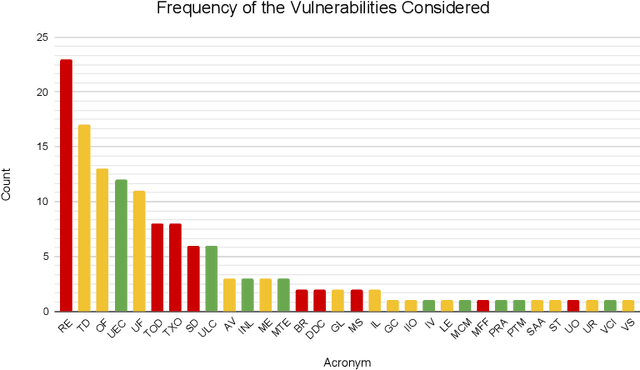
Smart contracts are central to a myriad of critical blockchain applications, from financial transactions to supply chain management. However, their adoption is hindered by security vulnerabilities that can result in significant financial losses. Most vulnerability detection tools and methods available nowadays leverage either static analysis methods or machine learning. Unfortunately, as valuable as they are, both approaches suffer from limitations that make them only partially effective. In this survey, we analyze the state of the art in machine-learning vulnerability detection for Ethereum smart contracts, by categorizing existing tools and methodologies, evaluating them, and highlighting their limitations. Our critical assessment unveils issues such as restricted vulnerability coverage and dataset construction flaws, providing us with new metrics to overcome the difficulties that restrain a sound comparison of existing solutions. Driven by our findings, we discuss best practices to enhance the accuracy, scope, and efficiency of vulnerability detection in smart contracts. Our guidelines address the known flaws while at the same time opening new avenues for research and development. By shedding light on current challenges and offering novel directions for improvement, we contribute to the advancement of secure smart contract development and blockchain technology as a whole.