 Add to Chrome
 Add to Firefox
 Add to Edge
WISE-FM:Operation-Aware, Engineering-Informed Foundation Model for Multi-Task Well Design
Apr 26, 2026
Deploying machine learning models across diverse well portfolios requires generalisation to wells with design parameters outside the training distribution. Current data-driven approaches to virtual flow metering (VFM) and bottomhole estimation typically treat each well independently or ignore the influence of well design on operational behaviour. We present WISE (Well Intelligence and Systems Engineering Foundation Model), a design-aware, physics-informed multi-task model that integrates three complementary mechanisms: Feature-wise Linear Modulation (FiLM) and cross-modal attention to condition operational embeddings on well design parameters; multi-task learning for simultaneous prediction of flow rates, bottomhole conditions, and flow regime classification; and structural mass conservation with soft physics constraints derived from well engineering principles. Evaluation on the ManyWells benchmark (2000 simulated wells, $10^6$ data points) demonstrates that design-aware models reduce VFM prediction error by up to $13\times$ compared to design-unaware baselines, and that physics constraints reduce negative flow predictions by 65%. Flow regime classification achieves 97.7% bottomhole accuracy, providing continuous well integrity monitoring without additional sensors. The methodology transfers to real operational data from five Equinor Volve producers (oil rate $R^2 = 0.89$, bottomhole pressure $R^2 = 0.98$, water rate $R^2 = 0.97$). The trained model additionally serves as a fast surrogate for integrity-aware well design optimisation over a 24-dimensional design space, with more than $1000\times$ speedup over drift-flux simulations. These results demonstrate that design awareness, physics enforcement, and multi-task learning are essential and complementary ingredients for foundation models intended to operate across large well portfolios.

A Robust Learning Methodology for Uncertainty-aware Scientific Machine Learning models
Sep 05, 2022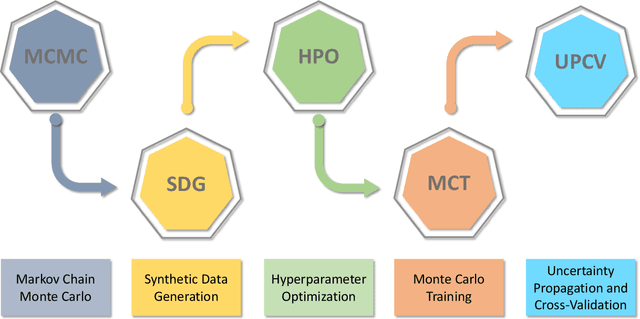
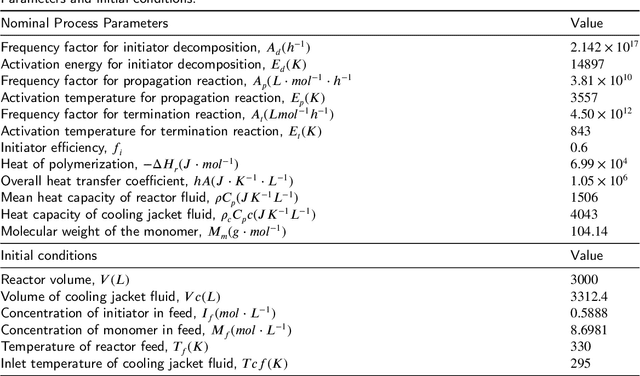
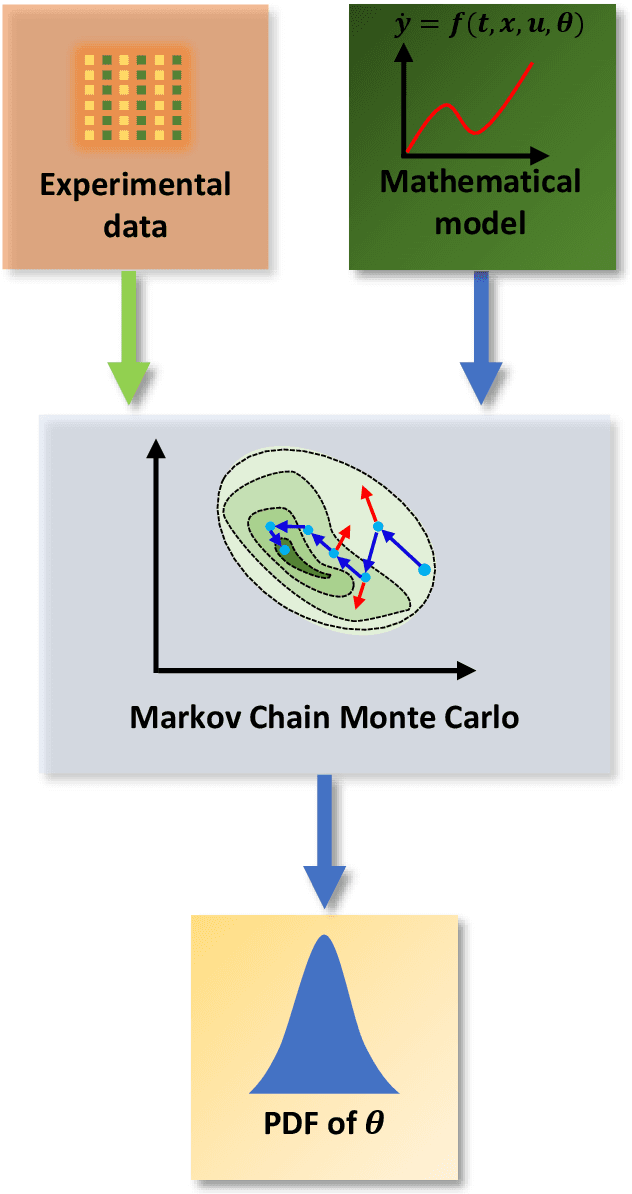

Robust learning is an important issue in Scientific Machine Learning (SciML). There are several works in the literature addressing this topic. However, there is an increasing demand for methods that can simultaneously consider all the different uncertainty components involved in SciML model identification. Hence, this work proposes a comprehensive methodology for uncertainty evaluation of the SciML that also considers several possible sources of uncertainties involved in the identification process. The uncertainties considered in the proposed method are the absence of theory and causal models, the sensitiveness to data corruption or imperfection, and the computational effort. Therefore, it was possible to provide an overall strategy for the uncertainty-aware models in the SciML field. The methodology is validated through a case study, developing a Soft Sensor for a polymerization reactor. The results demonstrated that the identified Soft Sensor are robust for uncertainties, corroborating with the consistency of the proposed approach.