 Add to Chrome
 Add to Firefox
 Add to Edge
Relational Feature Caching for Accelerating Diffusion Transformers
Feb 23, 2026
Feature caching approaches accelerate diffusion transformers (DiTs) by storing the output features of computationally expensive modules at certain timesteps, and exploiting them for subsequent steps to reduce redundant computations. Recent forecasting-based caching approaches employ temporal extrapolation techniques to approximate the output features with cached ones. Although effective, relying exclusively on temporal extrapolation still suffers from significant prediction errors, leading to performance degradation. Through a detailed analysis, we find that 1) these errors stem from the irregular magnitude of changes in the output features, and 2) an input feature of a module is strongly correlated with the corresponding output. Based on this, we propose relational feature caching (RFC), a novel framework that leverages the input-output relationship to enhance the accuracy of the feature prediction. Specifically, we introduce relational feature estimation (RFE) to estimate the magnitude of changes in the output features from the inputs, enabling more accurate feature predictions. We also present relational cache scheduling (RCS), which estimates the prediction errors using the input features and performs full computations only when the errors are expected to be substantial. Extensive experiments across various DiT models demonstrate that RFC consistently outperforms prior approaches significantly. Project page is available at https://cvlab.yonsei.ac.kr/projects/RFC

AccuQuant: Simulating Multiple Denoising Steps for Quantizing Diffusion Models
Oct 23, 2025We present in this paper a novel post-training quantization (PTQ) method, dubbed AccuQuant, for diffusion models. We show analytically and empirically that quantization errors for diffusion models are accumulated over denoising steps in a sampling process. To alleviate the error accumulation problem, AccuQuant minimizes the discrepancies between outputs of a full-precision diffusion model and its quantized version within a couple of denoising steps. That is, it simulates multiple denoising steps of a diffusion sampling process explicitly for quantization, accounting the accumulated errors over multiple denoising steps, which is in contrast to previous approaches to imitating a training process of diffusion models, namely, minimizing the discrepancies independently for each step. We also present an efficient implementation technique for AccuQuant, together with a novel objective, which reduces a memory complexity significantly from $\mathcal{O}(n)$ to $\mathcal{O}(1)$, where $n$ is the number of denoising steps. We demonstrate the efficacy and efficiency of AccuQuant across various tasks and diffusion models on standard benchmarks.
FYI: Flip Your Images for Dataset Distillation
Jul 11, 2024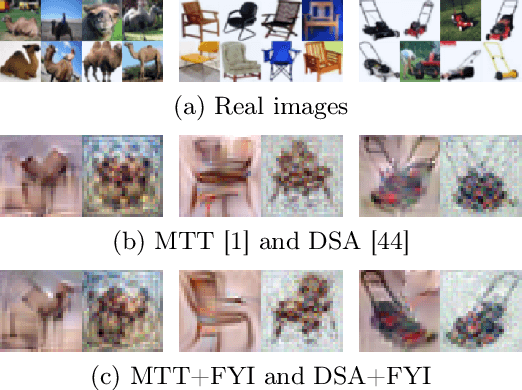
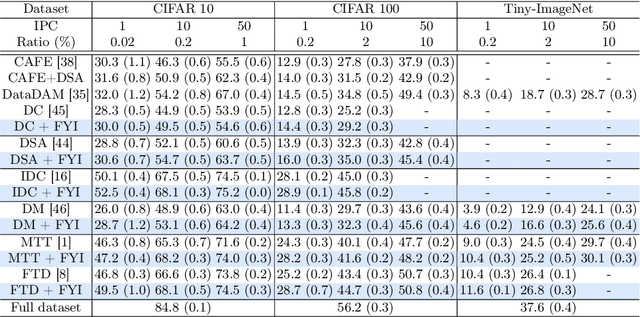


Dataset distillation synthesizes a small set of images from a large-scale real dataset such that synthetic and real images share similar behavioral properties (e.g, distributions of gradients or features) during a training process. Through extensive analyses on current methods and real datasets, together with empirical observations, we provide in this paper two important things to share for dataset distillation. First, object parts that appear on one side of a real image are highly likely to appear on the opposite side of another image within a dataset, which we call the bilateral equivalence. Second, the bilateral equivalence enforces synthetic images to duplicate discriminative parts of objects on both the left and right sides of the images, limiting the recognition of subtle differences between objects. To address this problem, we introduce a surprisingly simple yet effective technique for dataset distillation, dubbed FYI, that enables distilling rich semantics of real images into synthetic ones. To this end, FYI embeds a horizontal flipping technique into distillation processes, mitigating the influence of the bilateral equivalence, while capturing more details of objects. Experiments on CIFAR-10/100, Tiny-ImageNet, and ImageNet demonstrate that FYI can be seamlessly integrated into several state-of-the-art methods, without modifying training objectives and network architectures, and it improves the performance remarkably.