 Add to Chrome
 Add to Firefox
 Add to Edge
Pixel-level Scene Understanding in One Token: Visual States Need What-is-Where Composition
Mar 14, 2026
For robotic agents operating in dynamic environments, learning visual state representations from streaming video observations is essential for sequential decision making. Recent self-supervised learning methods have shown strong transferability across vision tasks, but they do not explicitly address what a good visual state should encode. We argue that effective visual states must capture what-is-where by jointly encoding the semantic identities of scene elements and their spatial locations, enabling reliable detection of subtle dynamics across observations. To this end, we propose CroBo, a visual state representation learning framework based on a global-to-local reconstruction objective. Given a reference observation compressed into a compact bottleneck token, CroBo learns to reconstruct heavily masked patches in a local target crop from sparse visible cues, using the global bottleneck token as context. This learning objective encourages the bottleneck token to encode a fine-grained representation of scene-wide semantic entities, including their identities, spatial locations, and configurations. As a result, the learned visual states reveal how scene elements move and interact over time, supporting sequential decision making. We evaluate CroBo on diverse vision-based robot policy learning benchmarks, where it achieves state-of-the-art performance. Reconstruction analyses and perceptual straightness experiments further show that the learned representations preserve pixel-level scene composition and encode what-moves-where across observations.

Aligning Forest and Trees in Images and Long Captions for Visually Grounded Understanding
Feb 03, 2026Large vision-language models such as CLIP struggle with long captions because they align images and texts as undifferentiated wholes. Fine-grained vision-language understanding requires hierarchical semantics capturing both global context and localized details across visual and textual domains. Yet linguistic hierarchies from syntax or semantics rarely match visual organization, and purely visual hierarchies tend to fragment scenes into appearance-driven parts without semantic focus. We propose CAFT (Cross-domain Alignment of Forests and Trees), a hierarchical image-text representation learning framework that aligns global and local semantics across images and long captions without pixel-level supervision. Coupling a fine-to-coarse visual encoder with a hierarchical text transformer, it uses a hierarchical alignment loss that matches whole images with whole captions while biasing region-sentence correspondences, so that coarse semantics are built from fine-grained evidence rather than from aggregation untethered to part-level grounding. Trained on 30M image-text pairs, CAFT achieves state-of-the-art performance on six long-text retrieval benchmarks and exhibits strong scaling behavior. Experiments show that hierarchical cross-domain alignment enables fine-grained, visually grounded image-text representations to emerge without explicit region-level supervision.
Textual Query-Driven Mask Transformer for Domain Generalized Segmentation
Jul 12, 2024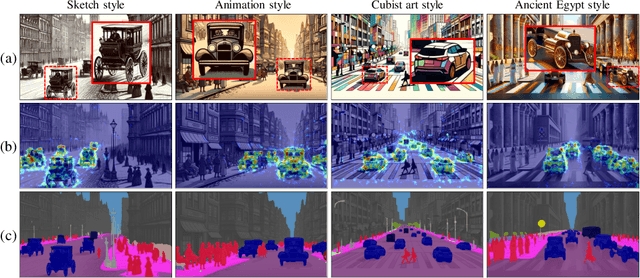
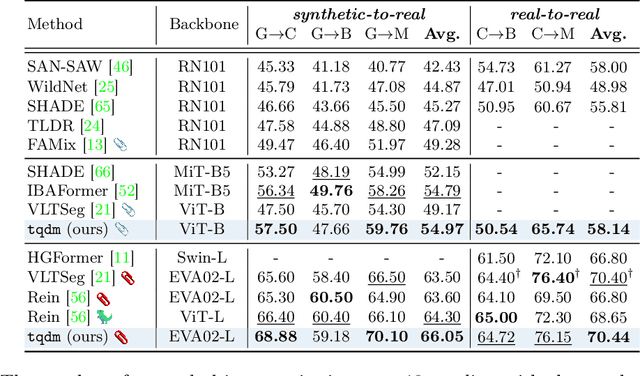
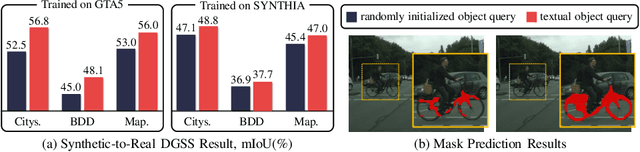
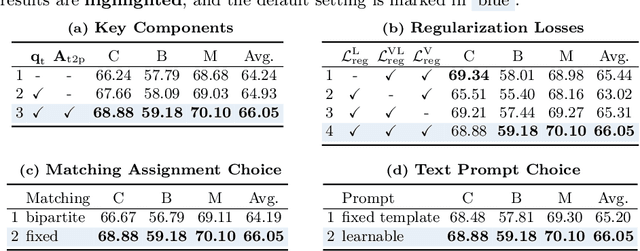
In this paper, we introduce a method to tackle Domain Generalized Semantic Segmentation (DGSS) by utilizing domain-invariant semantic knowledge from text embeddings of vision-language models. We employ the text embeddings as object queries within a transformer-based segmentation framework (textual object queries). These queries are regarded as a domain-invariant basis for pixel grouping in DGSS. To leverage the power of textual object queries, we introduce a novel framework named the textual query-driven mask transformer (tqdm). Our tqdm aims to (1) generate textual object queries that maximally encode domain-invariant semantics and (2) enhance the semantic clarity of dense visual features. Additionally, we suggest three regularization losses to improve the efficacy of tqdm by aligning between visual and textual features. By utilizing our method, the model can comprehend inherent semantic information for classes of interest, enabling it to generalize to extreme domains (e.g., sketch style). Our tqdm achieves 68.9 mIoU on GTA5$\rightarrow$Cityscapes, outperforming the prior state-of-the-art method by 2.5 mIoU. The project page is available at https://byeonghyunpak.github.io/tqdm.