 Add to Chrome
 Add to Firefox
 Add to Edge
Interpretable Human-Label-Free Deep Learning for Real-Bogus Classification with Uncertainty Quantification
Jul 06, 2026
Time-domain surveys generate many transient candidates, making Real-Bogus classification a critical step in automated discovery pipelines. Reliable labels are costly, while community labels can be noisy and survey-dependent. We aim to develop a Real-Bogus classification framework that can be trained without human-labeled data using injected transients and bogus-dominated survey data, remains robust under strong class contamination, and provides calibrated uncertainty quantification. We combine simulated transient injections with a contaminated survey class and train a dual-network model using asymmetric co-teaching for classes with different label-noise levels. We evaluate performance on a benchmark subset and analyze the learned representation with latent-space visualization tools. For uncertainty quantification (UQ), we compare MC dropout and deep ensembles and propose a low-cost hybrid strategy that exploits the dual-network setting to improve calibration. We extend the evaluation to the light-curve domain to assess recovery of light-curve classes. The method achieves strong Real-Bogus performance on the labeled subset and remains stable under severe class contamination. It recovers transient light-curve classes with high fidelity, while single-source identification is limited by ambiguity in light-curve-derived labels. Our hybrid UQ approach achieves competitive calibration relative to more expensive ensemble baselines. Latent-space analyses indicate that uncertainty aligns with the decision boundary and reveal subclasses within the bogus population. Our results show that injection-driven, weakly supervised training can enable scalable and consistent Real-Bogus classification without human-labeled training data while providing calibrated uncertainties. The method is suited for transfer to forthcoming surveys by re-running the injection-based training pipeline.

Astroalign: A Python module for astronomical image registration
Sep 06, 2019
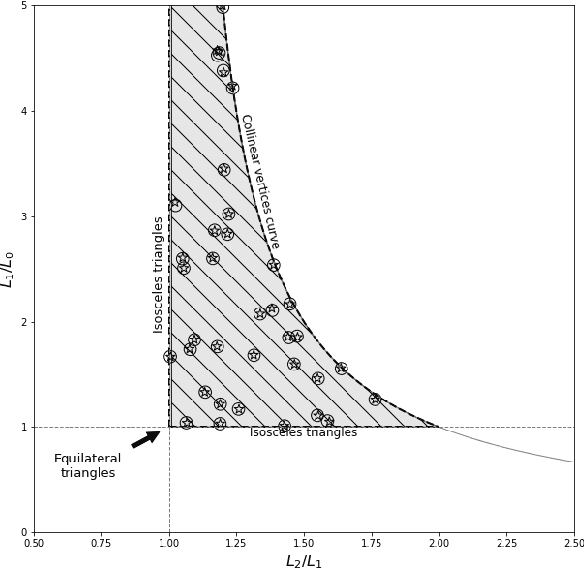
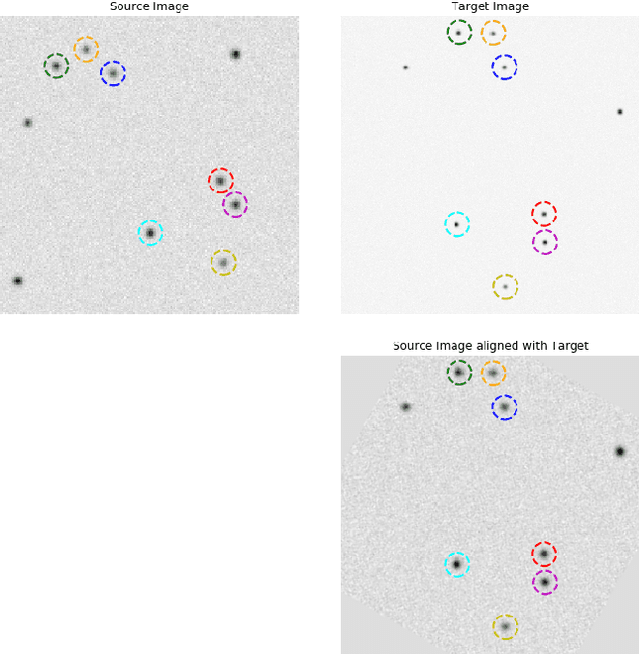
We present an algorithm implemented in the astroalign Python module for image registration in astronomy. Our module does not rely on WCS information and instead matches 3-point asterisms (triangles) on the images to find the most accurate linear transformation between the two. It is especially useful in the context of aligning images prior to stacking or performing difference image analysis. Astroalign can match images of different point-spread functions, seeing, and atmospheric conditions.