 Add to Chrome
 Add to Firefox
 Add to Edge
Robust Design for Multi-Antenna LEO Satellite Communications with Fractional Delay and Doppler Shifts: An RSMA-OTFS Approach
Dec 16, 2025
Low-Earth-orbit (LEO) satellite communication systems face challenges due to high satellite mobility, which hinders the reliable acquisition of instantaneous channel state information at the transmitter (CSIT) and subsequently degrades multi-user transmission performance. This paper investigates a downlink multi-user multi-antenna system, and tackles the above challenges by introducing orthogonal time frequency space (OTFS) modulation and rate-splitting multiple access (RSMA) transmission. Specifically, OTFS enables stable characterization of time-varying channels by representing them in the delay-Doppler domain. However, realistic propagation introduces various inter-symbol and inter-user interference due to non-orthogonal yet practical rectangular pulse shaping, fractional delays, Doppler shifts, and imperfect (statistical) CSIT. In this context, RSMA offers promising robustness for interference mitigation and CSIT imperfections, and hence is integrated with OTFS to provide a comprehensive solution. A compact cross-domain input-output relationship for RSMA-OTFS is established, and an ergodic sum-rate maximization problem is formulated and solved using a weighted minimum mean-square-error based alternating optimization algorithm that does not depend on channel sparsity. Simulation results reveal that the considered practical propagation effects significantly degrade performance if unaddressed. Furthermore, the RSMA-OTFS scheme demonstrates improved ergodic sum-rate and robustness against CSIT uncertainty across various user deployments and CSIT qualities.

Multicarrier Rate-Splitting Multiple Access: Superiority of OFDM-RSMA over OFDMA and OFDM-NOMA
Mar 25, 2023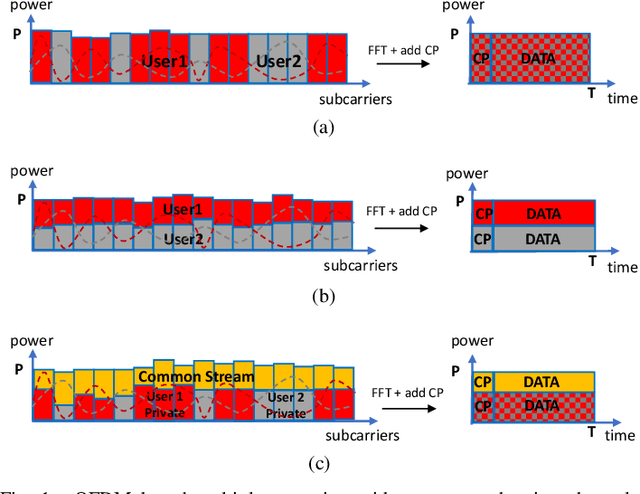

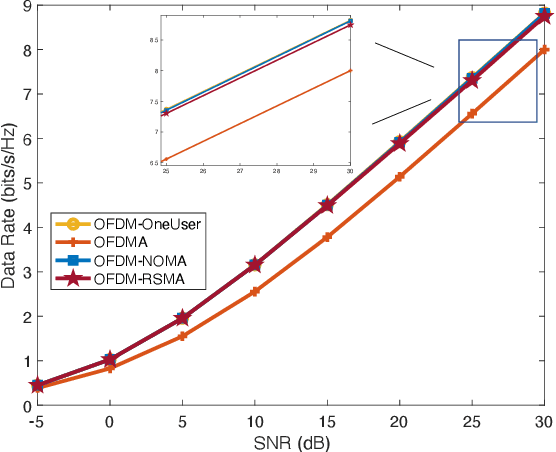
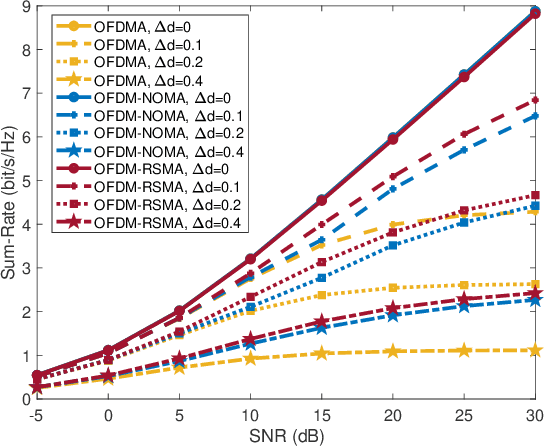
Rate-splitting multiple access (RSMA) is a multiple access technique generalizing conventional techniques, such as, space-division multiple access (SDMA), non-orthogonal multiple access (NOMA), and physical layer multi-casting, which aims to address multi-user interference (MUI) in multiple-input multiple-output (MIMO) systems. In this study, we leverage the interference management capabilities of RSMA to tackle the issue of inter-carrier interference (ICI) in orthogonal frequency division multiplexing (OFDM) waveform. We formulate a problem to find the optimal subcarrier and power allocation for downlink transmission in a two-user system using RSMA and OFDM and propose a weighted minimum mean-square error (WMMSE)-based algorithm to obtain a solution. The sum-rate performance of the proposed OFDM-RSMA scheme is compared with that of conventional orthogonal frequency division multiple access (OFDMA) and OFDM-NOMA by numerical results. It is shown that the proposed OFDM-RSMA outperforms OFDM-NOMA and OFDMA under ICI in diverse propagation channel conditions owing to its flexible structure and robust interference management capabilities.