 Add to Chrome
 Add to Firefox
 Add to Edge
Analyzing Fairness of Neural Network Prediction via Counterfactual Dataset Generation
Feb 11, 2026
Interpreting the inference-time behavior of deep neural networks remains a challenging problem. Existing approaches to counterfactual explanation typically ask: What is the closest alternative input that would alter the model's prediction in a desired way? In contrast, we explore counterfactual datasets. Rather than perturbing the input, our method efficiently finds the closest alternative training dataset, one that differs from the original dataset by changing a few labels. Training a new model on this altered dataset can then lead to a different prediction of a given test instance. This perspective provides a new way to assess fairness by directly analyzing the influence of label bias on training and inference. Our approach can be characterized as probing whether a given prediction depends on biased labels. Since exhaustively enumerating all possible alternate datasets is infeasible, we develop analysis techniques that trace how bias in the training data may propagate through the learning algorithm to the trained network. Our method heuristically ranks and modifies the labels of a bounded number of training examples to construct a counterfactual dataset, retrains the model, and checks whether its prediction on a chosen test case changes. We evaluate our approach on feedforward neural networks across over 1100 test cases from 7 widely-used fairness datasets. Results show that it modifies only a small subset of training labels, highlighting its ability to pinpoint the critical training examples that drive prediction changes. Finally, we demonstrate how our counterfactual datasets reveal connections between training examples and test cases, offering an interpretable way to probe dataset bias.

Can LLMs Formally Reason as Abstract Interpreters for Program Analysis?
Mar 16, 2025LLMs have demonstrated impressive capabilities in code generation and comprehension, but their potential in being able to perform program analysis in a formal, automatic manner remains under-explored. To that end, we systematically investigate whether LLMs can reason about programs using a program analysis framework called abstract interpretation. We prompt LLMs to follow two different strategies, denoted as Compositional and Fixed Point Equation, to formally reason in the style of abstract interpretation, which has never been done before to the best of our knowledge. We validate our approach using state-of-the-art LLMs on 22 challenging benchmark programs from the Software Verification Competition (SV-COMP) 2019 dataset, widely used in program analysis. Our results show that our strategies are able to elicit abstract interpretation-based reasoning in the tested models, but LLMs are susceptible to logical errors, especially while interpreting complex program structures, as well as general hallucinations. This highlights key areas for improvement in the formal reasoning capabilities of LLMs.
Large Language Models for Interpretable Mental Health Diagnosis
Jan 13, 2025
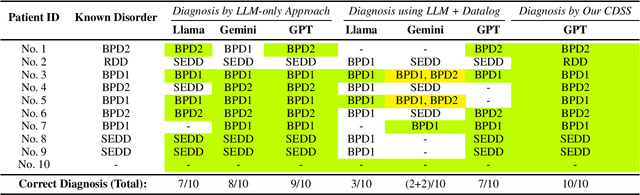
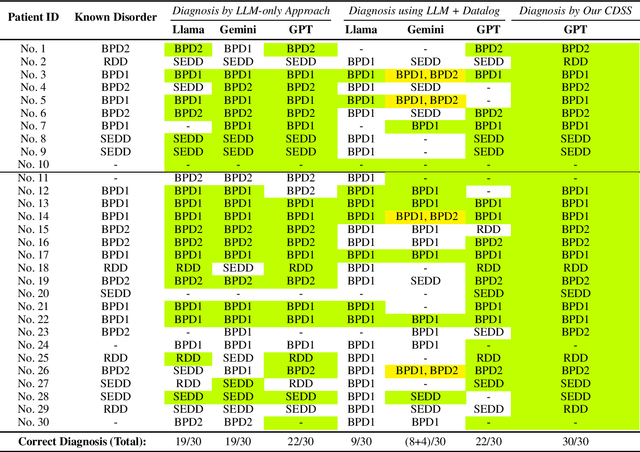
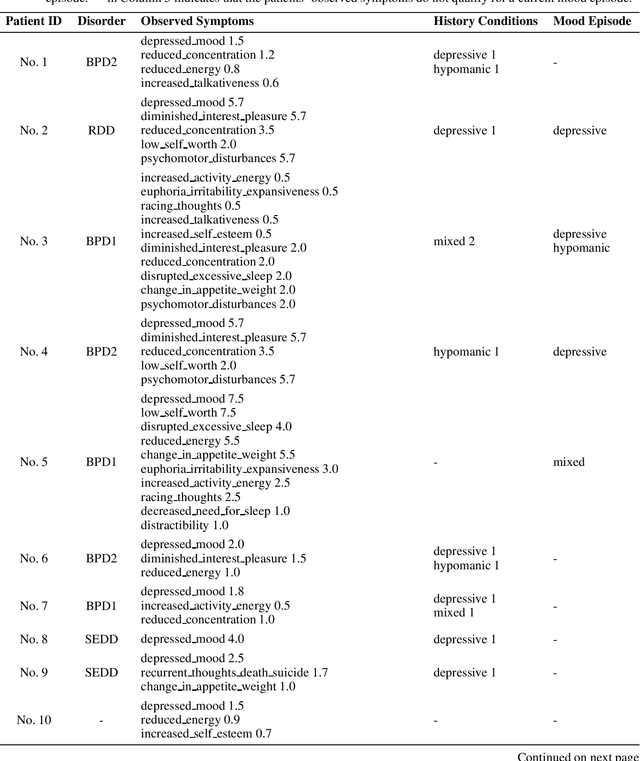
We propose a clinical decision support system (CDSS) for mental health diagnosis that combines the strengths of large language models (LLMs) and constraint logic programming (CLP). Having a CDSS is important because of the high complexity of diagnostic manuals used by mental health professionals and the danger of diagnostic errors. Our CDSS is a software tool that uses an LLM to translate diagnostic manuals to a logic program and solves the program using an off-the-shelf CLP engine to query a patient's diagnosis based on the encoded rules and provided data. By giving domain experts the opportunity to inspect the LLM-generated logic program, and making modifications when needed, our CDSS ensures that the diagnosis is not only accurate but also interpretable. We experimentally compare it with two baseline approaches of using LLMs: diagnosing patients using the LLM-only approach, and using the LLM-generated logic program but without expert inspection. The results show that, while LLMs are extremely useful in generating candidate logic programs, these programs still require expert inspection and modification to guarantee faithfulness to the official diagnostic manuals. Additionally, ethical concerns arise from the direct use of patient data in LLMs, underscoring the need for a safer hybrid approach like our proposed method.
FairQuant: Certifying and Quantifying Fairness of Deep Neural Networks
Sep 05, 2024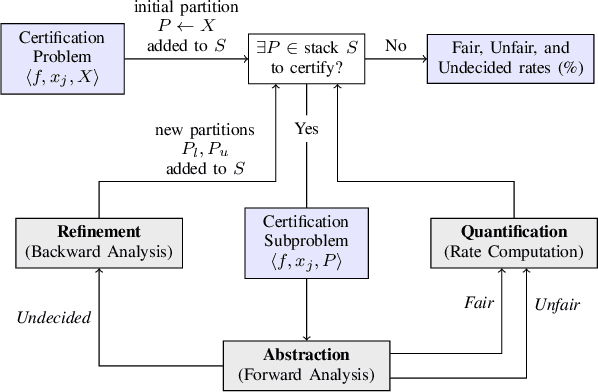
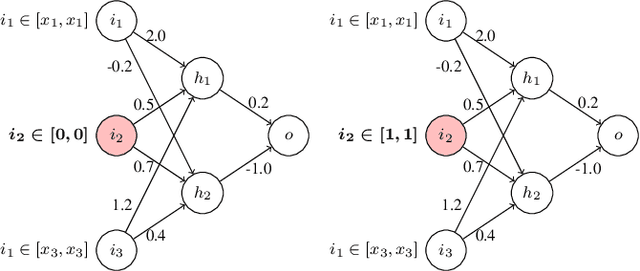
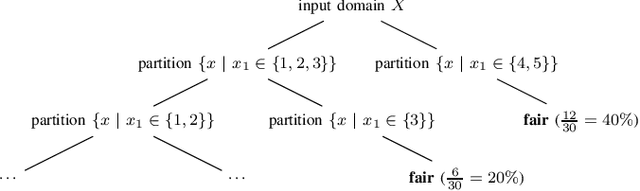
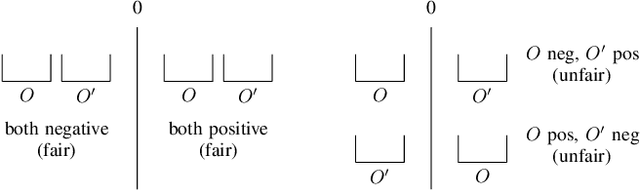
We propose a method for formally certifying and quantifying individual fairness of deep neural networks (DNN). Individual fairness guarantees that any two individuals who are identical except for a legally protected attribute (e.g., gender or race) receive the same treatment. While there are existing techniques that provide such a guarantee, they tend to suffer from lack of scalability or accuracy as the size and input dimension of the DNN increase. Our method overcomes this limitation by applying abstraction to a symbolic interval based analysis of the DNN followed by iterative refinement guided by the fairness property. Furthermore, our method lifts the symbolic interval based analysis from conventional qualitative certification to quantitative certification, by computing the percentage of individuals whose classification outputs are provably fair, instead of merely deciding if the DNN is fair. We have implemented our method and evaluated it on deep neural networks trained on four popular fairness research datasets. The experimental results show that our method is not only more accurate than state-of-the-art techniques but also several orders-of-magnitude faster.