 Add to Chrome
 Add to Firefox
 Add to Edge
Error-Conditioned Neural Solvers
Jun 25, 2026
Neural surrogate models offer fast approximate mappings from PDE parameters to solutions, but they typically treat solving as a purely statistical task: once trained, they struggle to correct their own constraint violations and extrapolate beyond the training distribution. Recent hybrid methods promote physical correctness by targeting the PDE residual via gradient descent or Gauss--Newton steps, but inherit the compute cost and instability of the underlying classical optimizers. We show, theoretically and empirically, that numerically minimizing the PDE residual can be an unreliable proxy for reconstruction accuracy in ill-conditioned systems, explaining why these methods often do not make accurate predictions despite achieving low residuals. We propose error-conditioned Neural Solvers (ENS), built on a different principle: rather than an optimization target, the PDE residual field is passed as a direct input to the network at each iteration, enabling it to read the spatial structure of its own errors and learn an update policy to iteratively correct its predictions. Across four PDE families, ENS attains the highest prediction accuracy in the large majority of settings, with gains reaching $10\times$ on turbulent Kolmogorov flow, while avoiding the expensive compute cost of hybrid methods. ENS's learned correction policy generalizes under distribution shift, including zero-shot parameter changes and cross-equation transfer, where its relative advantage is largest in the ill-conditioned regimes where residual minimization is least reliable. Project website: https://neuralsolver.github.io/.

Efficient Analysis of the Distilled Neural Tangent Kernel
Feb 11, 2026Neural tangent kernel (NTK) methods are computationally limited by the need to evaluate large Jacobians across many data points. Existing approaches reduce this cost primarily through projecting and sketching the Jacobian. We show that NTK computation can also be reduced by compressing the data dimension itself using NTK-tuned dataset distillation. We demonstrate that the neural tangent space spanned by the input data can be induced by dataset distillation, yielding a 20-100$\times$ reduction in required Jacobian calculations. We further show that per-class NTK matrices have low effective rank that is preserved by this reduction. Building on these insights, we propose the distilled neural tangent kernel (DNTK), which combines NTK-tuned dataset distillation with state-of-the-art projection methods to reduce up NTK computational complexity by up to five orders of magnitude while preserving kernel structure and predictive performance.
Persistent Classification: A New Approach to Stability of Data and Adversarial Examples
Apr 11, 2024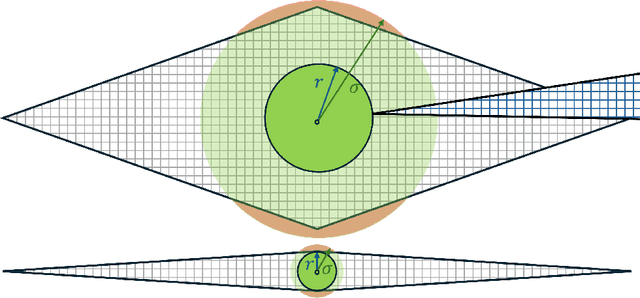
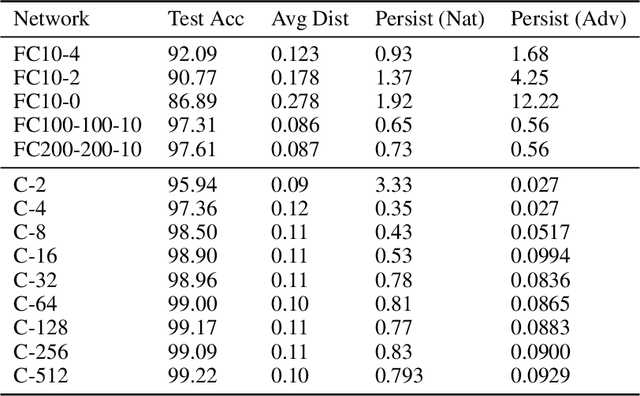

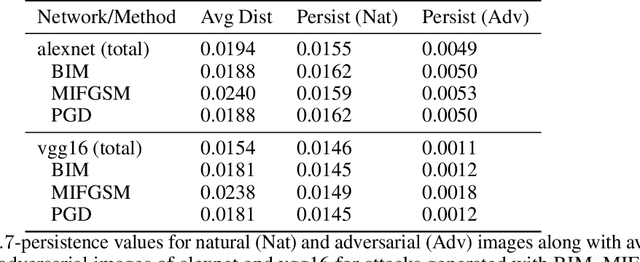
There are a number of hypotheses underlying the existence of adversarial examples for classification problems. These include the high-dimensionality of the data, high codimension in the ambient space of the data manifolds of interest, and that the structure of machine learning models may encourage classifiers to develop decision boundaries close to data points. This article proposes a new framework for studying adversarial examples that does not depend directly on the distance to the decision boundary. Similarly to the smoothed classifier literature, we define a (natural or adversarial) data point to be $(\gamma,\sigma)$-stable if the probability of the same classification is at least $\gamma$ for points sampled in a Gaussian neighborhood of the point with a given standard deviation $\sigma$. We focus on studying the differences between persistence metrics along interpolants of natural and adversarial points. We show that adversarial examples have significantly lower persistence than natural examples for large neural networks in the context of the MNIST and ImageNet datasets. We connect this lack of persistence with decision boundary geometry by measuring angles of interpolants with respect to decision boundaries. Finally, we connect this approach with robustness by developing a manifold alignment gradient metric and demonstrating the increase in robustness that can be achieved when training with the addition of this metric.
An Exact Kernel Equivalence for Finite Classification Models
Aug 09, 2023
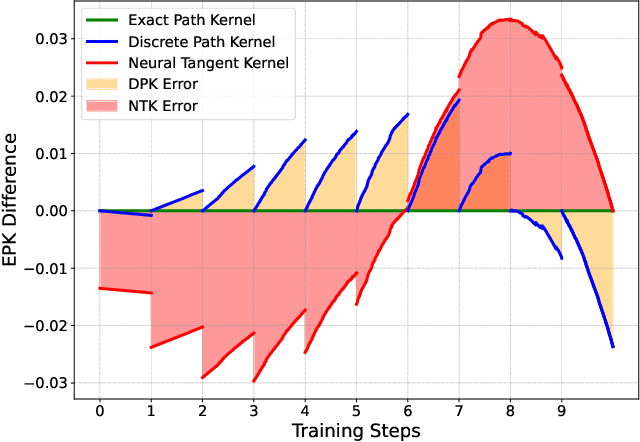

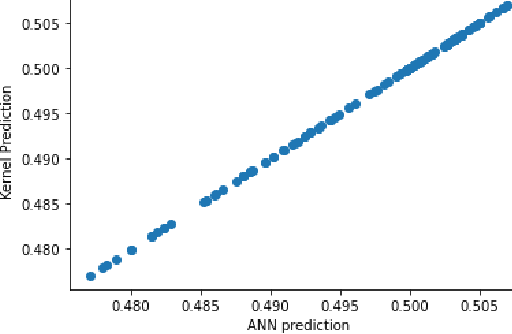
We explore the equivalence between neural networks and kernel methods by deriving the first exact representation of any finite-size parametric classification model trained with gradient descent as a kernel machine. We compare our exact representation to the well-known Neural Tangent Kernel (NTK) and discuss approximation error relative to the NTK and other non-exact path kernel formulations. We experimentally demonstrate that the kernel can be computed for realistic networks up to machine precision. We use this exact kernel to show that our theoretical contribution can provide useful insights into the predictions made by neural networks, particularly the way in which they generalize.