 Add to Chrome
 Add to Firefox
 Add to Edge
Multilingual Lexical Feature Analysis of Spoken Language for Predicting Major Depression Symptom Severity
Nov 10, 2025
Background: Captured between clinical appointments using mobile devices, spoken language has potential for objective, more regular assessment of symptom severity and earlier detection of relapse in major depressive disorder. However, research to date has largely been in non-clinical cross-sectional samples of written language using complex machine learning (ML) approaches with limited interpretability. Methods: We describe an initial exploratory analysis of longitudinal speech data and PHQ-8 assessments from 5,836 recordings of 586 participants in the UK, Netherlands, and Spain, collected in the RADAR-MDD study. We sought to identify interpretable lexical features associated with MDD symptom severity with linear mixed-effects modelling. Interpretable features and high-dimensional vector embeddings were also used to test the prediction performance of four regressor ML models. Results: In English data, MDD symptom severity was associated with 7 features including lexical diversity measures and absolutist language. In Dutch, associations were observed with words per sentence and positive word frequency; no associations were observed in recordings collected in Spain. The predictive power of lexical features and vector embeddings was near chance level across all languages. Limitations: Smaller samples in non-English speech and methodological choices, such as the elicitation prompt, may have also limited the effect sizes observable. A lack of NLP tools in languages other than English restricted our feature choice. Conclusion: To understand the value of lexical markers in clinical research and practice, further research is needed in larger samples across several languages using improved protocols, and ML models that account for within- and between-individual variations in language.

DenseNet and Support Vector Machine classifications of major depressive disorder using vertex-wise cortical features
Nov 18, 2023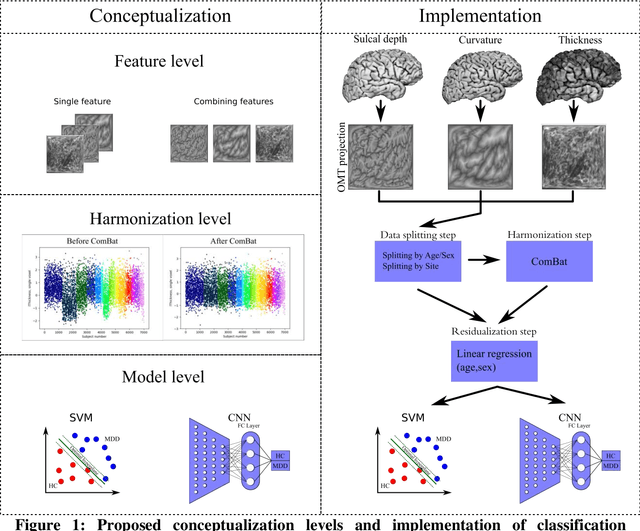
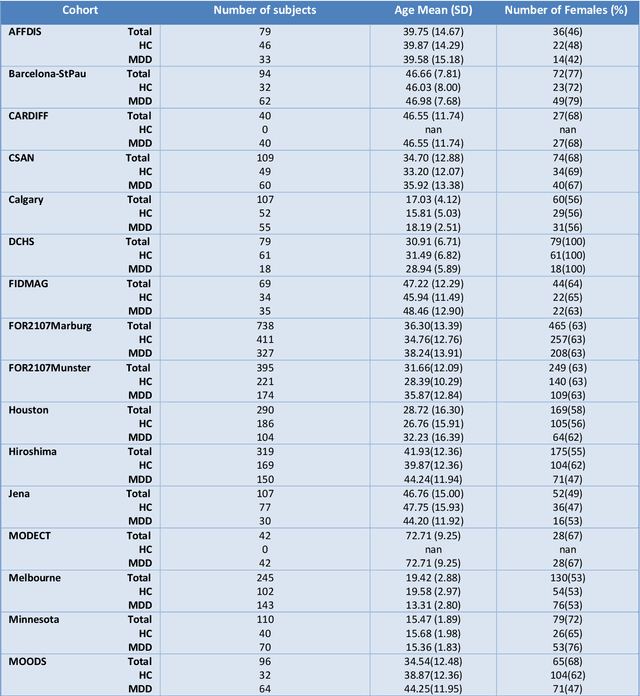

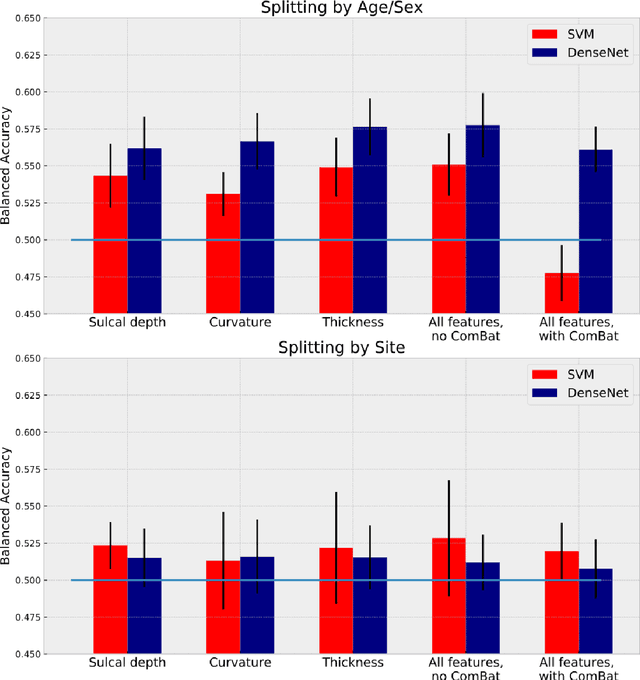
Major depressive disorder (MDD) is a complex psychiatric disorder that affects the lives of hundreds of millions of individuals around the globe. Even today, researchers debate if morphological alterations in the brain are linked to MDD, likely due to the heterogeneity of this disorder. The application of deep learning tools to neuroimaging data, capable of capturing complex non-linear patterns, has the potential to provide diagnostic and predictive biomarkers for MDD. However, previous attempts to demarcate MDD patients and healthy controls (HC) based on segmented cortical features via linear machine learning approaches have reported low accuracies. In this study, we used globally representative data from the ENIGMA-MDD working group containing an extensive sample of people with MDD (N=2,772) and HC (N=4,240), which allows a comprehensive analysis with generalizable results. Based on the hypothesis that integration of vertex-wise cortical features can improve classification performance, we evaluated the classification of a DenseNet and a Support Vector Machine (SVM), with the expectation that the former would outperform the latter. As we analyzed a multi-site sample, we additionally applied the ComBat harmonization tool to remove potential nuisance effects of site. We found that both classifiers exhibited close to chance performance (balanced accuracy DenseNet: 51%; SVM: 53%), when estimated on unseen sites. Slightly higher classification performance (balanced accuracy DenseNet: 58%; SVM: 55%) was found when the cross-validation folds contained subjects from all sites, indicating site effect. In conclusion, the integration of vertex-wise morphometric features and the use of the non-linear classifier did not lead to the differentiability between MDD and HC. Our results support the notion that MDD classification on this combination of features and classifiers is unfeasible.