 Add to Chrome
 Add to Firefox
 Add to Edge
Wideband Direct Satellite Uplink Enabled by Pilot-less Sparse Superposition Codes
Apr 22, 2026
Direct satellite uplink is severely constrained by limited link budgets, which hinder the exploitation of wideband resources, and ultimately limit the throughout. This paper presents a pilot-less coded modulation scheme based on sparse superposition coding (SSC) to enable efficient wideband usage in coverage-limited scenarios. This scheme leverages the structured Zadoff-Chu quasi-orthogonal (ZC-QO) dictionary to support scalable transmission. To address decoding complexity, the SSC transmitted signal embeds root index information via indicator sequences, allowing the receiver to restrict the decoding search space. In addition, a multi-codeword transmission framework with repetition and stop-feedback is developed, enabling reliable communication and better resource utilization. Simulation results show that the proposed scheme achieves throughput gains compared to a more conventional narrow-band multi-dimensional constellation-based approach.

Permutation Polynomial Interleaved Zadoff-Chu Sequences
Jun 28, 2023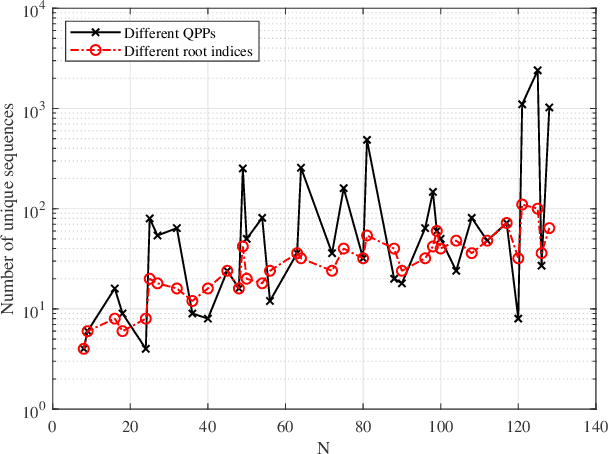
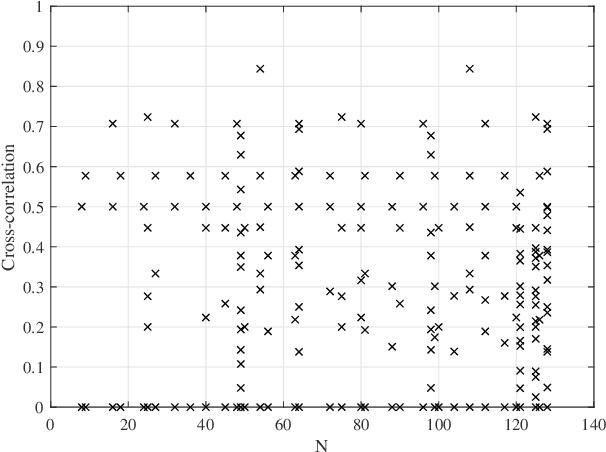
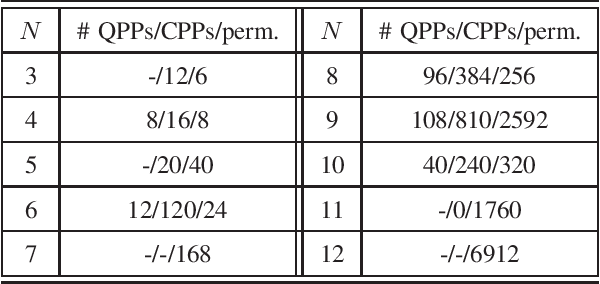
Constant amplitude zero autocorrelation (CAZAC) sequences have modulus one and ideal periodic autocorrelation function. Such sequences have been used in communications systems, e.g., for reference signals, synchronization signals and random access preambles. We propose a new family CAZAC sequences, which is constructed by interleaving a Zadoff-Chu sequence by a quadratic permutation polynomial (QPP), or by a permutation polynomial whose inverse is a QPP. It is demonstrated that a set of orthogonal interleaved Zadoff-Chu sequences can be constructed by proper choice of QPPs.
Joint radar and communications with multicarrier chirp-based waveform
Jun 09, 2022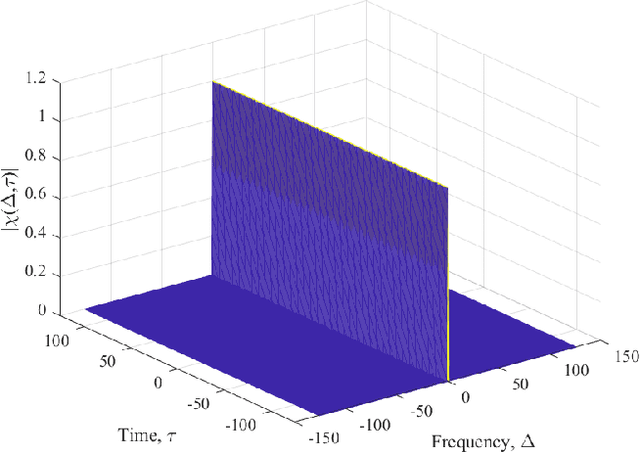
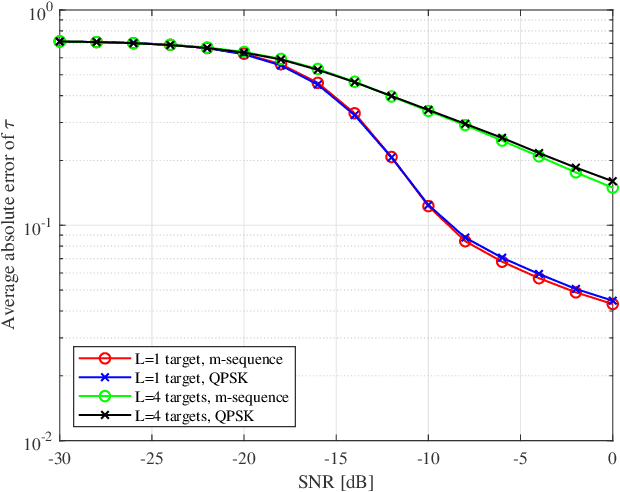
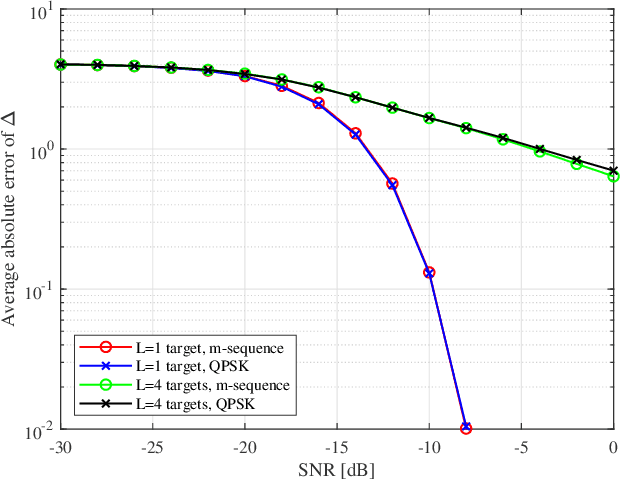
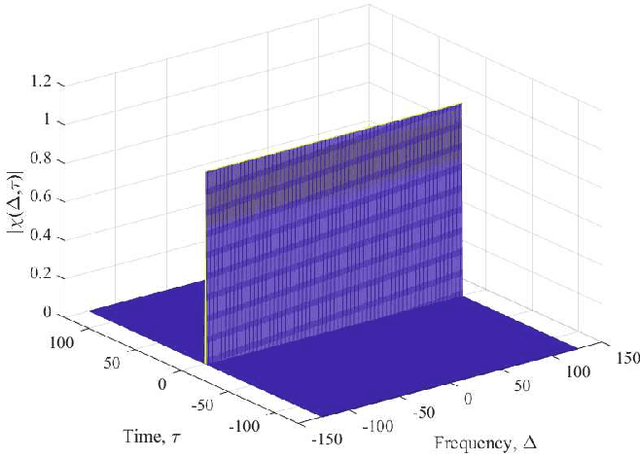
We consider a multicarrier chirp-based waveform for joint radar and communication (JRC) systems and derive its time discrete periodic ambiguity function (AF). An advantage of the waveform is that it includes a set of waveform parameters (e.g., chirp rate) which together with the transmit sequence, can be selected to flexibly shape the AF to be thumbtack-like, or to be ridge-like, either along the delay axis or the Doppler axis. These shapes are applicable for different use cases, e.g., target detection or time- and frequency synchronization. The results show that better signal detection performance than OFDM and DFT-s-OFDM can be achieved on channels with large Doppler frequency. Furthermore, it is shown how transmit sequences can be selected in order to achieve 0 dB peak-to-average-power-ratio (PAPR) of the waveform.
Deep Extended Feedback Codes
May 04, 2021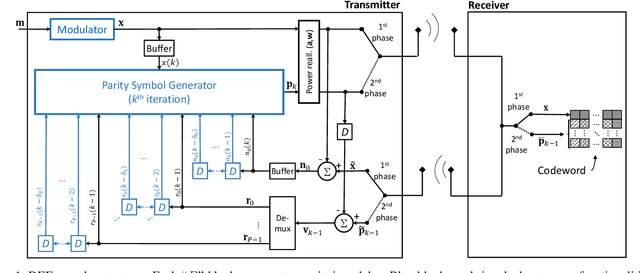
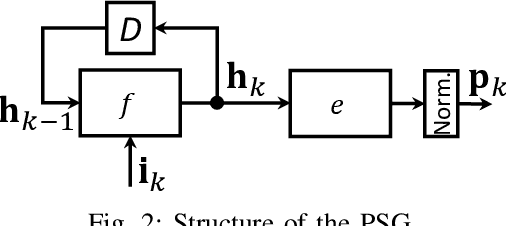
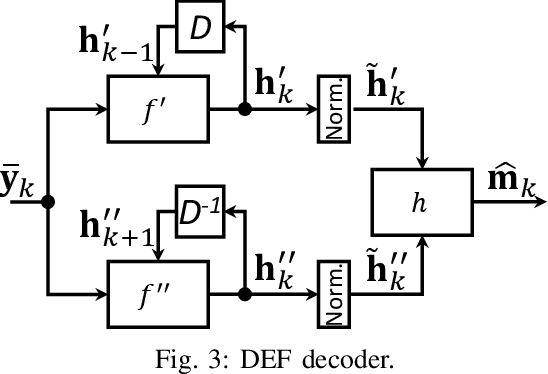
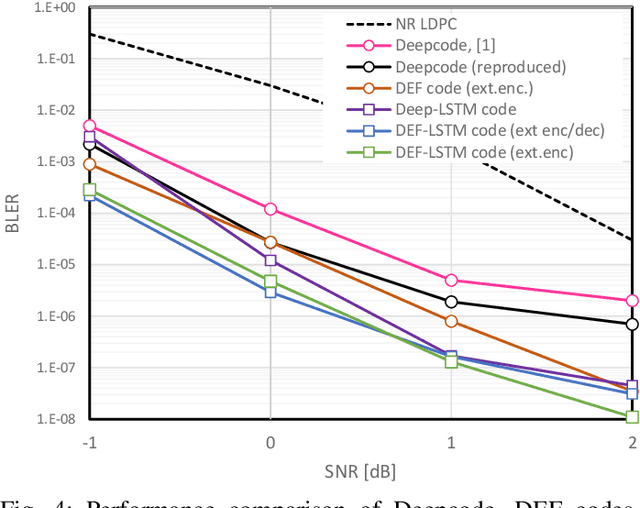
A new deep-neural-network (DNN) based error correction encoder architecture for channels with feedback, called Deep Extended Feedback (DEF), is presented in this paper. The encoder in the DEF architecture transmits an information message followed by a sequence of parity symbols which are generated based on the message as well as the observations of the past forward channel outputs sent to the transmitter through a feedback channel. DEF codes generalize Deepcode [1] in several ways: parity symbols are generated based on forward-channel output observations over longer time intervals in order to provide better error correction capability; and high-order modulation formats are deployed in the encoder so as to achieve increased spectral efficiency. Performance evaluations show that DEF codes have better performance compared to other DNN-based codes for channels with feedback.