 Add to Chrome
 Add to Firefox
 Add to Edge
A Further Efficient Algorithm with Best-of-Both-Worlds Guarantees for $m$-Set Semi-Bandit Problem
Mar 12, 2026
This paper studies the optimality and complexity of Follow-the-Perturbed-Leader (FTPL) policy in $m$-set semi-bandit problems. FTPL has been studied extensively as a promising candidate of an efficient algorithm with favorable regret for adversarial combinatorial semi-bandits. Nevertheless, the optimality of FTPL has still been unknown unlike Follow-the-Regularized-Leader (FTRL) whose optimality has been proved for various tasks of online learning. In this paper, we extend the analysis of FTPL with geometric resampling (GR) to $m$-set semi-bandits, which is a special case of combinatorial semi-bandits, showing that FTPL with Fréchet and Pareto distributions with certain parameters achieves the best possible regret of $O(\sqrt{mdT})$ in adversarial setting. We also show that FTPL with Fréchet and Pareto distributions with a certain parameter achieves a logarithmic regret for stochastic setting, meaning the Best-of-Both-Worlds optimality of FTPL for $m$-set semi-bandit problems. Furthermore, we extend the conditional geometric resampling to $m$-set semi-bandits for efficient loss estimation in FTPL, reducing the computational complexity from $O(d^2)$ of the original geometric resampling to $O(md(\log(d/m)+1))$ without sacrificing the regret performance.

The Llama 4 Herd: Architecture, Training, Evaluation, and Deployment Notes
Jan 15, 2026This document consolidates publicly reported technical details about Metas Llama 4 model family. It summarizes (i) released variants (Scout and Maverick) and the broader herd context including the previewed Behemoth teacher model, (ii) architectural characteristics beyond a high-level MoE description covering routed/shared-expert structure, early-fusion multimodality, and long-context design elements reported for Scout (iRoPE and length generalization strategies), (iii) training disclosures spanning pre-training, mid-training for long-context extension, and post-training methodology (lightweight SFT, online RL, and lightweight DPO) as described in release materials, (iv) developer-reported benchmark results for both base and instruction-tuned checkpoints, and (v) practical deployment constraints observed across major serving environments, including provider-specific context limits and quantization packaging. The manuscript also summarizes licensing obligations relevant to redistribution and derivative naming, and reviews publicly described safeguards and evaluation practices. The goal is to provide a compact technical reference for researchers and practitioners who need precise, source-backed facts about Llama 4.
Note on Follow-the-Perturbed-Leader in Combinatorial Semi-Bandit Problems
Jun 14, 2025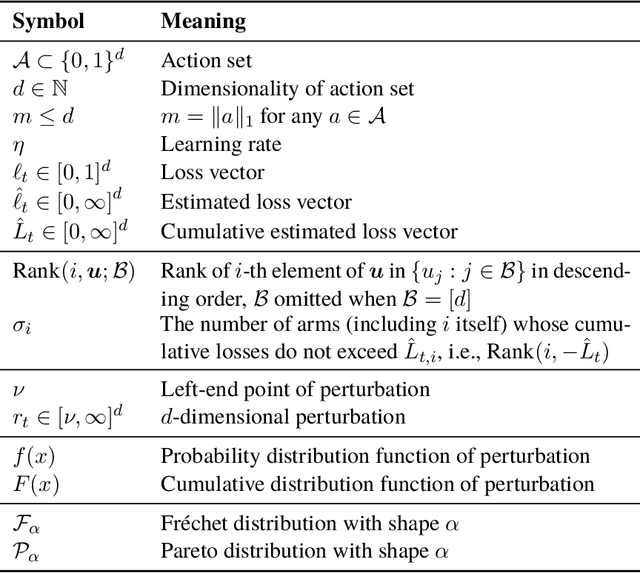
This paper studies the optimality and complexity of Follow-the-Perturbed-Leader (FTPL) policy in size-invariant combinatorial semi-bandit problems. Recently, Honda et al. (2023) and Lee et al. (2024) showed that FTPL achieves Best-of-Both-Worlds (BOBW) optimality in standard multi-armed bandit problems with Fr\'{e}chet-type distributions. However, the optimality of FTPL in combinatorial semi-bandit problems remains unclear. In this paper, we consider the regret bound of FTPL with geometric resampling (GR) in size-invariant semi-bandit setting, showing that FTPL respectively achieves $O\left(\sqrt{m^2 d^\frac{1}{\alpha}T}+\sqrt{mdT}\right)$ regret with Fr\'{e}chet distributions, and the best possible regret bound of $O\left(\sqrt{mdT}\right)$ with Pareto distributions in adversarial setting. Furthermore, we extend the conditional geometric resampling (CGR) to size-invariant semi-bandit setting, which reduces the computational complexity from $O(d^2)$ of original GR to $O\left(md\left(\log(d/m)+1\right)\right)$ without sacrificing the regret performance of FTPL.