 Add to Chrome
 Add to Firefox
 Add to Edge
CoToGrasp: Contact-Topology-Conditioned Dexterous Grasp Synthesis via Canonical Workspace Learning
Aug 20, 2026
Current dexterous grasp planners primarily optimize for physical stability, focusing on whether an object can be grasped rather than how it should be grasped to support downstream functional tasks. However, conditioning grasp synthesis on specific human grasp taxonomies typically requires prohibitively expensive, object-annotated datasets. To address these limitations, we propose CoToGrasp, a novel generative framework that synthesizes diverse, stable grasps strictly conditioned on specific contact topologies. To bypass the data collection bottleneck, CoToGrasp is trained entirely in an object-agnostic manner. We introduce a feature-based canonical workspace that projects local object features into a unified gripper-centric domain, effectively decoupling the semantic functional intent from the arbitrary object geometry. By learning the intrinsic contact manifold of the gripper within this workspace, our model achieves zero-shot generalization to unseen objects at inference. Extensive evaluations on the large-scale DexGraspNet dataset demonstrate that CoToGrasp achieves state-of-the-art performance, outperforming existing taxonomy-guided planners. Finally, we demonstrate the physical viability and kinematic feasibility of our synthesized contact topologies on a physical robot platform. Code is available on our project website https://cea-list.github.io/cotograspweb/ .
* Project website: https://cea-list.github.io/cotograspweb/

GOAG: Generative and Object-Agnostic Grasp Planner for Dexterous Robotic Manipulation
Aug 20, 2026Multifingered grasping is a crucial robotic skill, but current deep-learning grasp planners often struggle to generalize to new objects because they are trained on limited, object-specific datasets. We introduce a fundamentally different approach, grounded in the observation that the gripper and the object share identical surface geometry at their mutual contact points. We propose GOAG: Generative and Object-Agnostic Grasp Planner for Dexterous Robotic Manipulation, a novel deep generative model that learns a compact latent representation of a specific gripper's contact surface distribution, enabling the efficient sampling of valid grasp configurations without relying on object-specific training data. We show that by introducing object features only at inference time, our model can effectively retrieve admissible contact areas that are compatible with the gripper's capabilities. We validate our approach through extensive experiments on established grasp protocols in both simulated and real-world scenarios, demonstrating its effectiveness with different grippers from the literature. Our method delivers state-of-the-art results on the objects from the MultiDex dataset, achieving an average success rate of 86.93%. It offers significantly faster processing when generating numerous grasps, while matching the performance of leading approaches specifically trained on this dataset. Unlike these methods, our approach does not rely on object-specific training data, highlighting the advantages of object-agnostic learning. It effectively addresses the generalization challenges faced by traditional data-driven grasp planners. Code and videos are available on our project website https://cea-list.github.io/goagweb/ .
* Project website: https://cea-list.github.io/goagweb/
Corr2Distrib: Making Ambiguous Correspondences an Ally to Predict Reliable 6D Pose Distributions
May 05, 2025We introduce Corr2Distrib, the first correspondence-based method which estimates a 6D camera pose distribution from an RGB image, explaining the observations. Indeed, symmetries and occlusions introduce visual ambiguities, leading to multiple valid poses. While a few recent methods tackle this problem, they do not rely on local correspondences which, according to the BOP Challenge, are currently the most effective way to estimate a single 6DoF pose solution. Using correspondences to estimate a pose distribution is not straightforward, since ambiguous correspondences induced by visual ambiguities drastically decrease the performance of PnP. With Corr2Distrib, we turn these ambiguities into an advantage to recover all valid poses. Corr2Distrib first learns a symmetry-aware representation for each 3D point on the object's surface, characterized by a descriptor and a local frame. This representation enables the generation of 3DoF rotation hypotheses from single 2D-3D correspondences. Next, we refine these hypotheses into a 6DoF pose distribution using PnP and pose scoring. Our experimental evaluations on complex non-synthetic scenes show that Corr2Distrib outperforms state-of-the-art solutions for both pose distribution estimation and single pose estimation from an RGB image, demonstrating the potential of correspondences-based approaches.
BOP-D: Revisiting 6D Pose Estimation Benchmark for Better Evaluation under Visual Ambiguities
Aug 30, 2024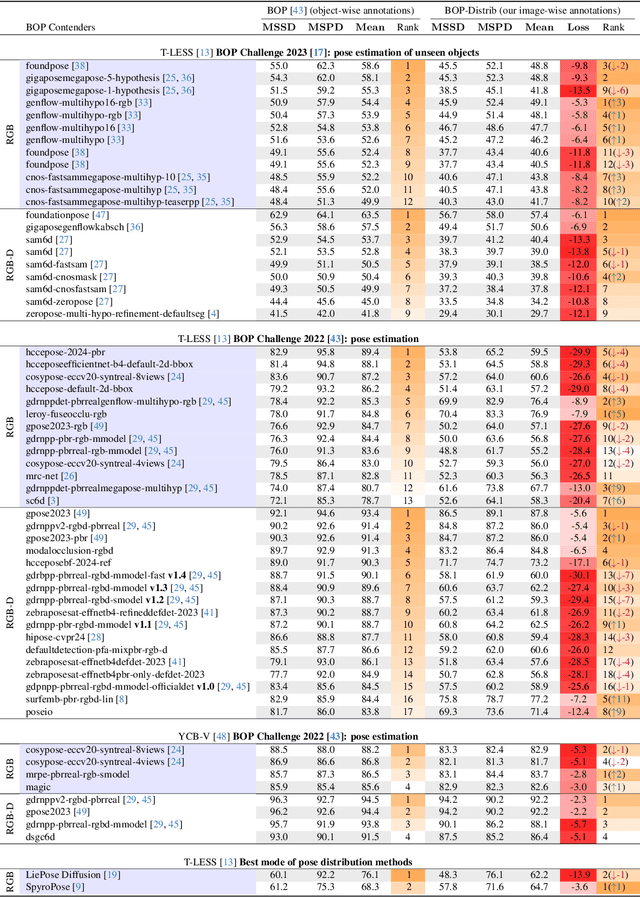
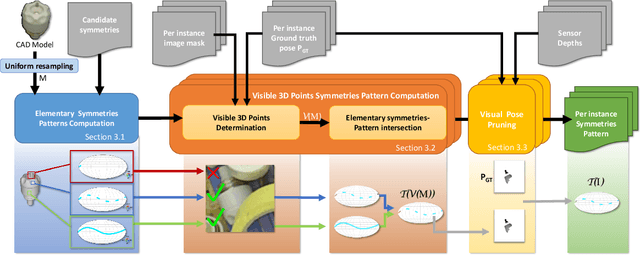

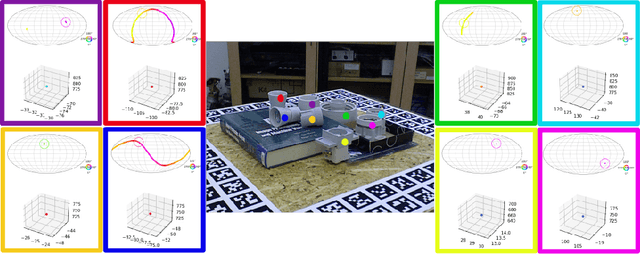
Currently, 6D pose estimation methods are benchmarked on datasets that consider, for their ground truth annotations, visual ambiguities as only related to global object symmetries. However, as previously observed [26], visual ambiguities can also happen depending on the viewpoint or the presence of occluding objects, when disambiguating parts become hidden. The visual ambiguities are therefore actually different across images. We thus first propose an automatic method to re-annotate those datasets with a 6D pose distribution specific to each image, taking into account the visibility of the object surface in the image to correctly determine the visual ambiguities. Given this improved ground truth, we re-evaluate the state-of-the-art methods and show this greatly modify the ranking of these methods. Our annotations also allow us to benchmark recent methods able to estimate a pose distribution on real images for the first time. We will make our annotations for the T-LESS dataset and our code publicly available.