 Add to Chrome
 Add to Firefox
 Add to Edge
Atomic Action Slicing: Planner-Aligned Options for Generalist VLA Agents
Dec 12, 2025
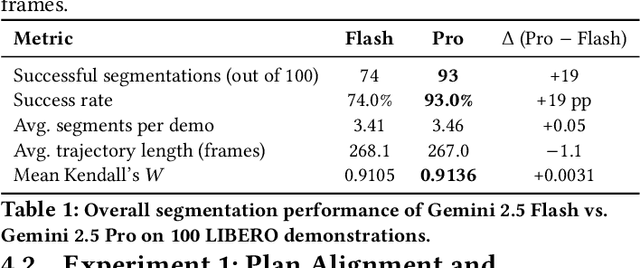
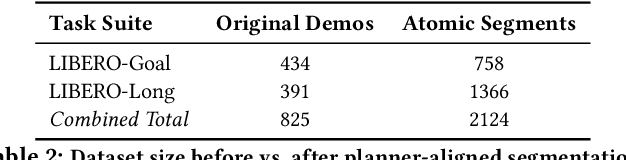
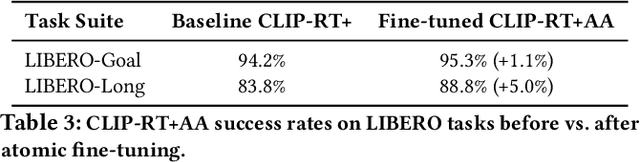
Current vision-language-action (VLA) models generalize poorly, particularly when tasks require new compositions of skills or objects. We introduce Atomic Action Slicing (AAS), a planner-aligned approach that decomposes long-horizon demonstrations into short, typed atomic actions that are easier for planners to use and policies to learn. Using LIBERO demonstrations, AAS produces a validated dataset of 2,124 atomic segments labeled with action type, temporal span, and confidence. A stronger segmenter (Gemini 2.5 Pro) closely matches planner-defined plans and remains robust under keyframe jitter, while smaller models perform worse on multi-object tasks. Fine-tuning CLIP-RT+ on our atomic dataset improves task success from 94.2% to 95.3% on LIBERO-Goal and 83.8% to 88.8% on LIBERO-Long. We publicly release the GATE-VLAP dataset on HuggingFace(https://huggingface.co/datasets/gate-institute/GATE-VLAP-datasets)

FedSym: Unleashing the Power of Entropy for Benchmarking the Algorithms for Federated Learning
Oct 11, 2023Federated learning (FL) is a decentralized machine learning approach where independent learners process data privately. Its goal is to create a robust and accurate model by aggregating and retraining local models over multiple rounds. However, FL faces challenges regarding data heterogeneity and model aggregation effectiveness. In order to simulate real-world data, researchers use methods for data partitioning that transform a dataset designated for centralized learning into a group of sub-datasets suitable for distributed machine learning with different data heterogeneity. In this paper, we study the currently popular data partitioning techniques and visualize their main disadvantages: the lack of precision in the data diversity, which leads to unreliable heterogeneity indexes, and the inability to incrementally challenge the FL algorithms. To resolve this problem, we propose a method that leverages entropy and symmetry to construct 'the most challenging' and controllable data distributions with gradual difficulty. We introduce a metric to measure data heterogeneity among the learning agents and a transformation technique that divides any dataset into splits with precise data diversity. Through a comparative study, we demonstrate the superiority of our method over existing FL data partitioning approaches, showcasing its potential to challenge model aggregation algorithms. Experimental results indicate that our approach gradually challenges the FL strategies, and the models trained on FedSym distributions are more distinct.