 Add to Chrome
 Add to Firefox
 Add to Edge
Predicting Brain Morphometry with MT-GNN: Mesh Evolution in Continuous Time with Graph-Based Metric Tensor Embeddings
Aug 05, 2026
Predicting how a subcortical structure's shape will evolve from a few prior scans could support prognosis and clinical-trial enrichment. Existing longitudinal mesh predictors either extrapolate shape trajectories via high-dimensional embeddings or regress vertex deformations directly. We instead predict the surface's intrinsic geometry in continuous time: a single per-structure graph network predicts the future per-vertex first fundamental form (metric tensor) for an arbitrary causal multiple-visit history and an arbitrary prediction horizon, conditioned on a Fourier encoding of the lead time. The predicted metric is decoded into a surface by a differentiable As-Rigid-As-Possible solver, and the model is trained end-to-end on the rigid-aligned vertex error. Training through the reconstruction keeps the decoded prediction a valid surface and consistently improves it. On 14 subcortical structures from the ADNI dataset, the proposed mesh evolution model (MT-GNN) predicts best among the evaluated methods at every horizon ($-2.29\%$ mean vertex error vs. the temporal mean, $p{=}6.1{\times}10^{-5}$, beating it on 14/14 structures), ahead of geodesic shape regression (DCM, $-0.19\%$) and a mesh transformer (TransforMesh, $-0.45\%$; $p{=}1.2{\times}10^{-4}$), with the lead widening as the horizon grows.

SMART: A Flexible, Interpretable, and Scalable Spatio-temporal Brain Atlas from High-Resolution Imaging Data
Jun 17, 2026We introduce SMART, a framework for learning a flexible, interpretable, and scalable spatio-temporal brain atlas from longitudinal high-resolution 3D medical images. Existing approaches to spatio-temporal atlas construction rely on black-box generative models that lack flexibility, limit interpretability, and struggle to scale to high-dimensional data. SMART addresses these challenges by learning a continuous disease-time atlas that decouples global group-wise disease dynamics from their patient-specific anatomical manifestation. Guided by anatomically inspired priors, SMART models interpretable global trajectories of regional progression along a shared disease timeline through region-specific differential equations. Global trajectories are further personalized to individual anatomies via dense diffeomorphic displacements parameterized by a flexible and scalable multi-scale Neural Cellular Automata. Evaluated on five longitudinal MRI datasets in Alzheimer's disease (ADNI-1/GO/2, OASIS-3, AIBL; > 1,300 subjects), SMART produces anatomically meaningful predictions of disease progression and achieves state-of-the-art forecasting accuracy and improved temporal consistency over adversarial and diffusion baselines. Our approach establishes a new paradigm for flexible, interpretable, and scalable modeling of spatio-temporal change in high-dimensional medical image time-series.
Federated Learning in Distributed Medical Databases: Meta-Analysis of Large-Scale Subcortical Brain Data
Oct 22, 2018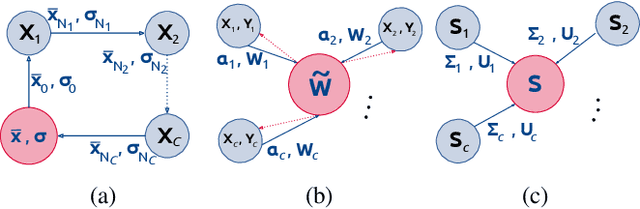

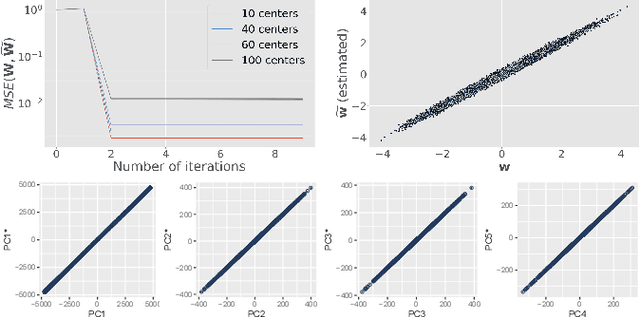
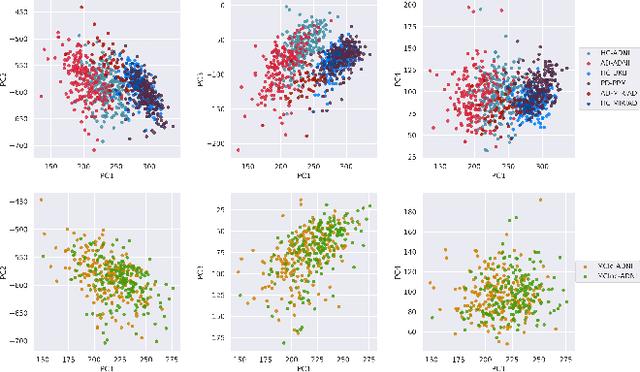
At this moment, databanks worldwide contain brain images of previously unimaginable numbers. Combined with developments in data science, these massive data provide the potential to better understand the genetic underpinnings of brain diseases. However, different datasets, which are stored at different institutions, cannot always be shared directly due to privacy and legal concerns, thus limiting the full exploitation of big data in the study of brain disorders. Here we propose a federated learning framework for securely accessing and meta-analyzing any biomedical data without sharing individual information. We illustrate our framework by investigating brain structural relationships across diseases and clinical cohorts. The framework is first tested on synthetic data and then applied to multi-centric, multi-database studies including ADNI, PPMI, MIRIAD and UK Biobank, showing the potential of the approach for further applications in distributed analysis of multi-centric cohorts
Connectivity-Driven Brain Parcellation via Consensus Clustering
Aug 10, 2018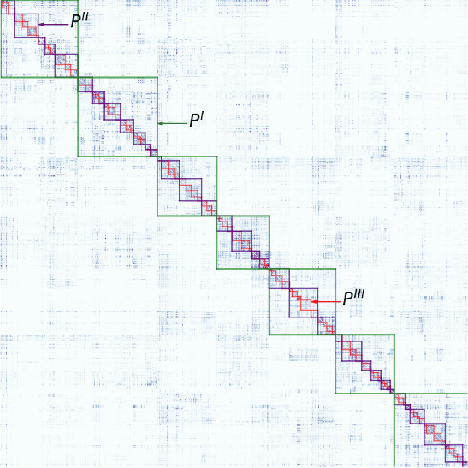
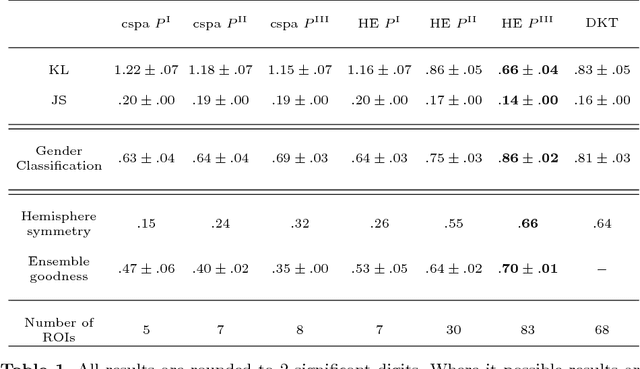
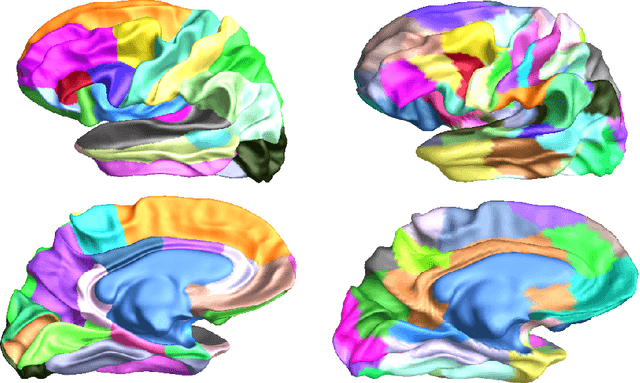
We present two related methods for deriving connectivity-based brain atlases from individual connectomes. The proposed methods exploit a previously proposed dense connectivity representation, termed continuous connectivity, by first performing graph-based hierarchical clustering of individual brains, and subsequently aggregating the individual parcellations into a consensus parcellation. The search for consensus minimizes the sum of cluster membership distances, effectively estimating a pseudo-Karcher mean of individual parcellations. We assess the quality of our parcellations using (1) Kullback-Liebler and Jensen-Shannon divergence with respect to the dense connectome representation, (2) inter-hemispheric symmetry, and (3) performance of the simplified connectome in a biological sex classification task. We find that the parcellation based-atlas computed using a greedy search at a hierarchical depth 3 outperforms all other parcellation-based atlases as well as the standard Dessikan-Killiany anatomical atlas in all three assessments.
Evaluating 35 Methods to Generate Structural Connectomes Using Pairwise Classification
Jun 19, 2017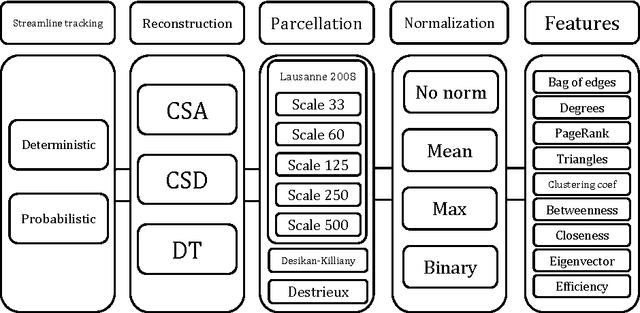
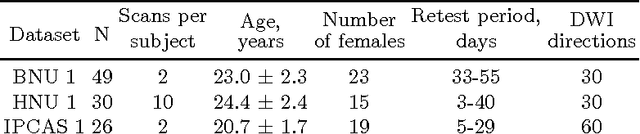
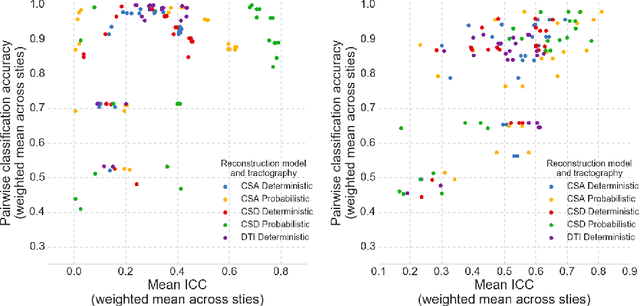
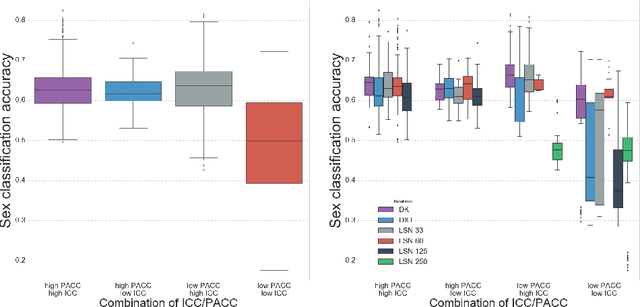
There is no consensus on how to construct structural brain networks from diffusion MRI. How variations in pre-processing steps affect network reliability and its ability to distinguish subjects remains opaque. In this work, we address this issue by comparing 35 structural connectome-building pipelines. We vary diffusion reconstruction models, tractography algorithms and parcellations. Next, we classify structural connectome pairs as either belonging to the same individual or not. Connectome weights and eight topological derivative measures form our feature set. For experiments, we use three test-retest datasets from the Consortium for Reliability and Reproducibility (CoRR) comprised of a total of 105 individuals. We also compare pairwise classification results to a commonly used parametric test-retest measure, Intraclass Correlation Coefficient (ICC).
Structural Connectome Validation Using Pairwise Classification
Jan 30, 2017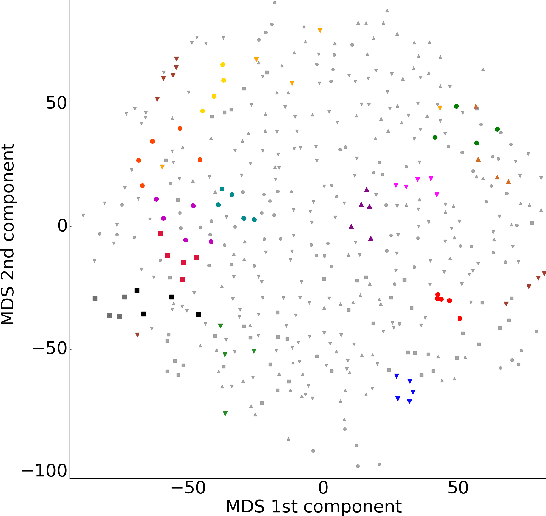
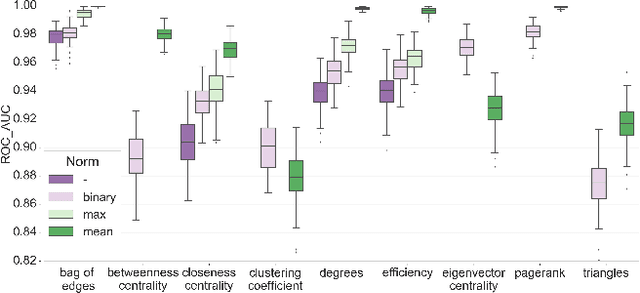
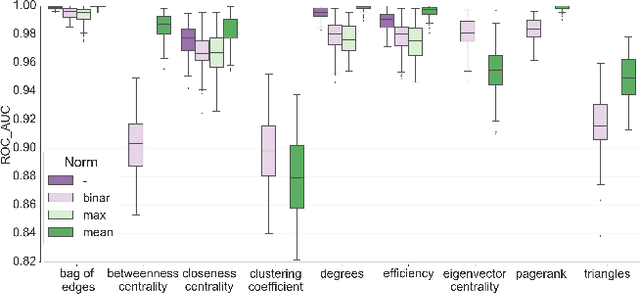
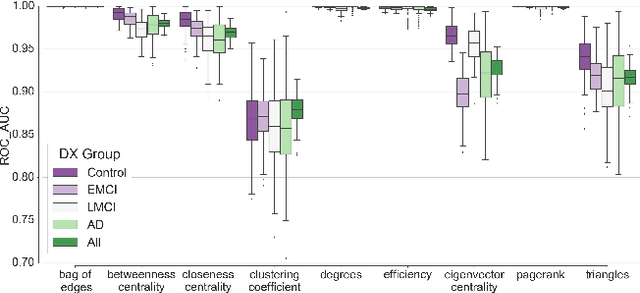
In this work, we study the extent to which structural connectomes and topological derivative measures are unique to individual changes within human brains. To do so, we classify structural connectome pairs from two large longitudinal datasets as either belonging to the same individual or not. Our data is comprised of 227 individuals from the Alzheimer's Disease Neuroimaging Initiative (ADNI) and 226 from the Parkinson's Progression Markers Initiative (PPMI). We achieve 0.99 area under the ROC curve score for features which represent either weights or network structure of the connectomes (node degrees, PageRank and local efficiency). Our approach may be useful for eliminating noisy features as a preprocessing step in brain aging studies and early diagnosis classification problems.
Proceedings of the Workshop on Brain Analysis using COnnectivity Networks - BACON 2016
Nov 24, 2016Understanding brain connectivity in a network-theoretic context has shown much promise in recent years. This type of analysis identifies brain organisational principles, bringing a new perspective to neuroscience. At the same time, large public databases of connectomic data are now available. However, connectome analysis is still an emerging field and there is a crucial need for robust computational methods to fully unravelits potential. This workshop provides a platform to discuss the development of new analytic techniques; methods for evaluating and validating commonly used approaches; as well as the effects of variations in pre-processing steps.