 Add to Chrome
 Add to Firefox
 Add to Edge
Label Granularity Skew in Federated Learning with Hierarchical Image Classification
Aug 10, 2026
Federated learning enables privacy-preserving collaboration across distributed devices without centralizing local data. However, clients may differ not only in data distributions but also in domain knowledge and annotation capabilities. In this paper, we introduce label granularity skew, a new form of statistical heterogeneity in federated hierarchical classification, in which clients provide taxonomy-consistent labels at different levels of detail within a shared class hierarchy. To model this heterogeneity, we generate client-specific local label hierarchies using a probabilistic relational neighbor classifier and construct a WordNet-guided hierarchy via silhouette score-based coarsening. Our analysis shows that strongly coupled hierarchical models are sensitive to incomplete supervision, while the conditional softmax classifier is more robust. Based on this insight, we propose Branch-wise Decoupled Fine-Tuning (BDFT) and its federated version, FedBDFT, which fine-tune branch-wise classifiers and aggregate them through federated optimization. Experiments on CIFAR-100, TinyImageNet, and ImageNet show that FedBDFT substantially improves robustness under severe label granularity skew, with average gains of 27.9% and 56.4% at skewness levels of 0.6 and 0.9, respectively. Zero-shot results further indicate that FedBDFT better preserves hierarchical representations for unseen fine-grained classes. These findings demonstrate its effectiveness for federated hierarchical classification with heterogeneous label granularities.

Efficient and Privacy Preserving Group Signature for Federated Learning
Jul 15, 2022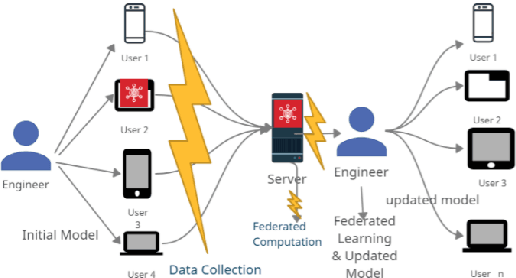
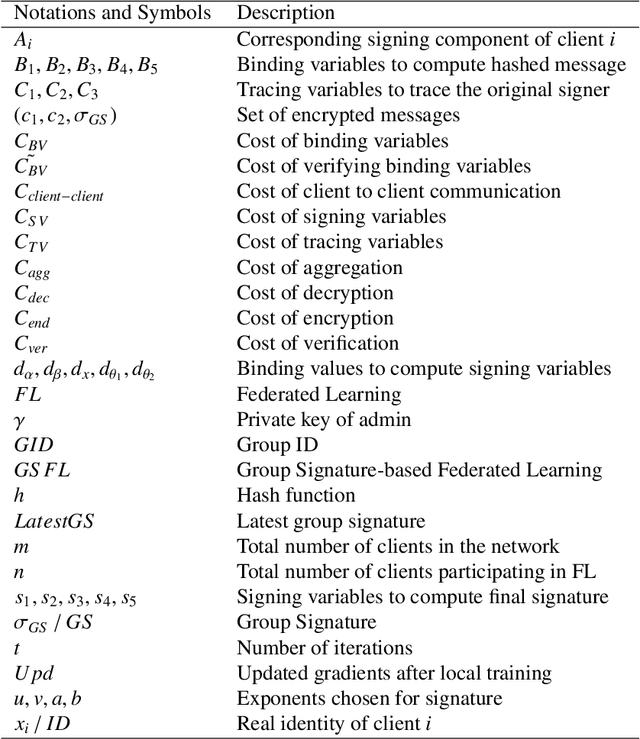
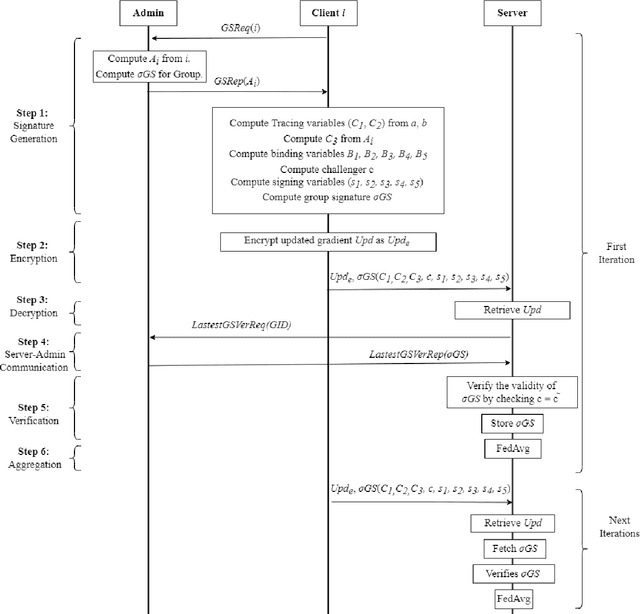
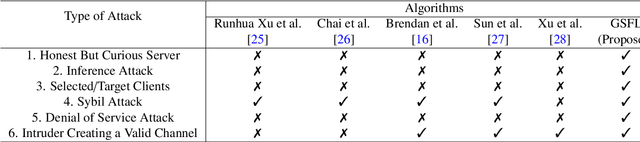
Federated Learning (FL) is a Machine Learning (ML) technique that aims to reduce the threats to user data privacy. Training is done using the raw data on the users' device, called clients, and only the training results, called gradients, are sent to the server to be aggregated and generate an updated model. However, we cannot assume that the server can be trusted with private information, such as metadata related to the owner or source of the data. So, hiding the client information from the server helps reduce privacy-related attacks. Therefore, the privacy of the client's identity, along with the privacy of the client's data, is necessary to make such attacks more difficult. This paper proposes an efficient and privacy-preserving protocol for FL based on group signature. A new group signature for federated learning, called GSFL, is designed to not only protect the privacy of the client's data and identity but also significantly reduce the computation and communication costs considering the iterative process of federated learning. We show that GSFL outperforms existing approaches in terms of computation, communication, and signaling costs. Also, we show that the proposed protocol can handle various security attacks in the federated learning environment.
Next Generation Business Intelligence and Analytics: A Survey
Apr 11, 2017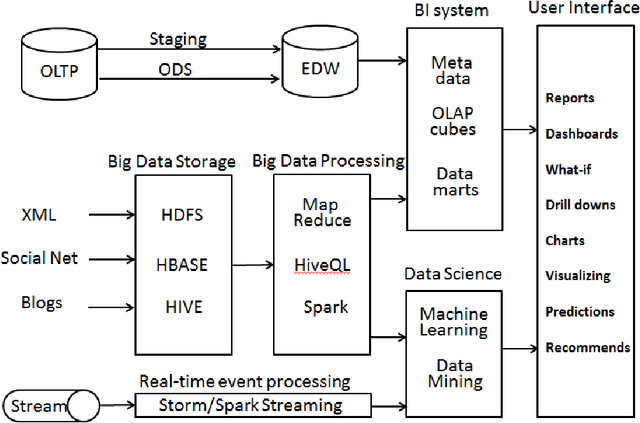
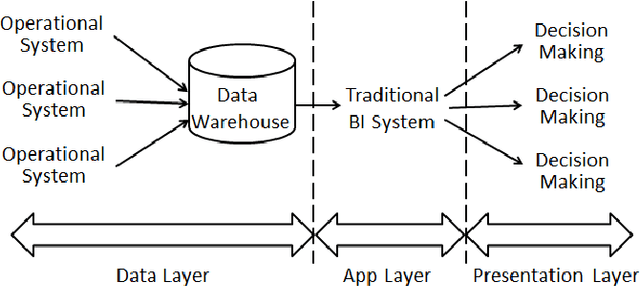
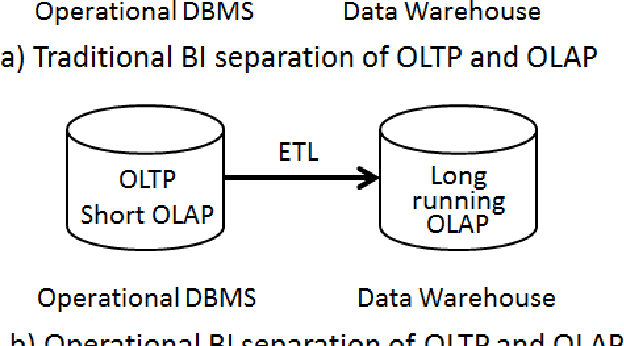
Business Intelligence and Analytics (BI&A) is the process of extracting and predicting business-critical insights from data. Traditional BI focused on data collection, extraction, and organization to enable efficient query processing for deriving insights from historical data. With the rise of big data and cloud computing, there are many challenges and opportunities for the BI. Especially with the growing number of data sources, traditional BI\&A are evolving to provide intelligence at different scales and perspectives - operational BI, situational BI, self-service BI. In this survey, we review the evolution of business intelligence systems in full scale from back-end architecture to and front-end applications. We focus on the changes in the back-end architecture that deals with the collection and organization of the data. We also review the changes in the front-end applications, where analytic services and visualization are the core components. Using a uses case from BI in Healthcare, which is one of the most complex enterprises, we show how BI\&A will play an important role beyond the traditional usage. The survey provides a holistic view of Business Intelligence and Analytics for anyone interested in getting a complete picture of the different pieces in the emerging next generation BI\&A solutions.