 Add to Chrome
 Add to Firefox
 Add to Edge
Prospective Compression in Human Abstraction Learning
May 11, 2026
A core challenge in program synthesis is online library learning: the incremental acquisition of reusable abstractions under uncertainty about future task demands. Existing algorithms treat library learning as retrospective compression over a static task distribution, where the learned library is determined by the corpus of past tasks. However, real-world learning domains are often non-stationary, with tasks arising from a generative process that evolves over time. We propose and test the hypothesis that in non-stationary domains human library learning selects abstractions prospectively: targeting compression of future tasks. We study this question using the Pattern Builder Task, a visual program synthesis paradigm in which participants construct increasingly complex geometric patterns from a small set of primitives, transformations, and custom helpers that carry forward across trials. Using this task, we conduct two experiments with complementary latent curricula, designed to dissociate between behaviors consistent with prospective compression, and alternative library learning accounts. Using six computational models spanning online library learning strategies, we show that human abstraction behavior reflects sensitivity to latent, non-stationary structure in the task-generating process. This behavior is consistent with prospective compression, and cannot be captured by existing retrospective compression-based algorithms, or inductive biases modeled by LLM-based program synthesis.

Online library learning in human visual puzzle solving
Mar 24, 2026When learning a novel complex task, people often form efficient reusable abstractions that simplify future work, despite uncertainty about the future. We study this process in a visual puzzle task where participants define and reuse helpers -- intermediate constructions that capture repeating structure. In an online experiment, participants solved puzzles of increasing difficulty. Early on, they created many helpers, favouring completeness over efficiency. With experience, helper use became more selective and efficient, reflecting sensitivity to reuse and cost. Access to helpers enabled participants to solve puzzles that were otherwise difficult or impossible. Computational modelling shows that human decision times and number of operations used to complete a puzzle increase with search space estimated by a program induction model with library learning. In contrast, raw program length predicts failure but not effort. Together, these results point to online library learning as a core mechanism in human problem solving, allowing people to flexibly build, refine, and reuse abstractions as task demands grow.
Building Object-based Causal Programs for Human-like Generalization
Nov 20, 2021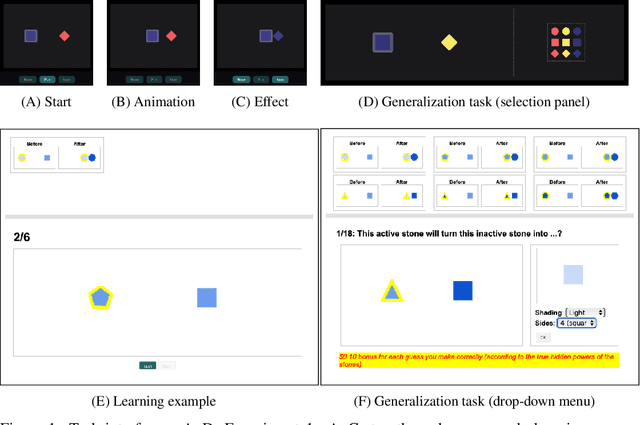
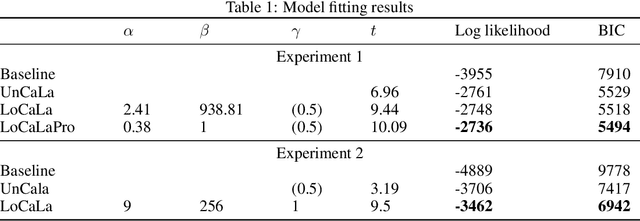
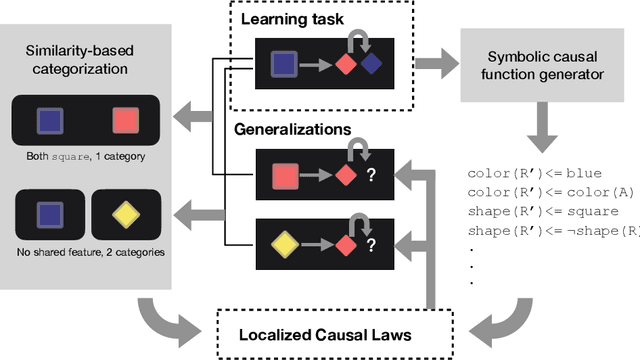
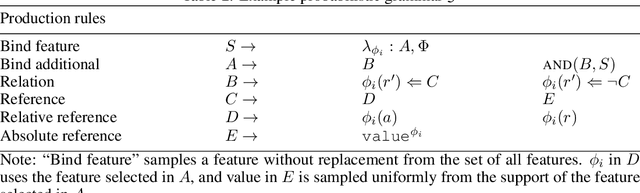
We present a novel task that measures how people generalize objects' causal powers based on observing a single (Experiment 1) or a few (Experiment 2) causal interactions between object pairs. We propose a computational modeling framework that can synthesize human-like generalization patterns in our task setting, and sheds light on how people may navigate the compositional space of possible causal functions and categories efficiently. Our modeling framework combines a causal function generator that makes use of agent and recipient objects' features and relations, and a Bayesian non-parametric inference process to govern the degree of similarity-based generalization. Our model has a natural "resource-rational" variant that outperforms a naive Bayesian account in describing participants, in particular reproducing a generalization-order effect and causal asymmetry observed in our behavioral experiments. We argue that this modeling framework provides a computationally plausible mechanism for real world causal generalization.