 Add to Chrome
 Add to Firefox
 Add to Edge
PARAN: Persona-Augmented Review ANswering system on Food Delivery Review Dataset
Dec 10, 2025
Personalized review response generation presents a significant challenge in domains where user information is limited, such as food delivery platforms. While large language models (LLMs) offer powerful text generation capabilities, they often produce generic responses when lacking contextual user data, reducing engagement and effectiveness. In this work, we propose a two-stage prompting framework that infers both explicit (e.g., user-stated preferences) and implicit (e.g., demographic or stylistic cues) personas directly from short review texts. These inferred persona attributes are then incorporated into the response generation prompt to produce user-tailored replies. To encourage diverse yet faithful generations, we adjust decoding temperature during inference. We evaluate our method using a real-world dataset collected from a Korean food delivery app, and assess its impact on precision, diversity, and semantic consistency. Our findings highlight the effectiveness of persona-augmented prompting in enhancing the relevance and personalization of automated responses without requiring model fine-tuning.

Automatic Tuning of Loss Trade-offs without Hyper-parameter Search in End-to-End Zero-Shot Speech Synthesis
May 26, 2023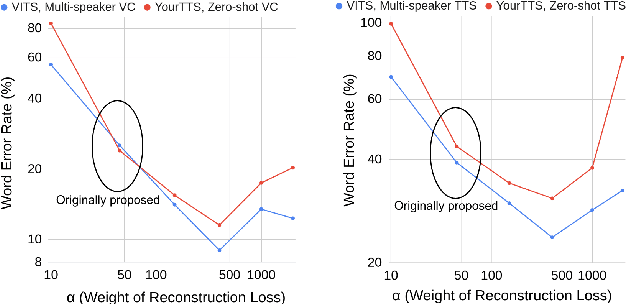


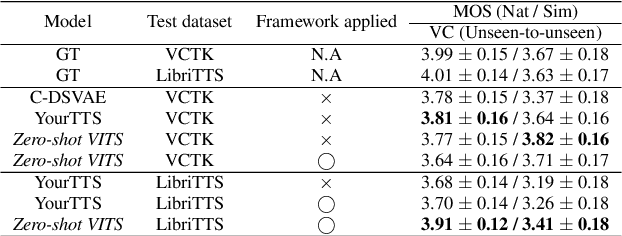
Recently, zero-shot TTS and VC methods have gained attention due to their practicality of being able to generate voices even unseen during training. Among these methods, zero-shot modifications of the VITS model have shown superior performance, while having useful properties inherited from VITS. However, the performance of VITS and VITS-based zero-shot models vary dramatically depending on how the losses are balanced. This can be problematic, as it requires a burdensome procedure of tuning loss balance hyper-parameters to find the optimal balance. In this work, we propose a novel framework that finds this optimum without search, by inducing the decoder of VITS-based models to its full reconstruction ability. With our framework, we show superior performance compared to baselines in zero-shot TTS and VC, achieving state-of-the-art performance. Furthermore, we show the robustness of our framework in various settings. We provide an explanation for the results in the discussion.
Unsupervised Pre-Training For Data-Efficient Text-to-Speech On Low Resource Languages
Mar 28, 2023Neural text-to-speech (TTS) models can synthesize natural human speech when trained on large amounts of transcribed speech. However, collecting such large-scale transcribed data is expensive. This paper proposes an unsupervised pre-training method for a sequence-to-sequence TTS model by leveraging large untranscribed speech data. With our pre-training, we can remarkably reduce the amount of paired transcribed data required to train the model for the target downstream TTS task. The main idea is to pre-train the model to reconstruct de-warped mel-spectrograms from warped ones, which may allow the model to learn proper temporal assignment relation between input and output sequences. In addition, we propose a data augmentation method that further improves the data efficiency in fine-tuning. We empirically demonstrate the effectiveness of our proposed method in low-resource language scenarios, achieving outstanding performance compared to competing methods. The code and audio samples are available at: https://github.com/cnaigithub/SpeechDewarping