 Add to Chrome
 Add to Firefox
 Add to Edge
S$^3$LDBO: A Snapshot Single-Loop Algorithm for Decentralized Bilevel Optimization
May 29, 2026
Networked AI systems increasingly rely on multiple agents that collaboratively learn and adapt models over communication networks. In such systems, bilevel formulations naturally arise in hyperparameter optimization, data cleaning, and meta-learning, but the repeated evaluation of gradients, Jacobians, and Hessians can impose a substantial computational burden on individual agents. To address this challenge, we propose Snapshot-SLDBO (S$^3$LDBO), an efficient single-loop decentralized bilevel optimization algorithm that enables agents to intermittently skip expensive derivative evaluations through a snapshot mechanism. This mechanism can be interpreted as an autonomous computation-adaptation strategy for networked AI, where agents selectively perform costly local updates while maintaining global collaborative learning. We establish the ergodic iteration complexity and the high probability nonergodic iteration complexity of the proposed algorithm within a deterministic setting. Experimental results on hyperparameter optimization with synthetic and MNIST datasets, data hyper-cleaning on Fashion-MNIST, and decentralized meta-learning on miniImageNet demonstrate that the proposed algorithm improves computational efficiency while maintaining competitive learning performance.

DRPN: Making CNN Dynamically Handle Scale Variation
Dec 21, 2021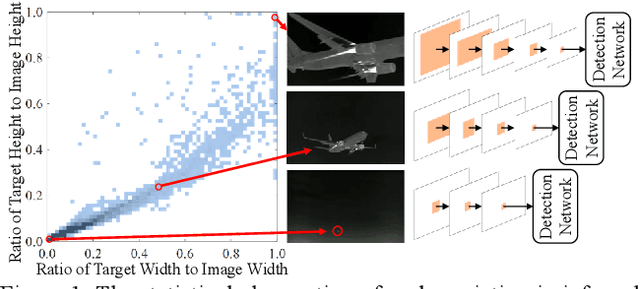
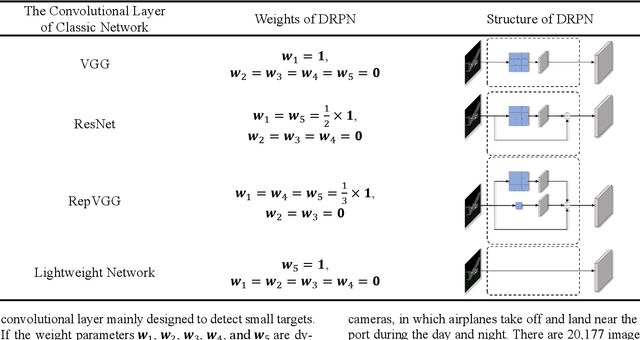
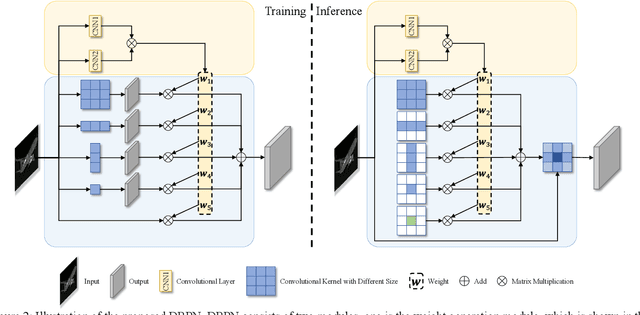
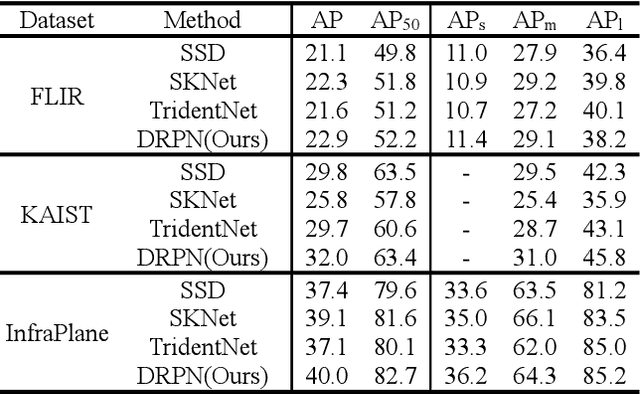
Based on our observations of infrared targets, serious scale variation along within sequence frames has high-frequently occurred. In this paper, we propose a dynamic re-parameterization network (DRPN) to deal with the scale variation and balance the detection precision between small targets and large targets in infrared datasets. DRPN adopts the multiple branches with different sizes of convolution kernels and the dynamic convolution strategy. Multiple branches with different sizes of convolution kernels have different sizes of receptive fields. Dynamic convolution strategy makes DRPN adaptively weight multiple branches. DRPN can dynamically adjust the receptive field according to the scale variation of the target. Besides, in order to maintain effective inference in the test phase, the multi-branch structure is further converted to a single-branch structure via the re-parameterization technique after training. Extensive experiments on FLIR, KAIST, and InfraPlane datasets demonstrate the effectiveness of our proposed DRPN. The experimental results show that detectors using the proposed DRPN as the basic structure rather than SKNet or TridentNet obtained the best performances.