 Add to Chrome
 Add to Firefox
 Add to Edge
Personalized Cell Segmentation: Benchmark and Framework for Reference-Guided Cell Type Segmentation
Mar 15, 2026
Accurate cell segmentation is critical for biological and medical imaging studies. Although recent deep learning models have advanced this task, most methods are limited to generic cell segmentation, lacking the ability to differentiate specific cell types. In this work, we introduce the Personalized Cell Segmentation (PerCS) task, which aims to segment all cells of a specific type given a reference cell. To support this task, we establish a benchmark by reorganizing publicly available datasets, yielding 1,372 images and over 110,000 annotated cells. As a pioneering solution, we propose PerCS-DINO, a framework built on the DINOv2 backbone. By integrating image features and reference embeddings via a cross-attention transformer and contrastive learning, PerCS-DINO effectively segments cells matching the reference. Extensive experiments demonstrate the effectiveness of the proposed PerCS-DINO and highlight the challenges of this new task. We expect PerCS to serve as a useful testbed for advancing research in cell-based applications.

Sparse Message Passing Network with Feature Integration for Online Multiple Object Tracking
Dec 06, 2022
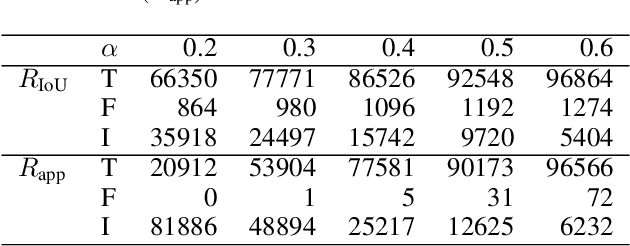
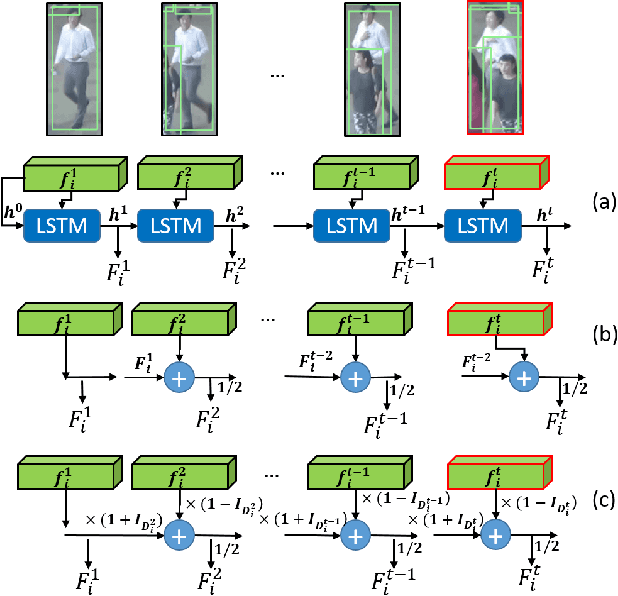
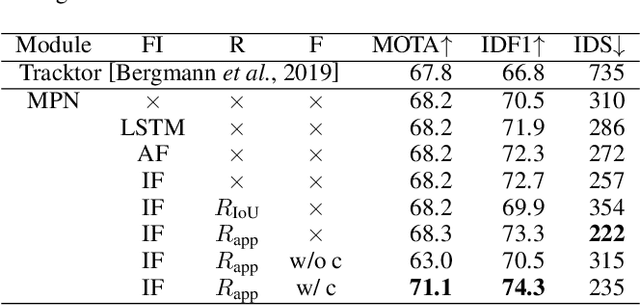
Existing Multiple Object Tracking (MOT) methods design complex architectures for better tracking performance. However, without a proper organization of input information, they still fail to perform tracking robustly and suffer from frequent identity switches. In this paper, we propose two novel methods together with a simple online Message Passing Network (MPN) to address these limitations. First, we explore different integration methods for the graph node and edge embeddings and put forward a new IoU (Intersection over Union) guided function, which improves long term tracking and handles identity switches. Second, we introduce a hierarchical sampling strategy to construct sparser graphs which allows to focus the training on more difficult samples. Experimental results demonstrate that a simple online MPN with these two contributions can perform better than many state-of-the-art methods. In addition, our association method generalizes well and can also improve the results of private detection based methods.