 Add to Chrome
 Add to Firefox
 Add to Edge
Minimax Rates and Spectral Distillation for Tree Ensembles
May 12, 2026
Tree ensembles such as random forests (RFs) and gradient boosting machines (GBMs) are among the most widely used supervised learners, yet their theoretical properties remain incompletely understood. We adopt a spectral perspective on these algorithms, with two main contributions. First, we derive minimax-optimal convergence for RF regression, showing that, under mild regularity conditions on tree growth, the eigenvalue decay of the induced kernel operator governs the statistical rate. Second, we exploit this spectral viewpoint to develop compression schemes for tree ensembles. For RFs, leading eigenfunctions of the kernel operator capture the dominant predictive directions; for GBMs, leading singular vectors of the smoother matrix play an analogous role. Learning nonlinear maps for these spectral representations yields distilled models that are orders of magnitude smaller than the originals while maintaining competitive predictive performance. Our methods compare favorably to state of the art algorithms for forest pruning and rule extraction, with applications to resource constrained computing.

Autoencoding Random Forests
May 27, 2025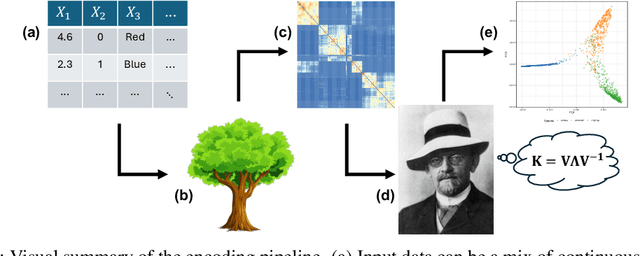


We propose a principled method for autoencoding with random forests. Our strategy builds on foundational results from nonparametric statistics and spectral graph theory to learn a low-dimensional embedding of the model that optimally represents relationships in the data. We provide exact and approximate solutions to the decoding problem via constrained optimization, split relabeling, and nearest neighbors regression. These methods effectively invert the compression pipeline, establishing a map from the embedding space back to the input space using splits learned by the ensemble's constituent trees. The resulting decoders are universally consistent under common regularity assumptions. The procedure works with supervised or unsupervised models, providing a window into conditional or joint distributions. We demonstrate various applications of this autoencoder, including powerful new tools for visualization, compression, clustering, and denoising. Experiments illustrate the ease and utility of our method in a wide range of settings, including tabular, image, and genomic data.