 Add to Chrome
 Add to Firefox
 Add to Edge
Generation Is Compression: Zero-Shot Video Coding via Stochastic Rectified Flow
Mar 27, 2026
Existing generative video compression methods use generative models only as post-hoc reconstruction modules atop conventional codecs. We propose \emph{Generative Video Codec} (GVC), a zero-shot framework that turns a pretrained video generative model into the codec itself: the transmitted bitstream directly specifies the generative decoding trajectory, with no retraining required. To enable this, we convert the deterministic rectified-flow ODE of modern video foundation models into an equivalent SDE at inference time, unlocking per-step stochastic injection points for codebook-driven compression. Building on this unified backbone, we instantiate three complementary conditioning strategies -- \emph{Image-to-Video} (I2V) with adaptive tail-frame atom allocation, \emph{Text-to-Video} (T2V) operating at near-zero side information as a pure generative prior, and \emph{First-Last-Frame-to-Video} (FLF2V) with boundary-sharing GOP chaining for dual-anchor temporal control. Together, these variants span a principled trade-off space between spatial fidelity, temporal coherence, and compression efficiency. Experiments on standard benchmarks show that GVC achieves high-quality reconstruction below 0.002\,bpp while supporting flexible bitrate control through a single hyperparameter.

Conformal Three-Dimensional Interphase of Li Metal Anode Revealed by Low Dose Cryo-Electron Microscopy
Jun 10, 2021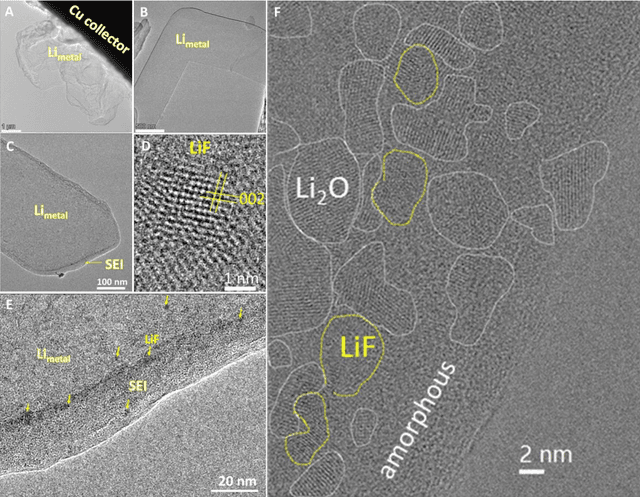
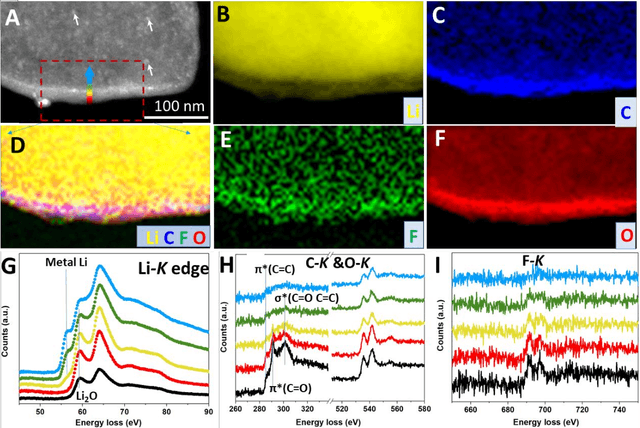
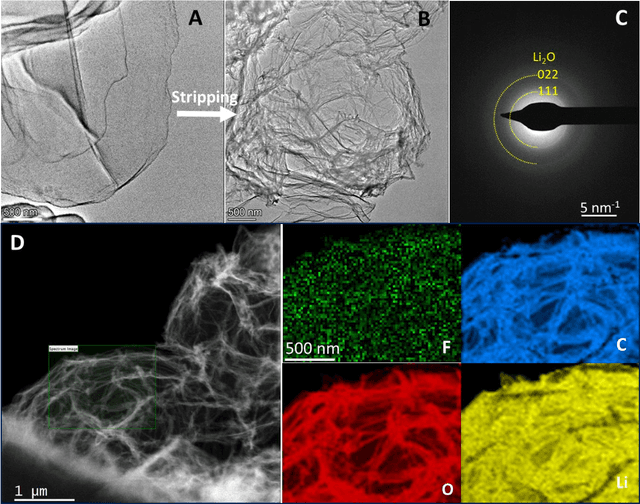
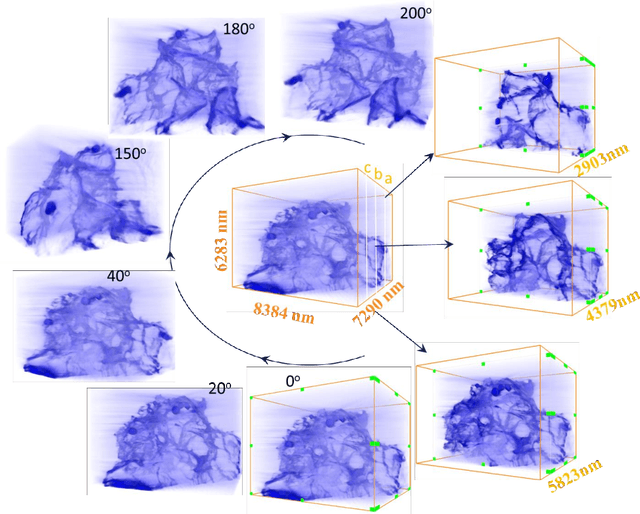
Using cryogenic transmission electron microscopy, we revealed three dimensional (3D) structural details of the electrochemically plated lithium (Li) flakes and their solid electrolyte interphase (SEI), including the composite SEI skin-layer and SEI fossil pieces buried inside the Li matrix. As the SEI skin-layer is largely comprised of nanocrystalline LiF and Li2O in amorphous polymeric matrix, when complete Li stripping occurs, the compromised SEI three-dimensional framework buckles, forming nanoscale bends and wrinkles. We showed that the flexibility and resilience of the SEI skin-layer plays a vital role in preserving an intact SEI 3D framework after Li stripping. The intact SEI network enables the nucleation and growth of the newly plated Li inside the previously formed SEI network in the subsequent cycles, preventing additional large amount of SEI formation between newly plated Li metal and the electrolyte. In addition, cells cycled under the accurately controlled uniaxial pressure can further enhance the repeated utilization of the SEI framework and improve the coulombic efficiency (CE) by up to 97%, demonstrating an effective strategy of reducing the formation of additional SEI and inactive dead Li. The identification of such flexible and porous 3D SEI framework clarifies the working mechanism of SEI in lithium metal anode for batteries. The insights provided in this work will inspire researchers to design more functional artificial 3D SEI on other metal anodes to improve rechargeable metal battery with long cycle life.