 Add to Chrome
 Add to Firefox
 Add to Edge
Adaptive Multi-UAV Relay Deployment Framework in Satellite Aerial Ground Integrated Systems
Apr 22, 2026
The sixth generation (6G) communication networks are expected to provide high data rates, ultra-reliable communication, and massive connectivity, especially in challenging environments such as dense urban areas and disaster-affected regions. However, traditional terrestrial-only networks face significant challenges in these scenarios, including signal blockages from high-rise buildings, traffic congestion, and dynamic user distributions. To address these limitations, we propose the adaptive multi-UAV deployment (AMUD) framework within satellite air-ground integrated networks (SAGINs). The AMUD framework dynamically deploys amplify-and-forward multiple unmanned aerial vehicle relay (UAVr) in with low Earth orbit (LEO) satellites to improve coverage, alleviate congestion, and ensure reliable communication in non-line-of-sight and high-demand conditions. We formulate an optimization problem that aims to jointly maximize the energy efficiency of the total network and the total capacity while ensuring the fairness of the total capacity and satisfying the users' requirements. The simulation results demonstrate that AMUD improves the total capacity of the network, improves the total energy efficiency, and increases the fairness of the capacity compared to traditional LEO satellite and ground base station (LEO-GBS) only systems.

Cooperative UAV-Relay based Satellite Aerial Ground Integrated Networks
Oct 09, 2024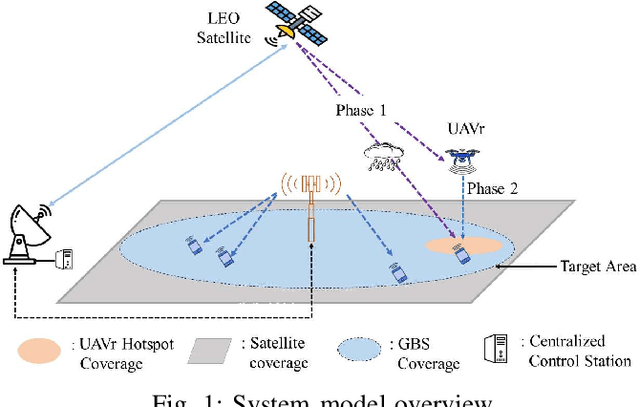
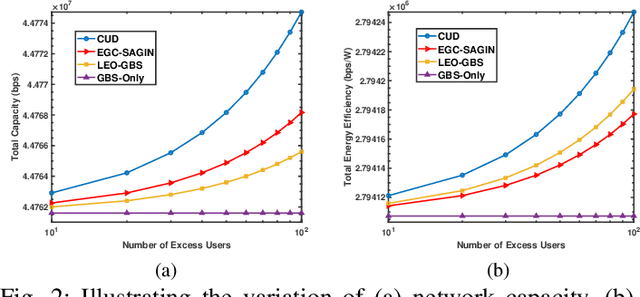
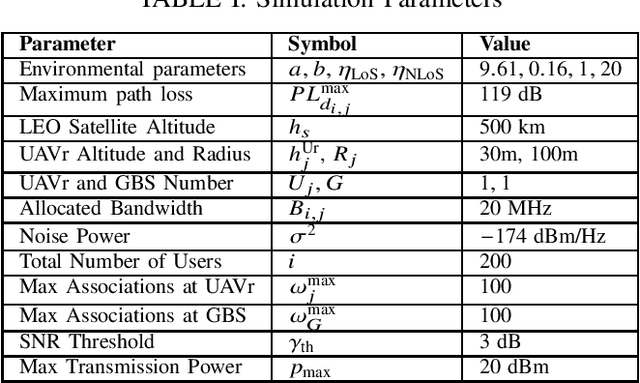
In the post-fifth generation (5G) era, escalating user quality of service (QoS) strains terrestrial network capacity, especially in urban areas with dynamic traffic distributions. This paper introduces a novel cooperative unmanned aerial vehicle relay-based deployment (CUD) framework in satellite air-ground integrated networks (SAGIN). The CUD strategy deploys an unmanned aerial vehicle-based relay (UAVr) in an amplify-andforward (AF) mode to enhance user QoS when terrestrial base stations fall short of network capacity. By combining low earth orbit (LEO) satellite and UAVr signals using cooperative diversity, the CUD framework enhances the signal to noise ratio (SNR) at the user. Comparative evaluations against existing frameworks reveal performance improvements, demonstrating the effectiveness of the CUD framework in addressing the evolving demands of next-generation networks.
Adaptive and Fair Deployment Approach to Balance Offload Traffic in Multi-UAV Cellular Networks
Nov 12, 2022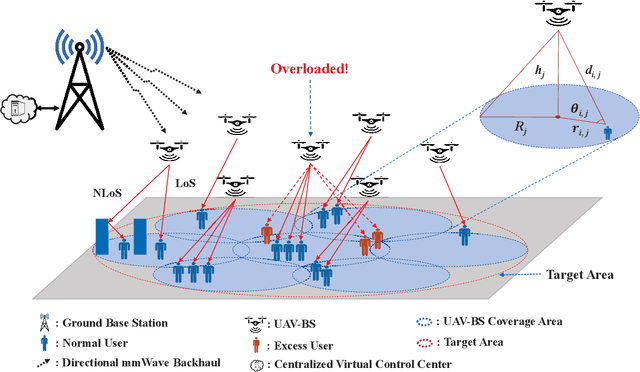
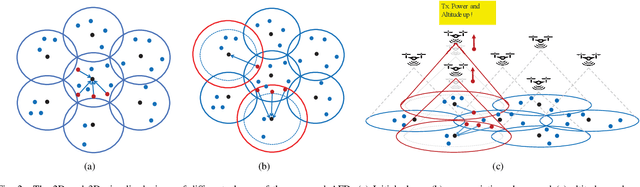
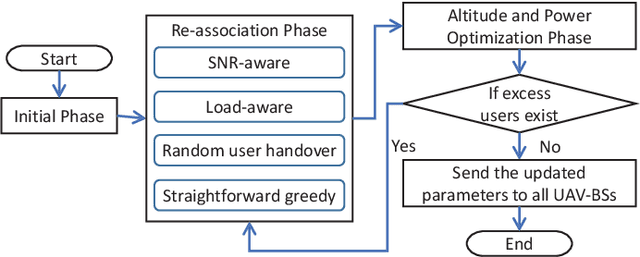
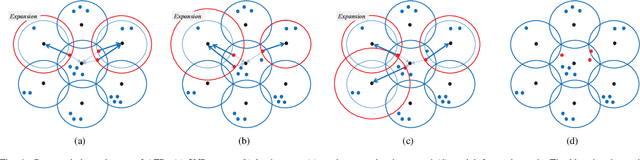
Unmanned aerial vehicle-aided communication (UAB-BS) is a promising solution to establish rapid wireless connectivity in sudden/temporary crowded events because of its more flexibility and mobility features than conventional ground base station (GBS). Because of these benefits, UAV-BSs can easily be deployed at high altitudes to provide more line of sight (LoS) links than GBS. Therefore, users on the ground can obtain more reliable wireless channels. In practice, the mobile nature of the ground user can create uneven user density at different times and spaces. This phenomenon leads to unbalanced user associations among UAV-BSs and may cause frequent UAV-BS overload. We propose a three-dimensional adaptive and fair deployment approach to solve this problem. The proposed approach can jointly optimize the altitude and transmission power of UAV-BS to offload the traffic from overloaded UAV-BSs. The simulation results show that the network performance improves by 37.71% in total capacity, 37.48% in total energy efficiency and 16.12% in the Jain fairness index compared to the straightforward greedy approach.