 Add to Chrome
 Add to Firefox
 Add to Edge
Image Synthesis Using Spintronic Deep Convolutional Generative Adversarial Network
Jan 04, 2026
The computational requirements of generative adversarial networks (GANs) exceed the limit of conventional Von Neumann architectures, necessitating energy efficient alternatives such as neuromorphic spintronics. This work presents a hybrid CMOS-spintronic deep convolutional generative adversarial network (DCGAN) architecture for synthetic image generation. The proposed generative vision model approach follows the standard framework, leveraging generator and discriminators adversarial training with our designed spintronics hardware for deconvolution, convolution, and activation layers of the DCGAN architecture. To enable hardware aware spintronic implementation, the generator's deconvolution layers are restructured as zero padded convolution, allowing seamless integration with a 6-bit skyrmion based synapse in a crossbar, without compromising training performance. Nonlinear activation functions are implemented using a hybrid CMOS domain wall based Rectified linear unit (ReLU) and Leaky ReLU units. Our proposed tunable Leaky ReLU employs domain wall position coded, continuous resistance states and a piecewise uniaxial parabolic anisotropy profile with a parallel MTJ readout, exhibiting energy consumption of 0.192 pJ. Our spintronic DCGAN model demonstrates adaptability across both grayscale and colored datasets, achieving Fr'echet Inception Distances (FID) of 27.5 for the Fashion MNIST and 45.4 for Anime Face datasets, with testing energy (training energy) of 4.9 nJ (14.97~nJ/image) and 24.72 nJ (74.7 nJ/image).

Spintronic Implementation of UNet for Image Segmentation
Mar 05, 2024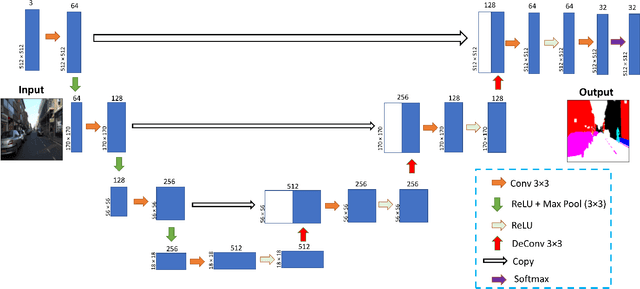
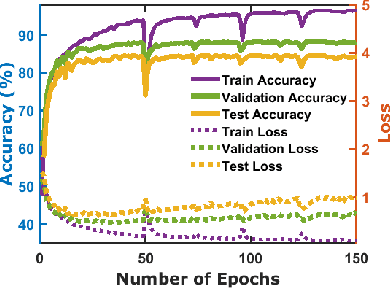
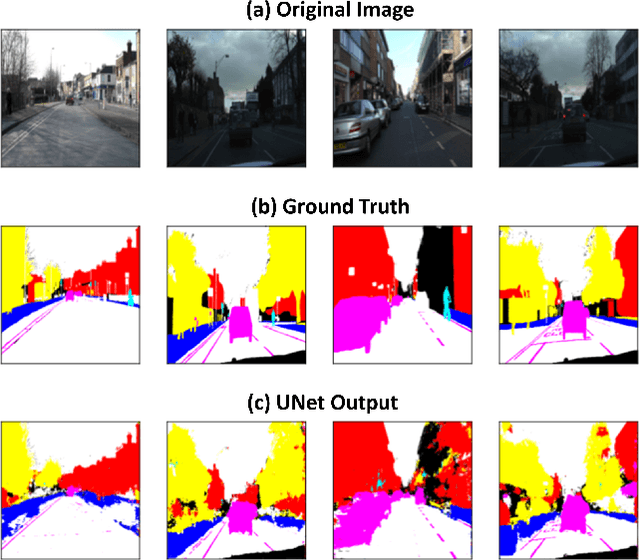
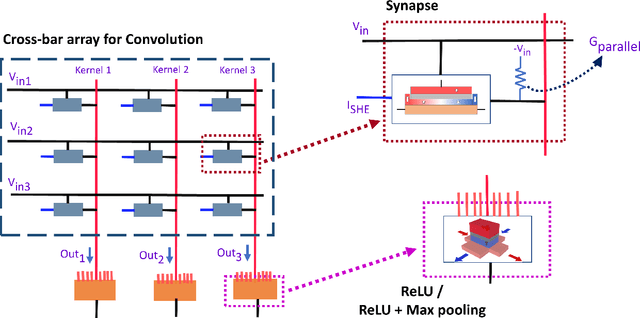
Image segmentation plays a crucial role in computer vision applications like self-driving cars, satellite imagery analysis, and medical diagnosis. Implementing these complex deep neural networks on conventional hardware is highly inefficient. In this work, we propose hardware implementation of UNet for segmentation tasks, using spintronic devices. Our approach involves designing hardware for convolution, deconvolution, ReLU, and max pooling layers of the UNet architecture. We demonstrate the synaptic behavior of the domain wall MTJ, and design convolution and deconvolution layers using the domain wall-based crossbar array. We utilize the orthogonal current injected MTJ with its continuous resistance change and showcase the ReLU and max pooling functions. We employ a hybrid simulation setup by coupling micromagnetic simulation, non-equilibrium Green's function, Landau-Lifshitz-Gilbert-Slonczewski equations, and circuit simulation with Python programming to incorporate the diverse physics of spin-transport, magnetization dynamics, and CMOS elements in our proposed designs. We evaluate our UNet design on the CamVid dataset and achieve segmentation accuracies that are comparable to software implementation. During training, our design consumes 43.59pJ of energy for synaptic weight updates.